


Dufresene's Amazon
Description
This section is from the book "Parrots In Captivity", by William Thomas Greene. Also available from Amazon: Parrots in Captivity.
Dufresene's Amazon
Variations of the same: and, in point of fact, there is more resemblance between the Amazons than there is between the Golden and the Amherst Pheasants, the cross-bred progeny of which has been satisfactorily proved to be fruitful. Again, some of these Parrots are so nearly alike, that it is difficult to believe they are not varieties of the same species, and certainly at first sight at all events, there appears to be much more dissimilarity between a Cochin China and a Game Fowl, than between the Blue-fronted Amazon and its relation with the Yellow Bridle, yet the offspring of the two fowls mentioned above is undoubtedly fruitful, proving the parents to belong to one and the same species, for hybrids are incapable of generation.
It is true that instances have been recorded, at various times, of mules having given birth to offspring, but there is a strong element of doubt in every such case that has been brought under our notice, so strong indeed, that we are of opinion that no verdict is possible, save the convenient Scotch alternative to guilty, or not guilty?, viz. not proven.
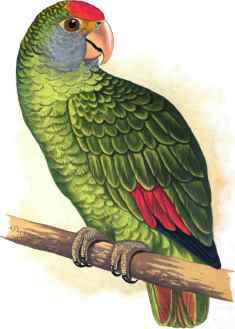
DUFRESENE'S AMAZON.
The solution of the problem with regard to the unity of the Amazons, is not very difficult, as solitary females not unfrequently lay eggs in captivity, and would, there is no doubt, under favourable circumstances, pair, and probably bring up their young.
Few private individuals have the accommodation or the leisure, not to mention the means, necessary to institute, and successfully carry out the experiments necessary to a complete solution of this and similar problems; but the Zoological Societies of this country and on the continent are in possession of the requisite conditions, and to them we must look for the elucidation of many an ornithological puzzle; most of them, however, will not move in a new direction without a considerable amount of external pressure, which a concerted movement on the part of amateurs is capable of being brought to bear upon them, and we hope, in the matter of the Psittacidoe, will very soon be exerted.
The Hon. And Rev. F. G. Dutton's Account Of Dufresne's Amazon
This is a handsome bird. He is about the size of the Common Amazon. The prevailing colour is an even green, but the upper tail coverts are brilliant crimson. He has a brownish line of feathers from eye to eye over the beak, which is dark horn colour.
They are not very attractive cage-birds. I have never seen a specimen that talked. They are rather quiet and dull. Their food is the same as that of the Common Amazon.
Continue to:


My Books

