


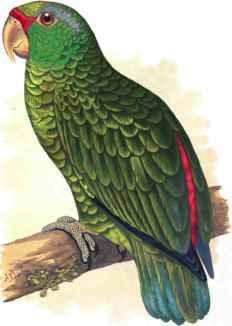
Festive Amazon Parrot
Description
This section is from the book "Parrots In Captivity", by William Thomas Greene. Also available from Amazon: Parrots in Captivity.
Festive Amazon Parrot
Selby declares that "It is docile, and easily tamed, and, being of an imitative disposition, readily learns to pronounce words and sentences with great clearness and precision", which is not at all our experience with the species.
On the other hand, as all these birds differ considerably in capacity and disposition, it is quite likely that an odd specimen, now and again, may be met with that has learned to speak as well and as clearly, as the rest of its compatriots are backward in this respect.
Among the palm groves of its native land, the Amazon feeds luxuriously on fruit, but in captivity is content with a more meagre fare of seed - seeds of various kinds, such as hemp, for which it always shows a predilection, canary seed, maize, and nuts of every description, from the cob-nut of our hedgerows, to the cocoa-nut of its native land; nor does it despise such humble fare as monkey-nuts, and in carrots and beet seems to find a substitute for the oranges and bananas of the tropics.
These birds soon become very tame and domesticated, and if their owner resides in the country, may be permitted to wander at will about the grounds, whence they will return to the house for their food: it is as well, however, not to permit them to ramble far when there is ripe fruit to be picked up in the neighbourhood, as their frugivorous propensities are apt under such circumstances to exert themselves with a degree of intensity that cannot fail to prove injurious to the gardener: at other times they may have full liberty, which we have never known them abuse by straying away altogether from their home.
It is curious that a pair of these birds will sometimes converse with each other in their acquired language, but such is nevertheless the fact. Some years ago a friend of ours had a pair of Amazons, though we cannot now say to what particular species they belonged, that used to talk to each other in Portuguese, which they had no doubt learned before their importation into this country. The effect was decidedly peculiar, sitting one in a pear-tree in the garden, and the other in a clump of hawthorn near the dining-room window, they regularly answered each other, and occasionally sang and laughed aloud, so that they were often taken for human beings by persons who had not seen them, and only heard the sound of their voices in the garden. What they were talking about, we regret we cannot say, as we are not acquainted with the language in which their conversation was carried on.
Continue to:


My Books

