


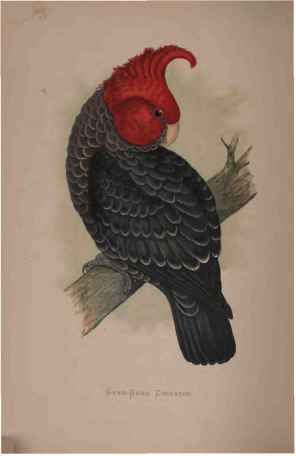
Gang-Gang Or Ganga Cockatoo. Psittacus galeatus, Khl., Lthm. Callocephalon galeatum, Gld
Description
This section is from the book "Parrots In Captivity", by William Thomas Greene. Also available from Amazon: Parrots in Captivity.
Gang-Gang Or Ganga Cockatoo. Psittacus galeatus, Khl., Lthm. Callocephalon galeatum, Gld
Psittacus galeatus, Khl., Lthm. Synonyms: Callocephalon galeatum, Gld.;
Calyptorhynchus galeatus, Vgrs.; Corydon galeatus, WGl.; Banksianus galeatus, Lss.; Plyctolophus galeatus, Swns.;
Callicephalus galeatus, Br.
German: Der rothköpfige Langschwanzkakadu, oder Helmkakadu.
French: Cacatois Ganga, ou Banksien à tête rouge.
THIS carious bird, which is not unlike a Timneh Parrot, with a bright red head and crest, was mentioned by Cook in the journal of his voyage of discovery to what was then called Terra incognita Australis, and is now known by the name of Australia; and was afterwards described and figured by Lesson in 1802.
It is stated by Gould to inhabit the south-west portion of the colony of Victoria, the islands of Bass's Straits and the northern parts of Tasmania; but is always a scarce bird, so much so that it has never been seen by some colonists of many years standing with whom we are acquainted; nor did we ever meet with it during our sojourn in those parts it is said to frequent.
It is a forest-loving bird, shy and difficult of approach, leading a solitary life among the topmost boughs of the Eucalypti, with which the whole face of its habitat was at one time covered, and subsisting mainly on the seeds of the peppermint gum-tree.
Authors vary greatly in their estimate of the Helmeted Cockatoo; some declaring that it makes a most charming cage-bird and pet, while others, on the contrary, give it a character for peevishness, moroseness, and in fact everything that a pet should not possess.
Thus Dr. Max Schmidt says that it is a little more active than the other Cockatoos, but much more morose, insusceptible of being tamed, and unteachable; while Mr. Westerman, of Amsterdam, on the contrary, declares that no bird could be tamer, or more gentle, and moreover that it speaks very well; a statement that is supported and confirmed by Dr. Buss, who says he bought one of the dealer Hieronymi, which would come on his finger, let itself be stroked, and would return of its own accord to its cage.
The price of this bird is necessarily high, in consequence of the infrequency of its appearance in the bird-market. £8 was demanded in 1880 by Jamrach of London for a fine specimen that had come into his possession.
The London Zoological Society first obtained a Ganga in 1859; since which date four more are recorded in their list, the last of them having been purchased in August, 1870. At present the species is unrepresented in the Parrot House in the Gardens.
These birds are not long-lived as a rule in captivity; a fact which would tend to prove that the proper treatment for them has not yet been discovered, and that some more appropriate substitute for the aromatic seeds of the peppermint gum-tree must be found, than hemp and maize, before connoisseurs can hope to see the Gangas established as inmates of their aviaries or bird-rooms.
It is not surprising that amateurs should differ with regard to the disposition and adaptability or otherwise of this bird for cage life, for but few of them have enjoyed an opportunity of intimately studying the Helmeted Cockatoo in confinement. Our own experience with the species does not extend, we regret to say, beyond a casual acquaintance with two specimens of the race in the Parrot House of the Zoological Society, in Regent's Park, a few years ago; since which time we have tried our best to obtain one, but without success.
One London dealer, to whom we spoke upon the subject, went so far as to assure us, confidentially, that it was impossible to bring over the Ganga alive, because it subsisted entirely upon roots, for which no adequate substitute could be provided on the journey. We ventured to suggest potatoes; but the dealer, a very consequential personage, pooh-poohed the idea, and said it could not be done. We then spoke to the late Mr. A. Jamrach, who promised to look out for one for us; but his untimely death put a stop to the strong hope we entertained that our desire to possess a Ganga would one day be realized.
In looking over Dr. Karl Buss's Die Papageien a short time since, we lit upon the following curious passage, which we transcribe in the original: - "Eine wunderliche Erfahrung hat Dr. Hasskarl im zoologischen Garten von Buitenzorg auf Java i. J. 1842 gemacht. Dort ertappte man einen schwarzen Kakadu mit rothem Schopf, welcher inhermals Meerschweinchen getödtet und gefressen hatte, und Pfarrer Snell, der dies mittheilt, hebt hervor, dass, obschon nichts absonderliches darin liege, wenn Papageien Fleisch fressen, hier vornämlich die Tödtung des kleinen Nagers durch den Kakadu auffallend erscheine."
Which we thus translate: "Dr. Hasskarl had an extraordinary experience in the Zoological Gardens of Buitenzorg, in the island of Java, in the year 1842; where a black Cockatoo with a red head was taken that on several occasions killed and ate guinea-pigs; and Pastor Snell, who relates the story, further adds that although there would be nothing remarkable in that, if Parrots ate flesh; yet the before-mentioned killing of the little rodents by a Cockatoo, must appear very strange."
It is possible, of course, that the above black Cockatoo with the red head may not have been a Ganga, but some other kind of bird; but it must nevertheless be borne in mind that, in captivity at all events, some of the Psittaci will kill small birds and animals, if they get the chance; their natural vegetarian appetite changing to one for a carnivorous diet. Thus a dear old Goffin we once possessed killed and partially ate a truant Canary that wandered into his cage; and the reported partiality of Nestor notabilis for mutton, dead or alive, are cases in point.
But how did a Tasmanian, or at least a Southern Australian Cockatoo get to Java? The distance is immense, and the climates so different, that it is almost impossible the guinea-pig killer, if really a Ganga, could have arrived at Buitenzorg of its own accord, but must have been conveyed thither by some one, from whose custody it afterwards escaped, which would account for its cannibalistic proclivities.
Almost daily we receive communications from persons whose Parrots or Cockatoos are suffering in various ways, in consequence of having been fed with "all sorts of scraps (including meat) from the table"; and we regret to say that our Goffin had been thus indulged before passing into our keeping, which might perhaps account for his reprehensible conduct with regard to poor little Yellow Feathers; while as to Nestor, we confess, we are at a loss to account for his perverted sense, otherwise than by assuming him to have been driven by sheer want to the commission of deeds that have made his name a bye-word in New Zealand, and must bring about his extermination at no distant date, as we have related when treating of that curious bird.
"Are bacon and ham bad for a Parrot?" recently inquired an innocent correspondent, adding, " because I have been told that is the reason my Polly has taken to pulling out her feathers, and biting herself, until she makes herself bleed."
To which we replied, "Cause and effect, my dear sir; stop the unnatural diet, and perhaps the feather-picking habit will be abandoned"; but we have not since heard from our correspondent; though once a Parrot, or a Cockatoo, acquires such a depraved taste as that of flesh eating, there is no telling what enormities it will not perpetrate, and a cure is all but impossible. We cannot get it to sign a pledge, and it is deaf to reason; nay, let us charm never so cunningly, it will disregard all our remonstrances; and, whenever it is left alone for a moment will recommence to disfigure itself.
"The rarity and beauty of the bird", writes Dr. Russ of the Granga, "naturally cause the price to be high"; and there seems no prospect of the figure being reduced, seeing that the bird is an inhabitant of the densest and most inaccessible districts, into which no one but an aborigine could penetrate; and these, in Tasmania at all events, as our colleague pathetically laments, are extinct.
Poor people! when Cook, in an ill-fated hour, discovered their beautiful and climatically highly favoured island home, they were very numerous; but in considerably less than one hundred years the last survivor of the race died a prisoner to the usurping whites in Hobart. We are a great nation, but we have not been kind to the aborigines anywhere where we have set our colonising feet; though perhaps in no possession of ours have we been so altogether wanting as in Van Diemen's Land, where the natives were hunted down, shot, poisoned, and massacred wholesale, like wild beasts, by the settlers and their bond slaves, as the deportés practically were; until, as we have said, the last survivor of the race died a few years since a virtual prisoner, though made much of as a curiosity when it was too late.
A case of the survival of the fittest, some one may say. Well, we cannot argue the point, nor is this the place to do so; but we hope that it may be a long long time before the Gang-Gang, and the other beautiful members of the Parrot family that are now to be found in tolerable abundance in Tasmania, where the Swift Lorikeet frequents the streets of Hobart, follow their human compatriots to that bourne from whence is no return.
To resume: there is considerable difference between the male and female Helmeted Cockatoo; for while the head, face, and crest of the former are bright scarlet, the same parts in the latter are a dusky brownish grey. The young are said, on the authority of Gould, to resemble their mother; and although we have not chanced to meet with one in its nest feathers, there can be no reasonable doubt upon the matter; seeing that in almost every case where the female differs in plumage from her mate, all the young resemble her until after their first moult; and sometimes the young males do not assume the full dress of their father, until they are two or three years old.
The Ganga is rather less than the Rose-breasted Cockatoo. It is a good climber and strong flyer, but somewhat of a clumsy bird upon the ground; as might be expected from its arboreal habits.
Nothing certain is known of the creature's habits in its wild state, that is, with regard to the season or site of its nidification, the number of the eggs, and whether there is, or is not, more than one brood in the year; and the probability is that these particulars will not be ascertained unless some Zoological or Acclimatisation Society takes the matter in hand, and lodging a pair of Gangas by themselves in a suitably furnished aviary, gives them an opportunity of reproducing their species in captivity; for it is to be feared that as cultivation proceeds in their native land, and the settlers encroach upon the wilderness, the shy and solitary Helmeted Cockatoo will at last be added to the already too long list of extinct species.
The Gangas possessed at different times by the Zoological Society were fed on canary seed, hemp, and oats; to which should, we think, have been added boughs of trees with leaves and buds on, among which they would have been able to find some larvae of various insects; upon which there is little doubt these birds at least partially subsist in their island home.
The thought occurs to us in this connection, whether it might not be possible to import the seeds of the Eucalypti in sufficient quantity to constitute them an article of commerce for the feeding of Australian Parrakeets and other birds, natives of that great island and its dependencies ?
Perhaps some bird-importer or seed merchant will take the hint, and make the experiment.
It is certain that the proper food for many of the most beautiful of the denizens of the Australian bush, has not yet been obtainable for them in captivity; the Gangas are a case in point, and the same might be said of Pulcherrimus and Multicolor, not to speak of Bourke's Parrakeets and the ever-charming Pileated Parrakeet; which can but rarely be induced to exchange a life of freedom for one of confinement for any length of time.
The Port Lincoln, too, the Collared and Bauer's and Barnard's Parrakeets, are not as acclimatisable as they ought to be; and the reason is that the only food we are able to provide for them does not quite suit their constitution, and that they pine and in too many instances die for want of something we cannot give them. What more likely than that this desideratum should be the seeds of the Eucalypti, that certainly furnish a large portion of their sustenance in their native land?
It is not fair to generalise from an individual, or even from two or three individuals, for a variety of trivial circumstances may conduce to impart quite another complexion than the natural one, to its or their character; and therefore we hesitate for the present to recommend the Ganga to amateurs, who are not very strongly imbued with a love of foreign birds, and that for the reasons stated - they are shy birds; consequently nervous, and require patience and perseverance in the treatment accorded them. So far they have not proved themselves long lived in captivity, and especially they are expensive.
On the other hand, they are handsome birds, undeniably handsome, and of such rare occurrence, that their very scarcity is in itself a recommendation in the eyes of many fanciers; some of whom are ready and willing to put up with almost any amount of inconvenience and even loss for the sake of possessing a unique, or at all events a rare specimen of animated nature, which they rejoice to be able to call their very own; and which would lose half its value in their estimation if everybody, or indeed anybody, could share its possession with them.
A reprehensible sentiment it may be said; perhaps so, but very human.
The Hon. And Rev. F. G. Dutton's Account Of The Gang-Gang Cockatoo (Callocephalon Galeatum)
AftER seeing the beautiful drawing of this bird in Gould's Birds of Australia, I was always hoping I might see one; perhaps that it might be imported in sufficient numbers to enable me to buy one. At length, to my great delight, I saw one at the Zoological Gardens. Alas! never was there a greater proof that "distance lends enchantment to the view." The bird was neither brilliant in colour, nor graceful in shape; but it was decidedly sulky in temper, and its name Gang-Gang was music itself compared to its note, which is the most rasping and aggravating of all Cockatoo cries, and that is saying a great deal.
Our editor has still a great desire to possess one of these birds. He generally seems to me to be in luck about Parrots. I hope he may get his wish. For my part, if Fortune has no unkinder turn in store for me than that I should never possess a Gang-Gang, that fickle lady and myself will always remain on the best of terms.
Continue to:


My Books

