


Hawk-Headed Or Ruffed Parrot. Psittacus Accipitrinus. Psittacus Clusii, Shaw; Pionias accipitrinus, Finsch
Description
This section is from the book "Parrots In Captivity", by William Thomas Greene. Also available from Amazon: Parrots in Captivity.
Hawk-Headed Or Ruffed Parrot. Psittacus Accipitrinus. Psittacus Clusii, Shaw; Pionias accipitrinus, Finsch
Psittacus Accipitrinus. Synonyms: Psittacus Clusii, Shaw; Pionias accipitrinus, Finsch.
French: Perroquet à cravatte.
German: Kragenpapagei.
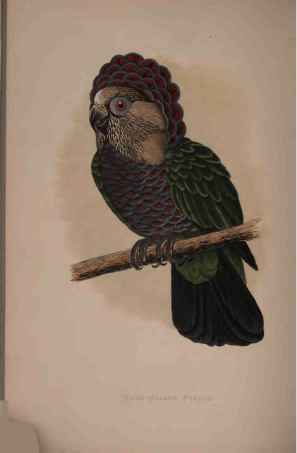
THE exceedingly curious bird, whose portrait, admirably drawn from nature by Mr. Lydon, heads this chapter, is one of the most commendable Parrots with which the writer is acquainted. In size it about equals the Grey, which it rivals in linguistic attainments, while it is infinitely more droll and amusing in its ways, as well as more gentle and confiding in its disposition.
It is not by any means a common bird, even in its own country, the Brazils and Honduras, and is very rarely imported. So scarce is it, that a pair of these birds would readily command the high price of £20: the dealers appear to be unacquainted with it, and the few specimens that now and then reach our shores are brought over by private hand, and are, consequently, quite tame and gentle on arrival.
Like most South American birds, the Buffed Parrot, though comparatively thinly clad with feathers, is perfectly hardy, and requires no particular care as to temperature, that usual in an ordinary dwellinghouse appearing to be sufficient to maintain it in health and comfort
It is frugal in its diet, and prefers hemp seed to any other kind of food, but will eat fruit, biscuits, sugar and bread, and a change of diet on these lines is conducive to maintaining the bird in health.
When " Pinto", as the writer has named his bird after the Portuguese gentleman who very kindly presented it to him, first arrived after a long journey in an open cage on a very cold winter's day, he was shivering, seemed very ill, and kept on repeating incessantly, in a loud and reproachful tone, "check, check, check", as if pitying himself and his condition exceedingly. The warmth of the room to which he was at once transferred, and some fresh food of which he partook freely, soon restored him to what has since been ascertained to be his normal state of equanimity, and he speedily composed himself to sleep; emitting every now and then a little self-congratulatory chuckle that sounded extremely droll.
Needless to say that "Pinto" soon became a prime favourite with every member of the family, and was allowed almost perfect liberty, of which, however, he was somewhat slow in availing himself at first, as he had not the least idea of flying, though provided by Nature with a pair of long, broad, and seemingly strong wings. He soon gained confidence though, can now fly anywhere, and is fond of using his powers of flight, but puffs a good deal when he settles down again after one of these aerial expeditions.
When he first arrived among us he could not speak at all, but repeated continually the sound made by clicking the tongue against the roof of the mouth, which we have endeavoured to express by the words "check, check, check"; but he soon acquired other accomplishments, and astonished us all one day very much by repeating, though of course, in a louder key, the song of a Canary that was kept in the room with him. His next feat was to imitate with wonderful fidelity the crying of a young child, and after that he began to pick up words, and now says, "Little boy", "Pretty Poll", and other short phrases, each of which he prefaces with the interjections "Ah! ha!" He always salutes the writer in the morning with the exclamation, "Ah! ha! Papa!" an observation he never addresses to any other person. He also laughs in the most natural manner possible.
He knows his name, "Pinto", perfectly well, and always answers to it; he generally salutes a stranger with the interrogative monosyllable "Well?" adding occasionally his favourite exclamation "check, check, check!" If he does not like the new comer, he raises his wonderful ruff, expands his tail, and drawing himself up to his full height, dances on his perch, and presents altogether so weird and uncanny an appearance, that most people are afraid of him, yet he is the dearest and most gentle old thing in the world, and not in the least spiteful, though fond of pretending to be very wicked indeed, now and then.
For instance, he has taken a great dislike to one lady visitor, and if he happens to be oat of his cage when she comes into the room, flies at her open mouthed, hissing like an Owl, and chases her all about the place; and when he has forced her to beat an ignominious retreat, runs along the table, pressing his beak to its surface, and every now and then emits a little squeal, not unlike the sound made by a wheel in want of greasing - wheeling a barrow, as the young folk of the household call this funny procedure on the part of their favourite.
He very much enjoys having his head rubbed, and will sit for any length of time on one's lap, grunting the while with satisfaction at the gentle friction and the genial warmth to his feet. He is very playful, and will frequently, in his cage and out, turn over on his back and amuse himself with a stone or a bit of stick, which he tosses about from beak to foot in evident enjoyment of the game.
Two objectionable habits he has; one of which is, that he will try to feed his friends by bringing up the half-digested food from his crop, and the other, that he takes it into his head to scream awfully at times, and can scarcely be pacified once he has begun. But on the whole his good qualities far and away outbalance the bad, so that the writer has no hesitation in recommending the Ruffed Parrot to the favourable consideration of his readers.
Though not as good, or bad, a carpenter as some of its congeners, this bird greatly enjoys picking a log of soft wood to pieces; an employment, or amusement, in which its powerful mandibles are doubtless of great assistance: it can also crack nuts and bend the wires of its cage; needless then to remark that it can bite, but fortunately appears to have no disposition to do so, even under a considerable amount of provocation.
The colouring of the Hawk-headed Parrot will be better understood by a glance at Mr. Lydon's excellent illustration than by the perusal of half a dozen pages of letterpress. It will, however, be necessary to observe that the conspicuous ruff that adorns the creature's neck is usually worn level with the remainder of the plumage, and that it is only when the bird is excited that it is raised, as shown in the plate.
The green of the wings and back varies in shade in the most curious manner, according to the light in which the bird is placed; thus, whilst ordinarily it is of a brilliant emerald tint, it will appear to be of a dull bronzed or even coppery hue when the creature is placed between the spectator and the window; and the same remark applies to the shading of the breast and back of the neck, where the feathers change from red to purple according to the point of view of the beholder.
The tail feathers, with the exception of the central pair, are black which is also the colour of the flight feathers of the wings; these never undergo the chameleon-like phases that a change in the relative positions of the spectator and the bird produces, for they are ever and always black.
There would seem to be several varieties of these birds, for the British Museum contains the skin of one that is as large as a White Cockatoo, and, while the top of "Pinto's" head is dull grey, a pair of Hawk-heads at the "Zoo" have the feathers in the same position white, but otherwise exactly resemble the bird from which our illustration is taken.
As it might be thought somewhat venturesome and illogical to generalize from an individual instance, and praise a whole race for the sake of one of its members, that deserves all that can be said in its favour; it is advisable to point out here that Dr. Buss also gives these birds an excellent character, including them among his " Talking Parrots", and voting them intelligent and docile.
The Hawk-headed Parrot is not the only member of the family that has the power of raising a nuchal crest, for the Orange-crested Cockatoo and several of the Amazons are similarly gifted; the former even to a much greater extent, for it not only elevates the feathers on the back, but on the sides, of the neck; as will be seen when we come to describe it further on.
It would be instructive, and curious too, if one could ascertain why this power was conferred upon these birds and not upon others of their race; but the inquiry is one that is not likely to be satisfactorily answered. Certain it is that the ornament in question imparts an extraordinarily savage appearance to its possessor, and is doubtless of service to the creature by inspiring terror in the beholder.
On one occasion when "Pinto" was sent to the Bird Show at the Crystal Palace, his curious appearance was commented upon by the reporters for the press, who one and all united in pronouncing him to be something unique, and exhorted visitors not to fail in getting a sight of so remarkable a bird; one of them even went so far as to characterize the dear old fellow as having a Satanic expression, which was perhaps excusable, for his brilliant colours were scarce discernible in the dim uncertain light of the Show, and his excited manner as he incessantly raised and depressed his nuchal ruff, and danced up and down, with widely expanded tail, on his perch, justified in a manner, the infernal epithet.
Yet this strange bird was left unnoticed by the judge, who thought possibly that it was a made-up creature, the movements of which were regulated by clock-work. Whether or not, "Pinto" will not be sent there again, for he was very much upset by the whole affair, and especially by the rude gaze, and ruder remarks of such an unwonted number of strangers; and for a long time after his return home would not come out of his cage, or allow himself to be touched by anyone.
As a rule, there is very little use in sending a new bird to a Show, for most of the Judges have long since fallen into a groove, and resent the obtrusion upon their notice of anything to which they are unaccustomed, either by passing it over in contemptuous silence, their favourite method; or by making an award, incommensurate with the value and merit of the intruder they find themselves reluctantly compelled to mention.
"Pinto" is very fond of drinking, and always has recourse to his cup after a meal of dry seed, bread, or biscuit; but he does not take much at a time, a couple of mouthfuls or so, and yet at the "Zoo" it is the custom to keep his relations without water, which must be a great privation to them, and have a tendency to shorten their lives; although we are glad to say that since we first noticed the fact in these pages there has been a marked change for the better in this respect in the "Parrot House."
He also likes to sprinkle himself well over with water occasionally and makes at such times a tremendous fuss, but we have never observed him actually enter the bath; the fact being that in their native land, where the dews are heavy, these birds get wet enough while flying about in the early morning among the trees, to renew the gloss of their plumage; for which reason others wash themselves several times a day, in countries where the dew-fall is not as excessive as it is in tropical and sub-tropical America.
Fruit forms a considerable proportion of the diet of Brazilian Parrots in their wild state, and should always be supplied to such of these birds as are kept in captivity. "Pinto", for instance, is extremely fond of a piece of apple or pear, of a few grapes or nuts, or even a piece of boiled potato or carrot; but at the same time another bird, that has not been accustomed to such dainties, must be cautiously supplied with them, lest he should get a surfeit by over-eating himself.
When "Pinto" flies down on the table during dinner, as he sometimes does, he always makes a grab at the meat on the nearest plate, and if he can secure a morsel devours it with gusto; rolling his tongue about as if he thoroughly enjoyed the bonne bouche, over which he actually smacks his lips; if the latter term can be applied to the sides of his horny mandibles. At the same time he is not in a general way allowed to have meat, which we believe to be very injurious to these birds, causing them to moult at all seasons, and even sometimes to pluck out their own feathers and disfigure themselves. In fact we look upon this partiality of our pet as an evidence on his part of depraved taste, and have strictly forbidden him the luxury he undoubtedly covets; and which may have been, most likely was, forced upon him in the first instance by a former injudicious owner or attendant.
Since he has been in our possession, "Pinto" has always enjoyed the rudest health; when he first arrived from Manchester he had a cold in his head that caused us a little uneasiness, but it soon passed off, and he has never ailed anything since. Last summer we turned him out into the aviary, thinking the change would be beneficial, bat he seemed so thoroughly miserable there, that we soon took him in again, and allowed him instead the range of the house, which he now enjoys.
He has quite recently developed a curious taste for sitting at the bottom of the cage and grubbing among the sand and splinters of wood, making the while a curious noise not unlike that of a hen whose chickens have just come out of their shells, which, according to Mr. Dutton's observations, would tend to prove that the bird is, after all, a female! a supposition that receives support from the fact that the top of "Pinto's" head is dark grey, while that of the "pair" at the "Zoo" is white.
As already observed, the feathery coating of the Hawk-headed Parrots is decidedly thin, and the birds are moreover quite destitute of the inner covering of down, that enables our native birds to successfully resist the inclemency of our winters, and this is particularly observable on the sides under the wings, which are almost naked; nor is this a peculiarity of an individual specimen, but is the normal condition of the species, from which it is fair to conclude that these birds are chilly and could not readily be housed out of doors in this country.
"Pinto" indeed is so fond of warmth that if, as we have occasionally done, he is let out of the cage in the morning, before we are up; he will fly on to the bed, and make his way under the bed-clothes to our side, when he will nestle down as close as he can and purr and chuckle in evident enjoyment of the congenial warmth.
He, for we cannot make up our mind to use the feminine pronoun in this bird's regard, is very ticklesome, and if touched under the wing with the tip of the finger almost laughs; at any rate wriggles about and contorts himself after the manner of a human being in a similar predicament; making at the same time a little remonstrant noise that sounds uncommonly like the familiar contraction "Don't!" but nevertheless evincing a keen appreciation of the fun, and retaliating on his tormentor by playfully nibbling the attacking finger.
Prom indications we have observed we feel sure this bird would willingly pair if it had a mate, and although we have been promised one, we do not see much sign of its arrival, and fear that poor "Pinto" is doomed to linger out a life of single blessedness (?) without a chance of helping to perpetuate the species.
Another observation we have made tending to confirm the opinion already expressed that "Pinto" is a lady, is that "she" does not appear at all disposed to make up to any of the fellow captives that occupy the same room, as male Parrots generally do; for instance, it utterly rejected the advances of a female Ring-necked Parrakeet, takes no notice of a Plumhead male, or of "Pilate", except to fly at the latter when it alights on the cage, and generally resenting the approach of its congeners.
Taking, however, "Pinto" for all in all, we have no hesitation in saying that he, she, or it is one of the most delightful and amusing birds we have ever kept, and, we feel assured, this species only requires to be better known to be appreciated as it deserves.
Quite recently "Pinto" has developed a new accomplishment, and, as we write, is whistling "bonnily", as a Scotchman would say. In fact we can place no limit to the development of his talents, seeing that he has learned so much during the two years he has been in our possession, and picks up a new trick almost every day.
Since writing the above we have acquired another bird of this species, which is even more droll and interesting than "Pinto", which it surpasses in linguistic attainments, possessing a repertoire that would do credit to any Grey Parrot; it is also full of tricks, rolls on its back and tosses a pebble about with its feet; stands on its head in a corner of the cage; cries "Hark!" and holds up one foot to call attention; quite confirming the impression we had already formed as to the intelligence and tractability of the Hawk-headed Parrots.
Continue to:


My Books

