


Jendaya Conure. Psittacus Jendaya. Conurus auricapillus, Bbmst.; Conurus Jendaya, Gr
Description
This section is from the book "Parrots In Captivity", by William Thomas Greene. Also available from Amazon: Parrots in Captivity.
Jendaya Conure. Psittacus Jendaya. Conurus auricapillus, Bbmst.; Conurus Jendaya, Gr
Psittacus Jendaya. Synonyms: Conurus auricapillus, Bbmst.; Conurus Jendaya, Gr.;
Aratinga chrysocephalus, Spx.; Arara auricapillus, Lss.; Psittacus pyrocephaluss, Hhn.; Psittacara auricapillus, Vgrs.;
Sittace Jendaya, Wgl.
French: Perruche Jendaya.
German: Der hyazinthrothe
Keilschwanzsittich oder Jendayasittich.
THE Jendaya Parrakeet, or Conure, is a native of the north-eastern parts of South America, where it occurs in such vast numbers as to cause no inconsiderable amount of damage to the growing crops of maize; but in these pages we are chiefly concerned with it as an inmate of the aviary or cage, to which it accommodates itself extremely . well; and being possessed of a good constitution can be so thoroughly acclimatised as to pass the most severe of our winters out of doors without inconvenience.
There is a great difference between the old and young birds, and it is certain that the latter, in various stages of their development, have been taken for one or more distinct species; and so described by authors. The only reliable method of clearing up the difficulty would be to breed some Jendayas in captivity, and watch them during their growth from the time they left the nest, until they had finally assumed the adult garb; care being taken to have their portraits correctly painted at each mutation of plumage. Such a record would be invaluable because incontrovertible, aud is by no means impossible of attainment, seeing that these Conures, as we have said, are hardy; and though we have no account of their having nested in confinement, it is not unlikely that so desirable a result may be ultimately attained; for a pair we have had under observation for some time incessantly caress each other, and have even paired on several occasions; the same thing has also been noticed by other aviarists, M. Alfred Rousse, for instance, writes: "Ne doit pas tarder de reproduire, car elle s'accouple souvent."
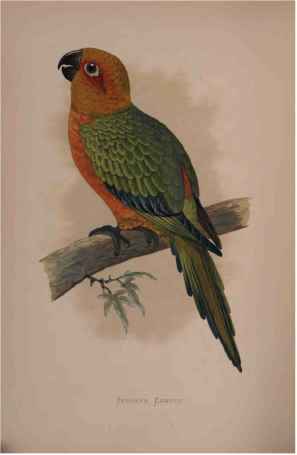
The following is a description of the adult plumage: - Head and neck bright golden yellow; lores, or spaces between the eyes and the mandibles red; rump rod; back and wings green; flight feathers blue; breast reddish yellow; thighs red; tail green and blue; beak black. The female, which is a trifle smaller than her mate, resembles him in almost every particular; however, she has less red about the lores, and is generally of a duller shade in every part.
The young, according to Finsch, are at first of a dull green colour on the upper surface of the body, the rump feathers only showing red at their edges. Russ, however, describes an immature Jendaya thus: "Upper parts dark grass green; sides and top of the head reddish with a purple shading; forehead and lores dull dark red; rump speckled with dark reddish purple; throat and breast pale olive green, with an edging of dull red to each feather; belly, sides, vent and under wing coverts dark purplish rod; thighs green; beak dark grey; eyes black; feet blackish grey.
" In the adult male the eyes are pearl grey, with a narrow red border round the pupil, and the legs and feet are black."
The Jendaya is about the same size as the Half-Moon Conure, that is to say, about a foot long, of which the tail measures about five inches. •
The attractive appearance of this Conure is beyond dispute, and if the proverb "handsome is that handsome does" were only applicable in its case, few birds would bo more commendable as inmates of the aviary, especially as they soon become very tame and confiding; but unhappily it has a voice, and is possessed with a mania for letting it be heard on every possible occasion, which would not be so very objectionable if its tones were only soft and sweet, but they are painfully shrill and harsh, and soon become distressing even to not very sensitive ears. In an out-door aviary however, this failing of the Jendaya is of comparatively little moment, for there its incessant vociferations only add an item to the universal noise; its shrill cries being indistinguishable in the general din.
It must, however, be said that this bird, as happens with most of its kind, is less noisy when kept in pairs than when confined by itself; the companionship of a fellow, whether male or female, seems to have a soothing effect upon the temper of both; and if they do occasionally yell, as a rule their conversation is carried on in a decidedly minor key; and the "love-song" of the male is really not at all unpleasant for human ears to listen to; then he is so attentive to his mate, combing her head incessantly, unless when he is feeding her, or asleep, or she is performing the same kind and soothing office for him.
Such an affectionate couple would no doubt make exemplary parents, if they only decided to continue the species, or at least help to do so, in captivity; but so far, with the exception of a pair belonging to a lady in Vienna, Frau von Proschek, they have not even produced eggs in Europe, and unfortunately those were barren; but no doubt success can be obtained, and will be by-and-by, though few amateurs have the necessary accommodation and appliances for making the experiment with any chance of a satisfactory result.
The Jendaya is not at all fastidious in the matter of its food, but will live and thrive on a diet of canary and hemp seed, with a little boiled maize thrown in for a change sometimes. Of ripe fruit it will also partake occasionally, but care must be exercised in giving it dainties of any kind, which have a tendency to derange the digestive apparatus, and cause the bird to tear out its feathers by the roots, making itself an object pitiable to behold; instead of, as it should be, "a thing of beauty and a joy for ever."
It may not be amiss to repeat here what we have already more than once observed, that Parrots of every kind, should have access to water both for drinking and bathing, whenever the inclination takes them to bathe or drink. Coarse sand, or rather small gravel, is quite as essential to their well-being as water, and soft half decayed wood not only affords a never-ending source of amusement, but is also necessary for preserving most members of the Parrot family in health; for they eat it, and the woody fibre seems to exert a beneficial effect upon their economy.
The Jendaya, like all the other Conures, is extremely fond of whittling, to use an Americanism, and should never be debarred the option of indulging in such an innocent and natural recreation; for, in their wild state, they breed in holes they excavate, or at least arrange, in the decayed trunks or limbs of trees; and probably if a soft log were more often given to them in captivity, the association of ideas thus evoked might lead them to consider that they were not fulfilling their destiny by refusing, or neglecting, to bear their part in the great work of continuing the species, and decide them to set about doing so at once; for we have found that birds which for years had made no attempt to nest, immediately commenced to do so when suitable conditions were found available; that is to say when appropriate nesting material was placed within their reach.
In Dr. Karl Russ's account of this Conure he records the history of a pair that were kept by Herr V. Schlechtendal, who narrates a
Continue to:


My Books

