


Bowed Knees
Description
This section is from the book "The Horse - Its Treatment In Health And Disease", by J. Wortley Axe. Also available from Amazon: The Horse. Its Treatment In Health And Disease.
Bowed Knees
This affection is very common in foals at the time of birth, and to such an extent does it occasionally exist, that the breeder is doubtful as to whether the young animal will ever become upright upon his legs. However, it is often the case that young foals, more or less malformed in this direction, become quite straight upon their limbs as time goes on; indeed, such a formation is generally more pleasing to the breeder, if not present in too great a degree, than that called calf-kneed, a position the reverse of the one we have just described. In the latter case the anterior part of the fore-leg, in a line from above downwards, is concave, and the posterior part is convex; and while in knees bowed forward the owner looks for daily improvement in the form of his foal's legs, in the backward malformation he is assured from experience that no improvement can be anticipated. In the adult horse we occasionally observe "bowed knees" in legs that were originally upright, or perhaps had only a slight tendency to be bowed; the animal having been put to hard work on the road, or hunted for three or four years, by the time he has become eight years old his legs are so deformed, so much over at the knees, that while standing they appear incapable of supporting the weight of the fore parts of his body. There are many persons who consider such horses unsafe both to ride and drive; but experience teaches us that these fears are, to a great extent, unfounded. It is not to be understood, however, that we consider such a form of the fore-legs as safe as those we term perfect. But let us endeavour to ascertain what gives rise to this affection in the working horse, since to account for congenital deformity in the foal would be altogether beside the purpose.
Various hypotheses have been advanced as to what parts are implicated which would cause this alteration in the form of the carpus. Some persons consider it to depend on a relaxed and lengthened state of the extensors, others on that of the ligamentous tissue at the anterior part of the knee; and again there are others who assert that it consists in an inordinate contraction of the flexors, and to such an extent that the equilibrium of the two sets of muscles (namely, the flexors and extensors) is destroyed. Now, although the last hypothesis seems the most feasible, still the results of my dissections of the fore-legs of horses thus affected - and which were purposely selected - certainly do not confirm any of those opinions.
The only muscles likely to produce a curving forward of the knee are the three which flex the metacarpus on the carpus, their attachments being superiorly to the condyles of the humerus, inferiorly to the trapezius, and two small metacarpal bones; but in these the scalpel develops nothing abnormal either in their muscular tissue or the tendinous structure by which they are inserted and intersected, nor should we expect to find anything, seeing their function is not interfered with.
At the posterior part of the carpus numerous ligaments arc found, which are so arranged as to admit of extension only in a forward direction, while the bones present tuberous projections for the attachment of other ligaments, the direction of which is from above downwards, obliquely crossing-each other (crucial).
May it not be that these ligaments at the posterior part of the knee become so deranged as to cause this affection? I am inclined to think such is the case. I know of nothing else that would so effectually prevent the full extension of the limb. It may be asked, What is the primary cause? Does the scalpel develop any lesion of this ligamentous tissue? In the specimens I have examined, all have shown the same peculiarities. I have carefully removed the muscles, both the flexors and extensors, taking care not to divide the annular ligaments, or, in fact, any of those proper to the carpus; after which I have endeavoured to straighten the leg, but invariably have failed. The abnormal position was persistent, and that to the same extent as before the muscles were removed. Further, to test the share the ligaments took in the flexure, I have made as many as four transverse sections through them, each of which was followed by an altered position of the bones, thus allowing the limb to be easily placed in a straight line, and of necessity leaving a considerable space between the divided ends of each ligament. The question that now arises is, Can anything be done to remedy this defect, either by the employment of the knife, mechanical contrivance, or any other means?
It would seem that the ligaments at the posterior parts of the carpus are in the first instance slightly sprained, giving rise to a disposition on the part of the animal to refrain from putting them on the stretch, as this, no doubt, would produce a certain amount of pain. To avoid this when standing the extensors are a little relaxed, thus allowing the knee to come somewhat forwards, thereby removing the tension of the ligaments posteriorly. This state of parts we observe only occasionally; for when the animal is excited, or at work, the limbs resume their natural position. This goes on for a time, but the cause alluded to being still in operation, the abnormal position becomes permanent; and the bursae which are situated at the lateral, inclining to the posterior, part of the limb, a little above the knee, are now more than usually filled, which, if the animal be a valuable one, induces the owner to seek advice. This being determined on, it is usually recommended that the horse be placed on a mash diet, and have a dose of purgative medicine administered to him, and that afterwards he be blistered once or twice and have a long rest - not less than two months. The general result of such a course of procedure is that the animal comes up much improved. He is put to work, which, if hard, in the course of two or three months causes his legs again to become as bad as ever. Still he is worked on, until finally he is permanently bowed at the knees, not being able, as when at first affected, to stand at times upright.
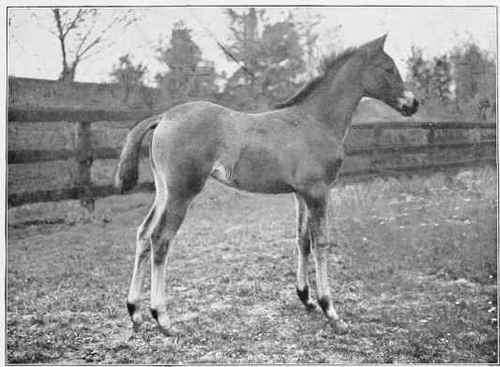
PLATE XL. WELL-SHAPED FOAL.
Photo by W. A. Rouch.
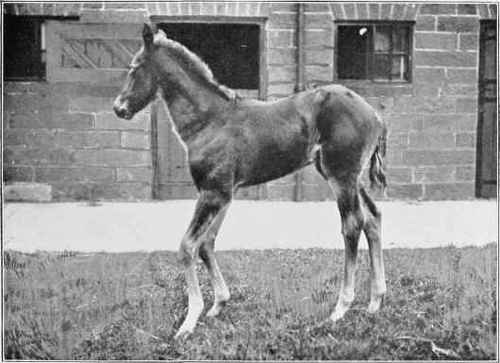
PLATE XL. FOAL WITH BOWED LEGS.
The impediment now consists in a slight thickening and consequent shortening of the ligamentous tissue we have before referred to.
No treatment in this advanced stage would be of any avail, whether medicinal, surgical, or mechanical. Such a horse must be considered as unsound, if the affection exist in more than a slight degree; for although we daily observe horses thus deformed doing their work well, still, on the other hand, many of them show blemished knees, the result of falls.
Continue to:


My Books

