


Curb
Description
This section is from the book "The Horse - Its Treatment In Health And Disease", by J. Wortley Axe. Also available from Amazon: The Horse. Its Treatment In Health And Disease.
Curb
A curb is an enlargement on the posterior part of the hock-joint,, about 4 or 5 inches below its point. Pathologically it consists in an inflammatory thickening of the sheath of the flexor pedis perforans tendon as it passes down the back of the leg. An enlargement of the calcaneocuboid ligament, i.e. a strong ligament uniting the bones of the hock behind with the splint and canon bones below, is also spoken of as curb by some, and by others certain forms of spavin are included in the term.
Causes
Curbs are common to all varieties of the horse, but they are most frequently seen in the lighter breeds, and especially in hunters and thoroughbreds.
The causes out of which they arise must be considered under two heads,. viz. predisposing and exciting. Of the former, heredity is a marked factor quite apart from conformation, for it is noticeable that the produce of some horses and mares, against the make and shape of whose limbs nothing can be said, show a special liability to the disease. It must be observed, however, that conformation is a conspicuous feature in the origin of curb. Animals with short calces, or, in other words, wanting in prominence and length of hock-point, are singularly liable to the disease, and the same may be said of others whose hind-limbs slope unduly forward, and are brought more immediately under the weight of the body.
In both these cases the condition generally described as "curby" or "sickle" hocks is represented (Plate XIII, Vol. I). It is also said that hocks, when small at their point of union with the canon - "tied-in" hocks, as they are termed - are specially prone to develop curbs.
The exciting causes of this disease are such as impose sprain or undue tension on the ligaments and tendons behind the hock; hence it results when animals are called upon to carry too much weight, and especially when young or out of condition. In any case, it may be induced by galloping in deep ground, jumping, kicking, rearing, and heavy draught.
Symptoms
The existence of a curb is indicated by the presence of a curved or convex enlargement at the lower part of the hock behind, where it breaks the straight line which usually marks the course of the leg between the point of the hock and the fetlock (fig. 369). In some instances it is very slight, and the appearance may require to be verified by careful manipulation, while in others it presents a very considerable and pronounced enlargement. In the diagnosis of curb the fact must not be overlooked that in some horses whose hocks are "rough" or coarse in conformation, undue development of the head or upper extremity of the outer splint-bone may give the part a curby appearance, especially when the curb is viewed from the outer side. Careful examination, however, will show that the undue prominence is limited to the seat of the outer splint-bone, and does not extend across the back of the hock as in curb proper.
In addition to swelling, more or less heat, pain, and lameness usually result as the immediate effects of the injury. The action of the horse is peculiar in the fact that the animal, in endeavouring to relieve the injured part, throws the weight of the body on the toe or the front of the foot, according as the case is severe or otherwise, and progresses much after the manner of a horse suffering from spavin. In the slighter forms of the disease lameness is but little in evidence, and sometimes hardly perceptible, save when weight is placed on the back or special effort is made in draught.
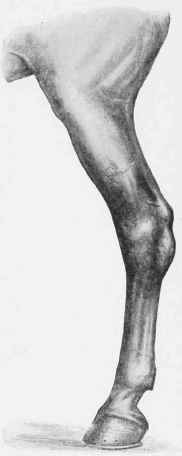
Fig. 309. - Curb.
Treatment
When the injury is severe and the lameness acute, the horse must be placed in a state of absolute rest, and the part well fomented with hot water every three or four hours, and a hot bandage should be worn in the intervals. Strain on the injured structures should be removed by applying a high-heeled shoe to the foot and directing the weight towards the toe. A dose of physic and a temporary reduction of the corn ration will assist in dispersing existing inflammation. When this has been done a blister or two, with rest, will suffice to reduce the swelling. It is seldom that this is altogether removed, but where active treatment is promptly applied a great reduction may be effected in it. Hand-rubbing the part repeatedly with even pressure is often attended with benefit.
In cases where the injury is slight, irrigation with cold water for a day or two, followed by a blister and a short rest, is all that is needed.
Where the enlargement is consider-able and lameness continues after these measures have been carried out, firing either by the puncturing or lining method will require to be adopted.
Young horses predisposed to curb should be carefully conditioned under slow exercise before being put to work.
In the laudable endeavour to restrict the spread of hereditary diseases in horses, the Royal Commission of Horse-breeding drew up a schedule of diseases, the existence of any one of which should disqualify a thoroughbred sire from receiving a premium. The list of disqualifying ailments included spavin, ring-bone, side-bone, diseases of the feet, cataract, roaring, and whistling, but curb, one of the most hereditary of horse diseases, had no place in it. It was not surprising, therefore, to find that a large percentage of the rejections at a recent show of the Hunters' Improvement Society were on account of curbs. It is no excuse for such a course to say, as has been said by some, that the lameness resulting from this disease sooner or later passes away, since the fact remains that it constitutes unsoundness, and largely depreciates the value of its victims.
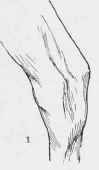
1, Good hock with curb.
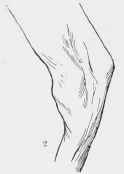
Fig. 370. - Curb 2, Bad hock without curb.
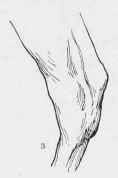
3, Bad hock with curb.
Continue to:


My Books

