


Fracture Of The Navicular Bone
Description
This section is from the book "The Horse - Its Treatment In Health And Disease", by J. Wortley Axe. Also available from Amazon: The Horse. Its Treatment In Health And Disease.
Fracture Of The Navicular Bone
The frequent occurrence of navicular disease, as a result of which the bone becomes weakened by ulceration and rarefaction of its tissue, renders, the bone in question peculiarly liable to fracture, and this predisposition is still further increased by the position which it occupies, and the weight and concussive force to which it is exposed during locomotion.
It is, however, more particularly in horses the nerves of whose feet have been divided that the accident occurs. While the nerves are intact, and sensation exists in the feet, the animal relieves himself from pain by throwing the weight of the body on the front of the foot, but when sensation has been removed by division of the nerves, pain disappears. The heels are then brought to the ground, and the navicular bone, weakened by disease, is made to bear the full weight and impact of the body.
At this time the perforans tendon has undergone more or less excoriation and inflammatory softening, and failing in consequence to give the bone support, a fracture results. It is no uncommon thing for rupture of the tendon to follow upon fracture of the bone.
Nails penetrating the frog have been noticed to cause fracture of this bone, but such an occurrence is very rare indeed.
Symptoms
Evidence of fracture of the navicular bone is difficult to differentiate from that severe inflammation of the navicular joint and tissues of the foot which sooner or later follows upon neurectomy. A little fulness in the hollow of the heel is first observed, which on pressure is somewhat yielding, and suggests the existence of deep-seated fluid. The toe has a slight inclination upwards, and the fetlock joint is somewhat depressed. Soon the coronet exhibits an abnormal fullness, and oozing of serosity appears between hair and hoof. The coronal thin border of the latter becomes white by saturation with serosity, and the horn commences to separate from the skin, and soon the hoof sloughs, a result which sooner or later follows upon fracture of the navicular bone.
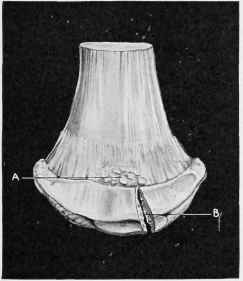
Fig. 342. - Fracture of Navicular Bone.
A, Cretification of Superior Navicular Ligament. B, Diseased Bone.
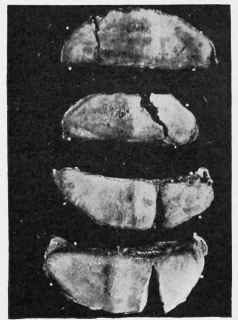
Fig. 343. - Fracture of the Navicular Bone.
Of course nothing in these cases can be done with any prospect of cure, and the better and more humane measure is to have the animal destroyed.
Continue to:


My Books

