


Predisposing Causes. Part 4
Description
This section is from the book "The Horse - Its Treatment In Health And Disease", by J. Wortley Axe. Also available from Amazon: The Horse. Its Treatment In Health And Disease.
Predisposing Causes. Part 4
Where difficulty is experienced in bringing the displaced parts into their proper position, the lower segment of the limb should be moved in various directions by an assistant while the operator manipulates the fracture. Slight rotation, first in one direction, then in another, and a little manoeuvring of this kind will sometimes direct the fragments into their normal position. If, however, exact coaptation cannot be effected, the best that can be done must suffice.
We have already pointed out the desirability of early "setting" as favourable to speedy and complete reparation. Where, however, delay has been allowed to occur, some consideration must be given to the state of the parts before readjustment is undertaken. Bound and about the broken bone the tissues will be swollen, inflamed, and painful, and more or less hard and rigid, and the broken pieces adherent to the neighbouring muscles. These are conditions which seriously interfere with replacement, and may altogether prevent it. In such circumstances no attempt should be made at reduction until the inflammation has been subdued by appropriate means, and some discrimination will be required as to the desirability of undertaking such a task in the horse at all.
When the parts have been returned to their proper position, or as nearly so as can be effected, the next requirement to be fulfilled is to secure them in such a manner as to prevent their displacement and favour the process of healing.
In man, whose intelligence is always at the service of the surgeon, this is not a difficult matter, but it is otherwise with the horse.
The one may be put to bed, and all weight having been re-moved from the broken limb, it may be placed in the position most favourable to reparation, and retained there largely by the will of the patient.
No such sense of self-government is available to the veterinary surgeon. His patient must for the most part support his own weight, and cannot be made to obey the behests of his attendant. His care of the limb is just so much as is dictated by fear of the pain which its movement excites, and the desire to use it, ever present, is always being indulged more or less, with the result that reparation is delayed, frequently imperfect, and not seldom altogether prevented. It is this want of guiding intelligence, this excitability and restlessness, that renders bone - "setting" in the horse so uncertain and unsatisfactory.
Among the various appliances employed for the purpose of retention, splints and bandages are the main and the most reliable. In fracture of the extremities the patient should always be placed in slings, and the opportunity afforded him to relieve the injured part and rest during the period of restraint.
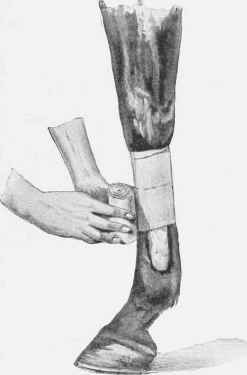
Fig. 331. - Bandaging a Fore-leg.
Showing the method of applying the bandage over a pad of cotton-wool.
Splints have for their object the restraining of movement by fixing the limb in such a way that the joints cannot be flexed. Anything which will accomplish this without injuring the part to which it is applied may be employed for the purpose. Narrow strips of wood, thin sheet-iron or tin, leather, gutta percha, strong cardboard, pitch or other adhesive plasters, etc. To obtain the greatest possible benefit from a splint it should be sufficiently long to extend over the joint above and the joint below the fracture. Of course this is not always practicable, but it should always be present to the mind of the operator to adopt any means in his power to restrict as much as possible the action of the joints of the affected limb.
Movement of the fractured bone is best controlled by bandages soaked in some material which will solidify and form an unyielding splice over the seat of the broken fragments. These hardening substances are variously compounded. Nothing, perhaps, is better than starch or flour mixed to the consistence of treacle with the white of egg. Dextrine, burnt alum, and alcohol is recommended by some; and plaster of Paris, with or without flour, and reduced to the consistence of treacle with water, is generally regarded as an excellent preparation.
These appliances will require to be supplemented with some soft compressible substance, by which the irregularities of the limb may be filled in and the pressure of the bandages equalized over the whole circumference of the leg. Where this precaution is neglected there is danger of undue compression of the more prominent parts, resulting in sloughing of the skin and the production of troublesome sores with their attendant evils.
After "setting" has been completed, the limb should be kept under close observation for several clays. It will sometimes be found to swell in consequence of injury done to the soft tissues at the time of the fracture, or from excessive pressure applied to a part or the whole in the adjustment of splints and bandages. In these circumstances relief must be given to the strangulated limb either by cutting the bandages or otherwise removing the pressure. If it is allowed to continue, more or less extensive sloughing will result, and a complication will be added to an already serious condition.
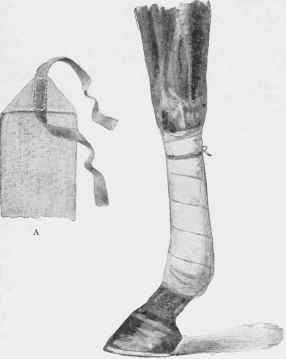
Fig. 332. - Bandaging a Fore-leg.
Showing the bandage completed and tied, a, End of bandage with tapes.
Continue to:


My Books

