


Predisposing Causes. Part 3
Description
This section is from the book "The Horse - Its Treatment In Health And Disease", by J. Wortley Axe. Also available from Amazon: The Horse. Its Treatment In Health And Disease.
Predisposing Causes. Part 3
The prospect of treatment - as to whether it is likely to be successful or otherwise - will depend upon a variety of circumstances, all of which should be well considered before a decision is arrived at.
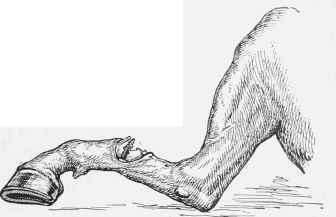
Fig. 329. - An Example of Compound Fracture.
The position of the bone and the nature of the fracture will claim attention first. A simple fracture without displacement is not a serious matter, unless it occurs in the immediate neighbourhood of a joint, to which the reparative inflammation may extend and occasion some permanent interference with its movements.
Compound and comminuted fractures are always more serious than simple ones, and in all the danger is greatly aggravated where the tissues in the region of the breakage are much bruised or torn, especially where large nerves and vessels are divided by the broken ends of the bone. All these are matters which impart to a fracture in such an uncontrollable subject as the horse a dangerous and discouraging outlook.
A young horse, with a sound constitution and a quiet generous temperament, is much more amenable to treatment than an old, declining, irritable subject.
In the treatment of fracture three important requirements must be fulfilled. The broken fragments must first be brought together and placed in their normal position; they then require to be retained there until they have again become firmly united by the natural process of repair.
The third requirement involves the care against complications, and prompt measures of treatment when they arise.
If there is no displacement of the broken pieces, but by the history and general symptoms of the case a fracture is denoted, the second and third indications only will require to be met.
It is no rare occurrence for horses to break the bones of their legs and to continue to work for hours, days, or weeks without any displacement occurring. A case came to the notice of the writer where a horse in the course of a day's hunting suffered a comminuted fracture of the canons of both hind-limbs. He was noticed to be lame after striking them against a stone wall, and was sent home in consequence. After being fed and dressed and "set fair" he lay down, and when the groom returned to him and caused him to rise, the broken fragments parted, and not till then was the existence of a fracture made known.
The horse was destroyed, and a post-mortem examination showed both bones to be broken into several pieces.
The means by which fractures are reduced or "set" will vary with the seat and nature of the displacement. Some are altogether beyond rectification. This is especially the case in the bones of the spine, and in some bones to which large muscles are attached. By the latter the broken parts are prevented from being brought together, or they are pulled away from each other by forcible contraction when this has been effected.
This is very much the case in fracture of the thigh and the humerus.
It is more especially in bones below these, and others about the face, that success may be hoped for.
In the absence of a properly-constructed operating-table, by which a horse can be taken off the ground while in a standing posture and again replaced directly on his feet, the reduction of a fracture in so large and uncontrollable an animal as the horse is in the last degree difficult.
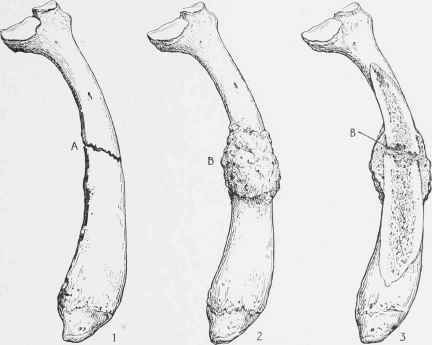
Fig. 330. - Fracture of First Rib of Horse (Inner Aspect) 1, Showing Fracture. 2, Repair of Fracture. 3, The same in section. A, Fracture. B, B, Callus.
Without some restraining influence the pain excited by the manipulation of the parts is such as to provoke the most violent opposition. To prevent this the animal must either be cast and placed under restraint, or his resistance must be overcome by the administration of a powerful sedative, or of chloroform or some other anaesthetic. Whichever course is adopted he will require to be brought to the ground, and after the fracture has been adjusted, to rise again.
In the one act the damage may be seriously aggravated, and in the other the work of setting may be completely undone.
In dealing with fracture of the pasterns, canons, and other long bones, a powerful opiate or a subcutaneous injection of morphia may in some cases so far overcome the irritability of the animal as to allow of readjustment of the broken parts and the application of retaining appliances. Where this fails the horse should be lifted on to a proper operating - table and placed under the influence of chloroform. By this means a more careful examination of the divided bone may be made, and a correct idea of the direction of the displacement and the extent of damage to neighbouring structures is obtained. In this connection it may be desirable to caution the operator against unnecessary manipulation, but when once he has decided what is required to be done, he must not hesitate to apply the necessary force to do it. How that force can best be obtained will be a question for solution when all the facts of the case are known. Hands and apparatus are the means to be applied, and whether one or both are brought into requisition, the direction in which they will be called upon to act will be the same. Ropes and pulleys are in some cases indispensable.
In proceeding to reduce the fracture of a long bone, force will require to be exercised to a greater or less extent in two directions, extension and counter-extension, and for this purpose one rope will need to be applied below the fracture and the other above it. On each steady and continuous traction is to be made by assistants, while the operator regulates the position of the limb according to his requirements, and directs the broken pieces into their normal position. Those to whom traction is confided should be reminded that sudden and spasmodic or jerky action may add to the difficulties of the operator by exciting the muscles to violent contraction, or lacerating their fibres and with them other correlated structures. The pull in both directions should be as nearly as possible equal in force and steadily maintained throughout in a line with the natural axis of the limb. Those parts of the limb to which the rope or webbing is applied should be well padded with tow.
Continue to:


My Books

