


Strangles Of The Horse
Description
This section is from the book "The Horse - Its Treatment In Health And Disease", by J. Wortley Axe. Also available from Amazon: The Horse. Its Treatment In Health And Disease.
Strangles Of The Horse
Strangles, or pyrogenic fever, or external scrofula, are names given to this catarrhal disease, which is so very common among young horses. On the question of the infectious nature of the disorder opinions differ very materially. Dr. Twill, in his recent work on the pathology of the domestic animals, describes strangles as an acute infectious disease. Robertson defines it as a specific febrile disease of the horse probably under certain conditions contagious. Williams states in definite terms his opinion that the disease is not contagious, but he admits, nevertheless, that it is better to take precautions against its diffusion by separating the diseased horse from healthy ones.
In the popular view the disease is the result of some peculiar condition of the system, which leads to the external manifestations characteristic of strangles, in the course of which the morbid matter is discharged from the system, and the animal is supposed to be so much the better for its removal.
In favour of the contagion theory there are the facts derived from experimental enquiry commenced a hundred years back. In these investigations strangles was directly transmitted by inoculation with the nasal discharge. Similar experiments have been performed by other investigators with negative results. Schutz, however, discovered an organism some years ago, a streptococcus, with pure cultivation of which he succeeded in causing the disease in healthy colts, and from the whole of the evidence it will be decidedly safe to accept the view that strangles is a contagious disease of the horse.
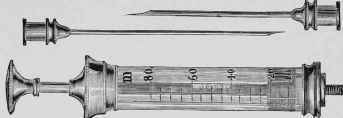
Fig. 215. - Mallein Syringe.
Strangles only occurs in the equine race, including the horse, ass, and mule. It is common to young horses from two to five years, and occasionally it occurs in colts of a few weeks old; also it may appear in very old horses, in which case it is commonly spoken of as bastard strangles, and invariably runs a mild course.
Symptoms
It is generally admitted that the earliest symptoms of strangles are those of a mild catarrh, slight fever, increase of pulsation and discharge from the nostrils, cough and sore throat, followed by a diffuse swelling of the glands and cellular tissue under the jaw. One of the difficulties in dealing with the disease as a contagious malady arises from the absence of any special symptoms, rendering-accurate diagnosis in the early stage impossible. Practically the question is only one of importance when immediate diagnosis is essential, as in the case of the admission of an animal to a show-yard. This difficulty, however, is lessened by the fact that all catarrhal affections may prove to be more or less contagious, and ordinary benign strangles is probably not more infectious than an ordinary cold in the head.
In a few hours, or at most in a day or two, more characteristic symptoms of strangles may be looked for. The nasal discharge becomes purulent. A swelling under the throat, the beginning of an abscess, will be apparent, and during the formation of pus, fever is more acute. The animal's appetite is now impaired, the temperature rises considerably, and the pulse becomes much more frequent. When the suppuration is complete, and the abscess beneath the jaw has been emptied, the febrile symptoms gradually disappear.
Treatment
Good nursing appears to be all that is really necessary in dealing with strangles of the ordinary type; fumigations to the throat (fig. 216) and poultices (fig. 217) are commonly employed for the purpose of assisting the suppurative process. When mature, the abscess should be opened, and the matter discharged collected in a basket on saw-dust and burned. The pus cavity should be well syringed out with a 5-per-cent solution of carbolic acid, and afterwards filled with cotton-wool which has been previously wrung out in the same solution. The plug of wool should be changed every clay, and the part kept thoroughly clean. Soft diet and warm clothing, with thorough ventilation of stables, constitute the additional treatment which is required.
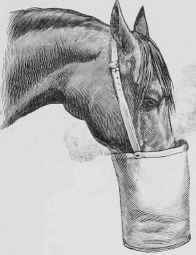
Fig. 216. - Steaming: for Strangles.
Strangles sometimes assumes a chronic, and occasionally a malignant, form, ending in the introduction of pus into the circulation (pyaemia) or the extension of the suppurative process to the glandular system; sometimes also blood-poisoning (septicaemia) occurs when the exudation products become putrid. Cases of the more malignant forms of the disease do not come within the scope of domestic treatment, but require skilled professional aid.
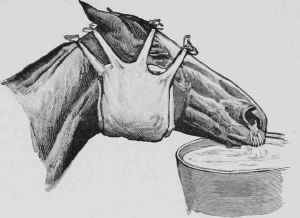
Fig. 217. - Poulticing for Strangles.
Continue to:


My Books

