


Use Of Mallein In The Detection Of Glanders
Description
This section is from the book "The Horse - Its Treatment In Health And Disease", by J. Wortley Axe. Also available from Amazon: The Horse. Its Treatment In Health And Disease.
Use Of Mallein In The Detection Of Glanders
Before the discovery of mallein, a few years ago, the only test which could be applied in doubtful cases was the inoculation of an ass with the nasal discharge. Later on, guinea-pigs were found to answer the purpose even better, and Dr. Woodhead employed a double test by inoculating the most susceptible animal, a guinea-pig, and at the same time a comparatively unsusceptible one, a rabbit.
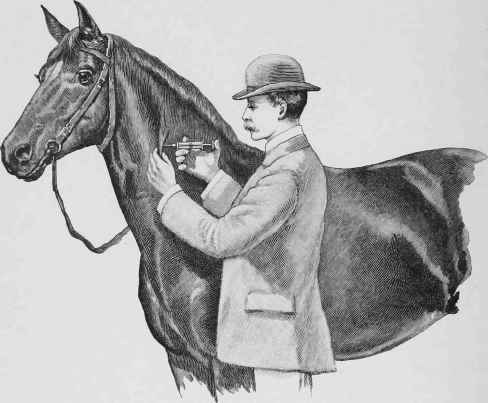
Fig. 214. - Inoculating with Mallein.
If the guinea-pig died after exhibiting distinct symptoms of glanders, and the rabbit recovered after showing slight signs of fever, as a rise of temperature with local irritation, or slight ulceration, it was concluded that the horse was affected with glanders.
The use of mallein, however, is a much more delicate test, because it is equally effective when applied to horses which are not suspected, or at least exhibit no sign of disease of any kind, but are known to have been in the same stable with a slandered horse. Mallein is prepared by cultivating the bacillus of glanders in bouillon, to which 5 per cent of glycerine has been added. The vessels containing the cultivation are kept from three to six weeks at a temperature of 100° Fahr. The cultures are then sterilized by steam, and afterwards filtered through unglazed earthenware to separate the dead bacilli. A clear sherry-coloured liquid is obtained, perfectly free from organisms.
It has been proved by numerous experiments in this country and on the Continent that the injection (fig. 214) of the fluid mallein under the skin of the neck of a horse produces characteristic reaction, even in cases in which after death only a single glanderous nodule has been found in the lungs. The test has been also applied to healthy horses and to horses affected with bronchial catarrh, pleurisy, strangles, and nasal gleet, but in no instance has the complete characteristic reaction been observed. It may, therefore, be considered that the mallein test is perfectly reliable, even in cases in which the disease was in the early stage.
Continue to:


My Books

