


Callosities (Chestnuts And Ergots). Part 2
Description
This section is from the book "The Horse - Its Treatment In Health And Disease", by J. Wortley Axe. Also available from Amazon: The Horse. Its Treatment In Health And Disease.
Callosities (Chestnuts And Ergots). Part 2
" In the horse's nearest relatives, the tapir and rhinoceros, the same arrangement holds good. There is a large pad under the fore part of the middle of the foot, which in these animals rests on the ground, and there is also a hard sole under each toe. Now the ergot of the horse clearly, both by structure and position, corresponds to the palmar or the plantar pads of those animals which walk more or less on the palm and the sole.
" Owing to the modified position of the horse's foot, standing only on the end of the last joint of the one toe, this part of the foot no longer comes to the ground, and yet the pad, with its bare and thickened epidermic covering, greatly shrunken in dimensions, and concealed among the long hair around, and now apparently useless in the economy of the animal, remains as an eloquent testimony to the unity of the horse's structure with that of other mammals, and its probable descent from a more generalized form for the well-being of whose life this structure was necessary."
In the illustration (fig. 664) the position of the parts described is shown.
In the description quoted, the reference to the ergot of the horse's fetlock - representing the palmar or plantar pad - as being characterized by " its bare and thickened epidermic covering greatly shrunken" does not convey an idea of its true structure. The excrescence, both in the horse and in the ass, is a decided prominence, and is identical in its minute structure with the hoof of the horse, as will shortly appear, while the palmar and the plantar pads of man and the dog are correctly described as " thickened epidermic covering" quite distinct from hoof horn.
A careful examination of specimens which have been obtained for the particular purpose of ascertaining what are the structural relations between the callosities and the ergots of the horse tribe and the plantar and the palmar pads in man and the dog has led to some very interesting results.
The several parts referred to may, for convenience, be considered in the first place as they appear to the unaided eye of the observer. After which their minute structure will be more easily explained.
Man has no distinct pads beyond those which have been described as hardened cuticle, the result of pressure and of friction affecting certain prominent parts of the soles of the feet and the palms of the hands. These points are indicated in the human feet a in fig. 664 by the letters a b c. To the unaided eye the parts referred to are apparently covered with a hard mass of cuticle, and a microscopic examination confirms this conclusion.

Black, White Snip on Nose Brown, White Face.
Skewbald Bay, White Blaze Chestnut, White Star

SKIN MARKINGS - II.
Blue Roan. White Stripe Gray.
Piebald Red Roan, White Stripe Cream.
In the dog the palmar and the plantar pads are underneath the fore-feet and the hind-feet B, fig. 664. Two fatty cushions form the bulk of each pad, and the surface of the skin covering the cushions is an extremely beautiful structure, to which the use of the term hardened epidermic covering, although strictly correct, certainly does very scant justice.
Looking at the surface of any one of the pads underneath the foot of the dog, when it is freed from the habitual coating of dirt, the observer will be struck by its tessellated or chequered appearance. A series of columns or cones will be distinguished, with the points directed, in the natural position of the foot, downwards to the ground surface of the pad.
The plantar pad of the foot of man is composed of epidermic scales, forming a nearly smooth covering to the sensitive and vascular skin.
Among the horse tribe there are no developed palmar or plantar pads; the remains of these are indicated in c of fig. 664. If, however, the ergots are to be accepted as the rudiments of the plantar pads in the primeval horse, it must not be forgotten that they differ in structure from the pads of animals in which pads are essential organs of progression, as the ergots are distinctly horny structures and not merely hardened cuticle.
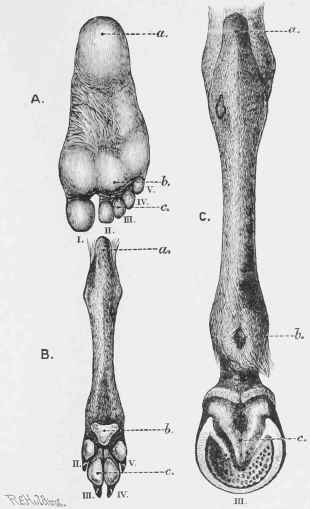
Fig. 664. - Plantar Surface of the Foot of - a, Man ; B, Dog; c. Horse.
The small letters a, b, and c indicate the corresponding points of the three. These points are in man at the centre of the heel a, the protuberance at the joint of the third or middle toe b, and in the centre of the middle toe c. In the dog at the back of the point of the hock a, which does not come in contact with the ground owing to the position of the limb, also on the centre pad b, and on the centre of the third toe c. In the horse in the centre of the point of the hock a, on the ergot b, and near the centre of the frog c.
Ergots are constantly present in horses and in asses; in the latter indeed they are relatively broader than in the horse, although they do not often protrude quite as far above the skin. After maceration the horny growths are easily pulled off, and even a naked-eye inspection suffices to prove their identity with horn of the sole or coronary surface of the foot.
Chestnuts or callosities are met with in different forms and in varied positions in the several members of the equine family. In the horse, breeding exercises some considerable influence on their development, and in their earliest condition in the foetus they are not at all like the horny excrescences which they afterwards become, but, on the contrary, correspond strictly to the description given of them in the other equidae, i.e. bare patches of skin with a thickened epidermic covering. It is interesting to note, however, that their true nature is at once ascertained by microscopic examination.
Continue to:


My Books

