


Changes Which Occur In The Uterus In Gestation
Description
This section is from the book "The Horse - Its Treatment In Health And Disease", by J. Wortley Axe. Also available from Amazon: The Horse. Its Treatment In Health And Disease.
Changes Which Occur In The Uterus In Gestation
Further consideration of embryonic growth and development may be deferred for a space, in order to explain the adaptive alterations which have up to this time taken place in the uterus.
At an early period in utero-gestation the openings of the glands of the mucous membrane lining the uterus increase in size and become more numerous. Meanwhile the membrane itself receives additions which render it softer, thicker, and more vascular than the normal membrane; in fact, the added materials constitute a new membrane under the name of the membrana decidua, which is afterwards divided into three layers - the decidua vera, decidua reflexa, and decidua serotina; the last named is especially devoted to the reception of the villi of the chorion. In the cavity of the uterus a quantity of fluid rich in nucleated cells collects, in contact with the deciduous membrane and the chorion, aiding in the process of nutrition and purification of the foetal blood.
The membranes which have been described as surrounding the embryo also contain fluid, and the young animal during the whole of its existence in the uterus is surrounded and protected by water cushions of the most perfect construction.
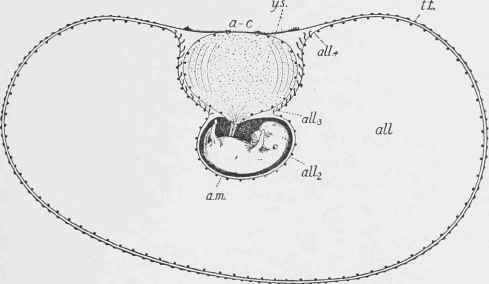
Fig. 541. - Embryo of Horse at Seven Weeks tt, Embryo sac; all, all2, all3, all4, allantois; am, amnion; ys, yolk sac; a-c, absorbing area.
It may be mentioned incidentally that all the membranes belonging to the foetus, with a large portion of the deciduous linings of the uterus, are cast off at the time of parturition as the after-birth, and the uterine mucous membrane gradually returns to its former condition.
Continue to:


My Books

