


Stump Moulding
Description
This section is from the book "Cassell's Cyclopaedia Of Mechanics", by Paul N. Hasluck. Also available from Amazon: Cassell's Cyclopaedia Of Mechanics.
Stump Moulding
The term stump moulding is generally applied to ironfounding, in which parts of cast-iron are added to other castings or to wrought-iron work, as in bedstead work, where the cast-iron knuckles are cast on the angle-iron forming the side-stays. This operation is done in the same way as ordinary founding, by placing the part to be inserted in the finished mould and pouring the metal on it. In brassfounding the term denotes the method used in cock-founding known as plate casting. In this method the patterns are specially made and fixed on a metal plate in a frame, which is reversible. Instead of the moulding tub, use brackets on the wall or other stand in the shop. The mould is made to one side first by applying the peg-side and making the mould in the ordinary manner. The peg-side is removed, the plate frame is reversed, a hole-side is put on, and the other half of the mould is made. This method obviates making an odd - side. Probably an iron moulding machine, similar to those used in wheel moulding, etc., would be an assistance, as the moulds could be more quickly made by using machine pressure. If using the above-named machine, the pattern plate, which serves as the parting plate, has half the pattern projecting from each side, as previously stated.
The mould is formed in sand contained in two moulding boxes which are placed on the pattern plate, one over and one under. The sand is pressed within the moulding boxes by the action of rams, which serve also, upon the removal of the pattern plate, to eject the sand moulds from the boxes. The advantage of the machine is that moulds may be made in one-eighth the time used in hand moulding.
Stump moulding is so called because the moulder works on a small bench called a " stump." The box parts used are about 18 in. square and 3 in. deep. The best are of mahogany or other hard wood to combine lightness and strength; they are hinged at one corner, and have a fastening at the opposite corner, as at A in the accompanying illustration. The hinges and fittings may be of brass. The other two corners of the box are dovetailed together. The box partsare fitted together in pairs, the bottom part being made to take the pegs B. The moulder takes the bottom part, brings the ends A together, and secures them. He rams it up on a pattern plate or an oddside, and then rams the other box with the top part on the other side of the pattern plate or the other oddside. The two box parts are then put together and moved off the bench or stump to the floor. The corner A is unfastened, and the box parts are opened and removed, leaving the sand mould on the floor ready for pouring in the iron. It will be seen that only one pair of box parts will be required to make any quantity of moulds on this principle.
Of course, this method is only suitable for use in casting comparatively small articles such as cast heel-tips for boots.
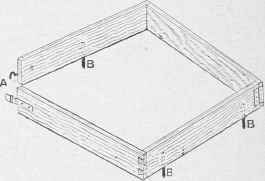
Box for Stump Moulding.
Continue to:


My Books

