


Gas Lighting. Part 8
Description
This section is from the book "The Engineer's And Mechanic's Encyclopaedia", by Luke Hebert. Also available from Amazon: Engineer's And Mechanic's Encyclopaedia.
Gas Lighting. Part 8
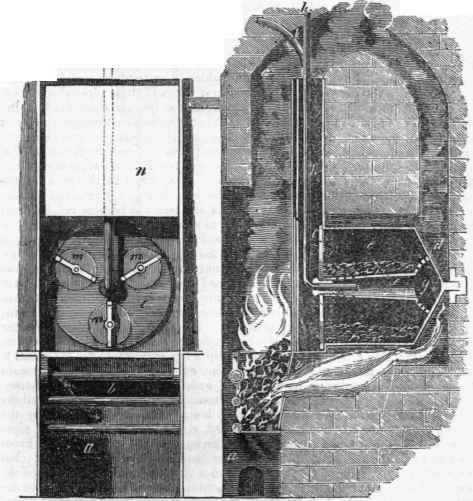
The retort is turned with a small rim or flange at the fore end, which fits into the plate c, and the hinder end is supported by a stout pin projecting from the back of the retort, and resting in an iron socket let into the brickwork. The hinder end of the pipe f terminates in a cup or cavity g, pierced with several holes, and serving as a chamber for the gas to collect in; the pipe f is also pierced with numerous small holes, to allow the tar, as it forms, to fall through them upon the burning fuel, where it, as well as that portion which runs down the conical pipe f and the cup g, is decomposed and converted into gas. In the fore end of the pipe f is screwed a stuffing box, through which passes the pipe h, leading to the condenser. Each compartment of the retort has a door or mouth-piece m m, by which the coal or other material for making gas is introduced, and the door is secured by screws, the joints being either ground true or luted; n is an iron plate, sliding in grooves, and, when lowered down, serving to defend the face of the retort and the pipe h from the action of the fire.
Fig. 5 is a vessel divided into two parts, the lower part o, which is air tight, containing a quantity of tar, into which the pipe h dips a few inches; it is supplied with tar from another vessel p, by means of a bent pipe g; r is a pipe for drawing off the tar when required, and s an opening by which the tar runs down the pipe k into h, and thence into the retort. The upper division of Fig. 5 contains a range of bent pipes t t surrounded by water, one end of which, v, opens into o, and the other end, x, leads to the gasometer; from the lower bends of these pipes short pieces yy descends into the tar in o, by which means the tar condensed in the pipes 11 descends into o, whilst the gas cannot escape through the short pipes. The operation is as follows: - the retort being charged, and the doors secured, the retort is turned till the chambers are in the position shown in Figs. 1 and 3; the shutter n is then let down and the fire lighted, a portion of the heat and flame from which passes through an aperture in the back of the range (shown by the black space between the bars in Fig. 1,) into the furnace b, causing, in a short time, the lower part of the retort to become red hot, and the coals or other materials in the interior to give out gas, which, collecting in the chamber g, passes through the pipes f and h to the condenser; at the same time the tar given out by the coals in the upper chambers of the retort, descends through f and g on to the burning fuel in the lower chamber, and becomes decomposed.
When it is supposed that the materials in the lower compartment have given out all the gas contained in them, the retort is turned partly round, so as to bring another compartment immediately over the flame, when the gas is again given out as before. The gas thus formed contains tar and other impurities, from some of which it can be freed by a reduction of temperature; the pipe h is therefore made to dip a few inches into the tar vessel o. and through this tar the gas has to rise to enter the condenser, by which means it is divested of a portion of its impurities, and, upon entering the condenser, it passes through a great length of pipe surrounded by cold water, when all the condensable impurities are separated, and descend into the tar vessel by the pipes y y. The tar, as we have before stated, returns to the retort by the pipes k and h, and is decomposed by falling on the burning coke in the retort. From the condenser the gas passes to the purifier, and thence to the gasholder; but the method of purifying the gas, either upon a large or a small scale, forms the subject of a separate patent to Mr. Pinkus, which we shall now proceed to describe, observing only that Fig. 4, in the preceding engraving, merely represents an oblong retort, which may be substituted for the one before described, when the length of the fire-place will admit of it; it will then of course be fixed, instead of turning upon a pivot, and the gas will pass off by the pipe f<, and the tar return by k, inserted in the top of the retort.
Fig.5.
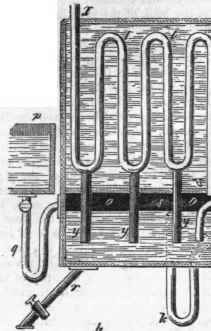
Fig. 4.
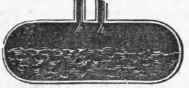
Fig. 3.
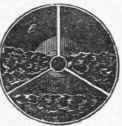
Fig. 1.
The purifying substances employed by Mr. Pinkus, are the chlorides of soda or of lime. The following engraving represents two arrangements of the purifying vessels; the one adapted to the use of gas works on a large scale, and the other for the use of private houses, to purify the gas as it passes from the public main to the burners. The method is as follows: the gas, upon leaving the condenser, passes through a solution of the chlorides of soda or of lime, which may be contained in a vessel resembling that shown in section at Fig. 1, through which the gas may be made to pass, acting under a pressure of from ten to twenty inches of water, by which means it will be purified, and its obnoxious odour and bad smell removed; in addition, the patentee recommends to pour a quantity of the same solution into the feeder A, Fig. 2, from whence it flows into the tar vessel b b b, through the bent tube c. In this vessel, (which communicates with the retort by the pipe d,) the solution will mix with the condensed matter that falls into it through the branch pipes connecting the refrigerator tubes fff, (which are immersed in a vessel of water.) g g with the tar vessel.
The compound thus formed, and kept agitated by the gas issuing from the dip pipe h h, is made to flow in a small stream through the pipe d, into the retort, while in action; upon coming in contact with the ignited materials within the retort, other vapours or gases will be generated, which, combining or mixing with the carburetted hydrogen gas, a chemical action will take place, whereby the gas, while in the retort and during its passage through the refrigerator, will become partly purified, or will be so altered as to be more easily acted upon in its passage through the solution of the chloride of lime, when its purification will be finished. In preparing the solution, the patentee directs to employ one part of chloride to about thirty-five parts of water, and when the chloride is in its most concentrated state a diluted acid, sulphuric or muriatic, may be added to the solution to assist the liberation of the chlorine gas from the lime; and the quantity of water may then be increased to forty or fifty parts, with one of the chloride.
Continue to:


My Books

