


Gas Lighting. Part 9
Description
This section is from the book "The Engineer's And Mechanic's Encyclopaedia", by Luke Hebert. Also available from Amazon: Engineer's And Mechanic's Encyclopaedia.
Gas Lighting. Part 9
Fig. 3 represents the apparatus for the more perfect purification of the gas on its passage from the street mains to the burners, i is a recipient, intended to contain and supply the purifying liquid; this vessel is connected with another vessel k by a syphon or by a bent tube f, inserted through the centre and top of the lower vessel k, and having a stopcock m. The lower vessel k is made gas tight, and formed of tin, copper, or sheet iron, and is a receptacle for gas, which flows through it, and for the purifying liquid that falls from the upper vessel j; n is a common sponge placed on a shelf of coarse wire gauze o; p is a manhole made in the side of the vessel k, sufficiently large to admit the hand and sponge; q is a pipe leading the gas from the main; and r is another pipe to supply the gas in a purified state to the burners; s is a waste pipe to let off the liquid when it has become too much impregnated with the impurities of the gas; and t is a washing pipe leading from a cistern; u and v are stop cocks for admitting and drawing off the liquid. The operation of this apparatus is as follows: into the recipient i pour a mixture of one measure of the concentrated liquor of the chloride of lime, diluted with from twenty-five to thirty measures of water.
When gas is required to supply the burners, turn on at the same time the stop-cocks m, in the bent tube f, and the leading pipe q; the purifying liquid will then flow through the bent tube l, on to the sponge n, which will absorb a portion sufficient to keep it always wet, and will permit the liquid to filter through, and fall to the bottom of the vessel k; at the same time the gas will continue rising through the moistened sponge n, where it will be acted upon by the purifying liquor, and its obnoxious odour will be removed before it arrives at the burners through the supply pipe r.
Fig. 2.
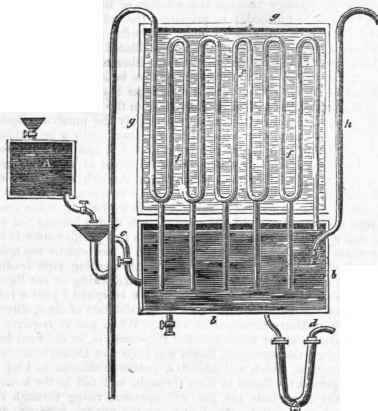
Fig. 3.
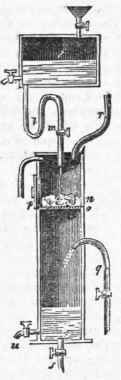
Fig. 1.
One object of great convenience and utility to which gas lighting has within these few years been applied, is the illumination of public clocks. This we believe was first put in practice at Glasgow, where a clock with two faces, supported at the extremity of a projecting bracket, was lighted by jets placed above it, the light of which was reflected on each face from minors placed within the wings of an elegant representation of a phoenix, which surmounted the clock. In order to light the burner without sending up a person for that purpose, in addition to the pipe which supplied it with gas, was another extending from the main to the burner, having a stop-cock at its junction with the main, and being perforated with numerous small holes throughout its length. Upon opening the cocks, the gas flowed through both pipes, and issued at the small holes in the flash pipe as it was called; and a light being applied below, quickly communicated along the whole length of the flash-pipe, and upon reaching the jet, ignited the gas issuing from it; after which, the cock on the flash pipe was shut.
Various methods have since been proposed of lighting up clocks, one of which is as follows: a dial plate, out of which the figures representing the hours are cut, in contrary succession in the usual representation of them, is made to revolve on the axis that would otherwise receive the hour hand. Behind it is a solid field, out of which a sufficient space is cut to show the hour, half hour, or quarter; each half hour is represented by a star, and each quarter by a dot; and the time is reckoned by the hours and quarters which have passed the centre of the opening Behind the revolving plate is placed a gas light, which is ignited by the jet of gas being directed on to a piece of spongy platina.
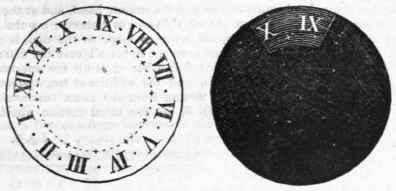
A somewhat superior method to the preceding is exhibited in the following engraving. A is the dial plate of a common clock, with the hours, etc. marked upon it, as usual; B is the proposed addition to it, for the purpose of exhibiting the time distinctly during the night; C is a light cog-wheel, placed immediately behind the day dial; having its centre fitted in the arbour of the hour hand, and revolving with it. The night dial B is designed to be made of plate glass, with the hours painted upon it in black, and to revolve on an axis in its centre. The index represented by an arrow is fixed. The periphery of the glass plate is encompassed by a rim of brass, having cogs in its outer edge, which fits into the cogs of the wheel C; consequently they move together, and being of equal diameters, they perform their revolutions in equal time. The time represented in our engraving, is a quarter past X; when the hour hand has moved on to XI. (for instance), the transparent dial B will have moved an equal space past the fixed index, and denote the same precise time.
Both dials must, by this simple contrivance, invariably agree in their respective indications of the time.
During the day, the time is observed on the large dial as usual; and at night a lighted lamp placed behind the transparent dial will always exhibit the time as distinctly.
But the most perfect and ingenious mode of illuminating public clocks which has come under our notice, is that by which several of the church clocks in London are lighted. By the revolution of the hands, and the addition of only one wheel and pinion to the clock, the gas is lighted and extinguished at regular stated hours, which hours may be varied monthly to suit the increase or decrease in the length of daylight, by simply adding or withdrawing a pin. ^ The inventor is Mr. Paine, from whose account in the Transactions of the Society of Arts we have taken the following abbreviated description.
Continue to:


My Books

