


Geometry Problems. Part 3
Description
This section is from the book "The Engineer's And Mechanic's Encyclopaedia", by Luke Hebert. Also available from Amazon: Engineer's And Mechanic's Encyclopaedia.
Geometry Problems. Part 3
Problem VI
To lay down an angle of any number of degrees.
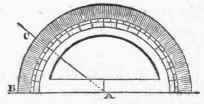
There are various methods of doing this. One is by the use of an instrument called a protractor, with a semicircle of brass, having its circumference divided into degrees; similar to Fig. 6. Let A B be a given line, and let it be required to draw from the angular point A a line making, with A B, any number of degrees, suppose 40. Lay the straight side of the protractor along the line A B, and count 40° from the end B of the semicircle; at C, which is 40° from B, mark; then, removing the protractor, draw the line A C, which makes, with A B, the angle required. Or, it may be done by a divided line, usually drawn upon scales, called a line of chords. Take 60° from the line of chords, in the compasses, and setting one at the angular point B, Prob. IV., with that opening as a radius, describe an arch, as a b: then take the number of degrees of which you intend the angle to be, and set it from b to a, then is a B b the angle required.
Fig. 4.
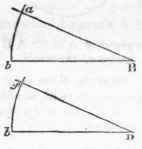
Fig. 5.
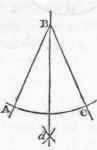
Fig. 6.
Problem VII
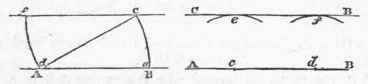
Tlirough a given point C, to draw a line parallel to a given line A B.
Case 1. Take any point d, in A B, Fig. 7, upon d and C with the distance C d, describe two arcs, e C, and d f, cutting the line A B, in e and d. Make d f equal to e C; through C and f draw C f, and it will be the line required.
Case 2. When the parallel is to be at a given distance from A B. From any two points c and d, in the line A B, with a radius equal to the given distance, describe the arcs e and f. draw the line C B to touch those arcs without cutting them, and it will be parallel to A B, as was required.
Fig. 7.
Problem VIII.- To divide a given line A B, into any proposed number of equal parts.
From A, Fig. 8, one end of the line, draw A C, making any angle with A B; and from B, the other end, draw B 9 parallel to A C, making the angle A B 9 equal to B A C. In each of these lines A C, B 9, beginning at A and B, set off as many equal parts, of any length, as A B is to be divided into. Join the points C 5; 4, 6; 3, 7; and A B will be divided as required.
Problem IX
To find the centre of a given circle.
Draw any chord A B, Fig. 9, and bisect it with the perpendicular C D. Bisect C D with the diameter E F, and the intersection O will be the centre required. Or the intersection of two lines drawn perpendicularly through two of its chords, will be the centre of a circle.
Problem X
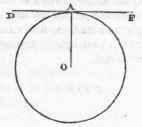
To draw a tangent to a given circle that shall pass through a given point, A.
From the centre O, Fig. 10, draw the radius O A. Through the point A, draw D F perpendicular to O A, and it will be the tangent required.
Fig. 8.
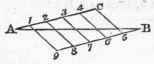
Fig. 9.
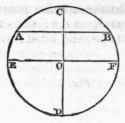
Fig. 10.
Continue to:


My Books

