


Geometry Problems. Part 4
Description
This section is from the book "The Engineer's And Mechanic's Encyclopaedia", by Luke Hebert. Also available from Amazon: Engineer's And Mechanic's Encyclopaedia.
Geometry Problems. Part 4
Problem XI
To draw a tangent to a circle, or any segment of a circle ABC through a given point B, without making use of the centre of the circle.
Take any two equal divisions upon the circle, Fig. 11, from the given point B towards d and e, and draw the chord e B. Upon B, as a centre, with the distance B d, describe the arc f d g, cutting the chord e B in /. Make d g equal to d f; through g draw g B, and it will be the tangent required.
Problem XII
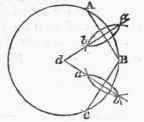
Given three points, A, B, C, not in a straight line, to describe c circle that shall pass through them.
Bisect the lines A B, BC, Fig. 12, by the perpendiculars a b, b a, meeting at d. Upon d, with the distance d A, d B, or d C, describe ABC, and it will be the required circle.
Fig. 11.
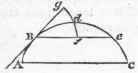
Fig. 12.
Problem XIII. To describe the segment of a circle to any length A B, and height C D.
Bisect AB, Fig. 13, by the perpendicular l) g, cutting A B in c. From c make c D, on the perpendicular, equal to C D. Draw A D, and bisect it by a perpendicular ef, cutting Dg in g. Upon g the centre, describe A D B, and it will be the required segment.
Fig. 13.
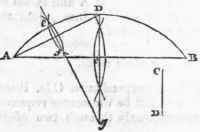
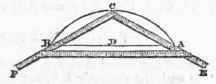
Fig. 14.
Problem XIV
To describe the segment of a circle by means of two rules, to any length A B, and perpendicular height C D, in the middle of A B, without making use of the centre.
Place the rules to the height at C, Fig. 14; bring the edges close to A and B; fix them together at C, and put another piece across them to keep them fast. Put in pins at A and B, then move the rulers round these pins, holding a pencil at the angular point C, which will describe the segment.
Problem XV
In any given triangle to inscribe a circle.
Bisect any two angles A and C, Fig. 15. with the lines A D and D C. From D, the point of intersection, let fall the perpendicular D E; it will be the radius of the circle required.
Problem XVI
In a given square, to describe a regular octagon.
Draw the diagonals A B and C D, Fig. 16, intersecting at e. Upon the points A, B, C, D, as centres, with a radius e C, describe the arcs he l, ken, meg,fe i. Join f n, mh, ki, Ig, and it will be the required octagon.
Problem XVII
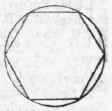
In a given circle, to describe any regular polygon.
Divide the circumference into as many parts as there are sides in the polygon to be drawn, and join the points of division. Or divide 360° by the given number of sides, and set off from the radius of the circle, an angle equal to the quotient, and its chord will be one side of the polygon, Fig. 17.
Fig. 15.
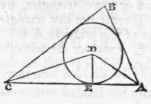
Fig. 16.
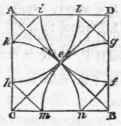
Fig. 17.
Continue to:


My Books

