


Geometry Problems. Part 5
Description
This section is from the book "The Engineer's And Mechanic's Encyclopaedia", by Luke Hebert. Also available from Amazon: Engineer's And Mechanic's Encyclopaedia.
Geometry Problems. Part 5
Problem XVIII
Upon a given straight line, A B, to form a polygon of any number of sides.
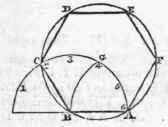
Produce the side A B to P, Fig. 18, and on A P from the centre B describe a semicircle A C P; divide the semicircumference A C P into as many equal parts as the number of sides intended; through the second division, from P, draw the line B C; bisect A B and P C by perpendiculars cutting each other in S; from S with the radius A S, B S, or C S, describe a circle A B C D E, then carry the side A B or B C round the remaining part of the arc, which will be found to contain the remaining sides of the number required. Fig. 18 is an example of a pentagon; we shall give in Fig. 19 an example of a hexagon, as in this figure we need not proceed by the general method: we have only to make a radius of the given side A B, and take the points A and B as centres; form the arcs A G and B G, and strike a circle with the radius G A or G B, which will contain the six sides.
Fig. 18.
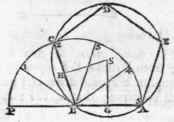
Fig. 19.
Problem XIX
Upon a given line A B, to construct an equilateral triangle.
Upon the points A and B, Fig. 20, with a radius equal to A B, describe arches cutting each other at C. Draw A C and B C, and A B C will be the triangle required.
Problem XX
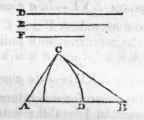
To make a triangle, whose sides shall be equal to three given lines D E F, any two of them being greater than the third.
Draw A B, Fig. 21, equal to the line D. Upon A, with the radius F, describe an arc C D. Upon B, with the radius E, describe another arc intersecting the former at C. Draw A C and C B, and A B C will be the triangle required.
Fig. 20.
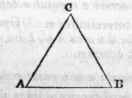
Fig. 21.
Problem XXI
To make a figure equal and similar to a given irregular figure, A BCD.
Divide the given figure as ABCD, Fig. 22, into two or more triangles, by the diagonal D B. Make E F equal to A B; upon E F construct the triangle E F H, whose sides shall be respectively equal to those of the triangle A B D, by the last problem. Upon H F, which is equal to D B, construct the triangle H F G, whose sides are respectively equal to D B C, then E F G H will be the figure required.
A figure having more than four sides must necessarily be divided into more than two triangles.
Problem XXII
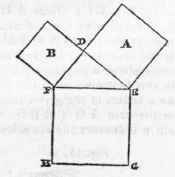
To make a square equal to two given squares.
Make the sides D E and D F, Fig 23, of the two given squares A and B, on opposite sides of the same straight lines, they will form the sides of a right-angled triangle F D E; draw the hypothenuse F E; on it describe the square EFGH, and it will be the square required.
Fig. 22.
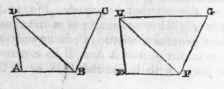
Fig. 23.
Continue to:


My Books

