


Hats. Continued
Description
This section is from the book "The Engineer's And Mechanic's Encyclopaedia", by Luke Hebert. Also available from Amazon: Engineer's And Mechanic's Encyclopaedia.
Hats. Continued
The beer grounds are applied in the inside of the crown to prevent the glue from coming through to the face, and also to give the requisite firmness, at a less expense than could be produced by glue alone. The glue stiffening is therefore applied after the beer grounds are dried, and then only upon the lower face of the brim and the inside of the crown. The dry hat, after this operation, is always rigid, and its figure irregular. The last dressing is given by application of moisture and heat, and the use of the brush, and a hot iron, as before mentioned, somewhat in the shape of that used by tailors, but shorter and broader on the face. The hat being softened by exposure to steam, is drawn upon a block, to which it is securely applied by the former method of forcing a string down from the crown to the commencement of the brim. The judgment of the workman is employed in moistening, brushing, and ironing the hat, in order to give and preserve the proper figure. Before the hat is quite finished, the brims are cut by a knife attached to a radius rod so as to describe a circle; the cut is not carried entirely through, so that one of the last operations consists in tearing off the redundant part, which, by that means, leaves an edging of beaver round the external face of the brim.
When the hat is thus finished, the crown is tied up in gauze paper, which is neatly ironed down, and it is then ready for the subsequent operations of lining, etc. for sale.
In that ably conducted work, Nicholsons Journal, Vol. IV. 4to, are several suggestions for effecting many of the foregoing operations by machinery. Amongst other subjects proposed for inquiry are the following: - whether carding, which is rapidly and mechanically done, be inferior to bowing; whether a succession of batts or carding might be thrown on a fluted cone, which rapidly revolving in contact with three or more cylinders, might perform the hardening and even the working with much more precision and speed than they are now done by hand; and whether blocking or shaping be not a process extremely well calculated for the operation of one or more machines. These ingenious suggestions have recently been in some measure acted upon.
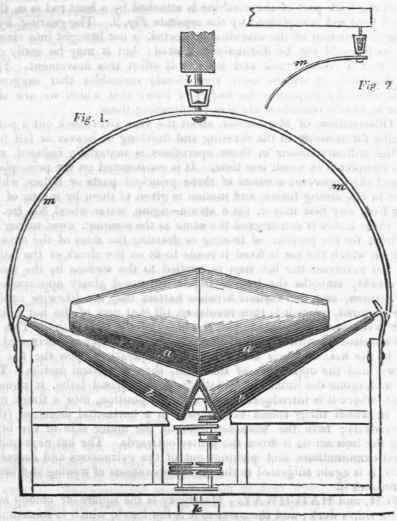
In 1826 Mr. G. Borradaile obtained a patent for an apparatus for the making or setting up of hat bodies, as it is termed, in which several cones or frustrums of cones are made to revolve upon their axes; and the frames in which these cones act being made to vibrate horizontally on a fixed pivot and swivel, the filaments of wool are caused to traverse each other diagonally, as they are wound upon a double cone, and by that means to produce a matted substance, which is afterwards to be wetted, shrunk, and felted together in the usual manner. The bodies of two hats, each of a conical figure, are thus made over the surface of a double cone, which are separated by cutting them along their middle or base line, and slipping them off at the end. a a in the diagram, represents this double conical block, and b b two conical rollers, of which there are two more on the opposite side of the machine, not seen in this view. The axes of these four rollers are placed in such an inclined position as to admit the double cone a a to bear equally upon them.
The two front cones b b have fixed upon their bases two bevelled toothed wheels, which gear into one another as shown; and rotary motion is given to both by the teeth of one of them taking into a bevelled tooth and pinion that revolves upon a vertical spindle, to which motion is communicated by a band and rigger. The large double cone a a, therefore, is made to revolve slowly by the friction of its surface against the four conical rollers underneath. The sliver of wool being conducted from the doffer of a carding engine, placed behind the machine, to the upper side of the double cone a a, and the cones b b being made to revolve as before described, causes the sliver of wool to be wound round the periphery of a a in an uniform layer. In order to give a diagonal crossing to the filaments, as they are wound upon the double cone, the machine is made to turn partly round horizontally upon the pivot k in front, and upon a swivel joint f at top, to which the back part of the machine is attached by a bent rod m m, the form of which bent rod is explained by the separate Fig. 2.
The gearing, by which the vibrating motion of the machine is effected, is not brought into view in the figure, as it could not be distinctly exhibited; but it may be easily comprehended that a rotary crank and lever will effect this movement. The plan above described, it will be seen, very closely resembles that suggested by Mr. Nicholson for preparing the bodies of hats; that which we are about to describe as nearly resembles his plan for finishing them.
Mr. Ollerenshaw, of Manchester, about the year 1824, took out a patent for a machine for assisting in the dressing and finishing of beaver or felt hats, by which the ordinary labour in those operations is materially reduced, and the work is completed in much less time. It is constructed on the principle of the lathe, and the apparatus consists of three principal parts or lathes, which are all fixed in one strong frame, and motion is given to them by means of a band passing from any first mover, (as a steam-engine, water-wheel, etc. etc.) The first of these lathes is constructed the same as the common wood-turner's lathe, and is used for the purpose of ironing or dressing the sides of the crown; the block upon which the hat is fixed is made to fit on the chuck of the lathe, and as the hat revolves, the hot iron is applied to the surface by the workman, which quickly smooths the hat, giving it the usual glossy appearance; the velvet cushion, and the various brushes hatters use, are likewise applied, as may be required, while it is thus revolving, till that part of the hat is finished, when it is removed and placed upon the block of the next lathe.
This second lathe is constructed with a vertical shaft, so as to produce a horizontal rotary motion to the hat, which is better suited for operating upon the flat part of the crown, and the upper side of the brim, than a vertical motion. The hat having undergone the usual manipulations in the second lathe, is removed to the third, where it is introduced, in an inverted position, into a frame made to receive it, which turns round very slowly in a horizontal direction (the axis being vertical); here the workmen smooth the under side of the brim, by drawing the iron across it from the centre outwards. The hat next undergoes the usual examinations, and pickings-out of the extraneous and coarse hairs; after this, it is again subjected to the former operations of ironing and brushing, which finishes it.
Continue to:


My Books

