


Silver. Part 4
Description
This section is from the book "American Library Edition Of Workshop Receipts", by Ernest Spon. Also available from Amazon: American Library Edition Of Workshop Receipts.
Silver. Part 4
Amalgamation is performed in a set of revolving barrels, one of which is shown in Fig. 160. It measures 2 ft. 8 in. long, and 2 ft. 8 in. and 2 ft. 10 in. in diameter at the ends and middle respectively; it is constructed of 31/2-in. pine, strengthened by iron hoops and binders, and is provided at one end with a toothed wheel a for receiving the rotary motion, and in the centre with a 5-in. plug-hole b by.


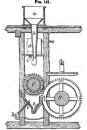
The prepared ore is placed in the hopper a, one of which is over each barrel, and provided with a wooden a cylinder of tin plate c; d are water-tanks supplied by pomps through means of pipes e; below each barrel f, which is caused to rotate by the cogs on the wheel g, it situated a triangular trough h for catching the matters discharged from the barrel. At starting, 3 cwt. of water is run into each barrel, then 10 cwt. of ore is let in through the spout i, and, in addition, 80 to 100 lb. wrought iron in fragments 1 in. square and 1/2 in. thick are introduced and periodically replaced as they become consumed by the chemical action which ensues in the barrels. The barrels being charged and their plugs secured, they are set to rotate, at the rateofl2 to 15 revolutions per minute, for 2 hours. The confute are then examined, and the consistence of the mass is adjusted by adding a, little water or ore as may be necessary; this done, 5 cwt. mercury is introduced, and the barrel is rotated again for 16 hours at 13 revolutions a minute, being twice examined, at intervals of 4 hours, as to the consistence of its contents, so as to ensure that the mercury is neither too much broken up by the mass being over thick, nor left at the bottom by its being too thin.
The chemical action generated within the barrel is evidenced by the increased temperature of its exterior. After 18 hours, the barret is ailed up with water, and set to rotate for 1} to 2 hours at 6 to 8 revolutions per minute, by which the mercury is separated from the other materials and collected in one mass; each barrel in succession is then thrown out of gear and stopped with its outlet upper most; a little pin in the centre of the plug is removed, and replaced by a tube attached to a length of small hose; the barrel is then turned with its outlet downwards, when the mercury escapes through the pin hole into the hose, and runs down the tube into a gutter i for collection and re-use. On the barrel being turned mouth upwards again, the large plug is withdrawn, and the barrel is turned over so that all the contents may escape into the gutter A, by which they flow to large underground tanks.
The nature of the changes which take place in the contents of the barrel, and the products resulting from them, may be summarized thus. The first 2 hours' agitation without mercury witnesses the reduction of the chlorides to protochlorides, the solution of the saline matters by the water, and the exposure of the particles of silver chloride. This last is decomposed by the constant and prolonged friction with the mercury and metallic iron, resulting in iron chloride and silver amalgam, with which latter are associated any copper or lead which would have simultaneously suffered reduction from their chlorides.
The mass run from the barrels to the underground tanks mentioned at the end of the last paragraph but one, is diluted with water, and kept in constant motion by revolving iron arms; outlets at various depths in the sides of the tanks allow the muddy waters to escape into settling-tanks, where the solid matters are deposited; these are examined for their yield of silver, and should this amount to 4 1/2 oz. per ton, they are dried, subjected to a second roasting with 15 or 16 Per cent. pyrites and 5 or S Per cent. salt, and the residues are sifted and amalgamated in the barrel for a rather shorter period than the bulk of the mass. The mercury which accumulates in the washing-tanks and settlers is periodically collected and treated separately from that run directly from the barrels, which treatment will be described presently. The barrel process of amalgamation entails a loss of about 5 to 10 per cent of the silver, and an expenditure of mercury equal to 1/6 to 1/4 of the weight of silver extracted.
(5) Krolinke's process has been successfully applied in Chili to silver ores containing complex sulphides rendering them unsuited to the patio process. The sulphides are decomposed by the employment of cuprous chloride, prepared by heating metallic copper with a solution of copper sulphate and common salt; and amalgamation is effected by mercury and zinc, agitated with Che ore in closed barrels, such as have just been described.
(6) Washos process-This was devised for treating the vast masses of comparatively poor argentiferous ores found in districts in Nevada, where labour, fuel, necessaries, and transport are too costly to admit of the adoption of any of the methods already described. The ore is divided into 3 classes, according to its character. The first class embraces all mineral assaying over 307. worth of metal per ton of 2000 lb., and in which the silver is intimately associated with antimony, arsenic, iron, and lead; the second class includes material affording 18l. to 30/. worth of metal; and the third class comprises all workable stuff of a lower value than 18l. per ton.
First-class ores are crushed dry, roasted with salt in reverberatury furnaces, and submitted to barrel amalgamation. The reverberatory furnaces are of the form shown in Fig. 162, and are built of common red brick; a is the hearth; b, stirring door; c, discharge door; d, grate; e, bridge; f, flues; g, ashpit; h, hopper. The charge consists of 1000 lb. ore mixed with 6 per cent. salt, the latter being added to the ore in the hopper. The charge is heated very gently at first, and the temperature is gradually increased towards the and, 6 hours being the usual duration of Touting; the charge is constantly stirred, and turned right oxer once or twice. The effect produced by the roasting with salt is, stated briefly, first the oxidation of the metallic compounds, converting the sulphides into sulphates, and next the decomposition of these sulphates by the ■alt, with consequent formation of metallic chlorides. Sometimes a little limestone is added to the charge, for the purpose of decomposing the copper end zinc chlorides, and thus in a measure preventing their subsequent amalgamation, along with the silver in the barrel. A furnace roasting 4 charges of 1000 lb. each in 24 hours consumes 1 cord of wood, and employs 2 men stirring on each 12-hoor shift.
Continue to:


My Books

