


Silver. Part 5
Description
This section is from the book "American Library Edition Of Workshop Receipts", by Ernest Spon. Also available from Amazon: American Library Edition Of Workshop Receipts.
Silver. Part 5
The rousted ore is passed through a screen with 1600 holes to the sq. in., to remove any caked lumps or coarse particles, and thence passes to the amalgamating barrels, which do not differ in any essential particular from those already described on pp. 413 - 4.

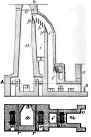
Often replaced by one recently introduced by Stetefeldt, the main feature of which consists in allowing the miiture of ore-powder and salt to meet an ascending current of hot air in a shaft, this plan obviating the need of so much labour for stirring the charge, and better ensuring its complete subjection to the action of the heat. The furnace (Fig. l63) consists essentially of a shaft a, about 20 ft. high and 3 to 4 ft. square at the base, where are situated 2 fireplaces e, whose products of combustion are led into the main shaft a, by short flues. On the top b of the shaft is placed an automatic feeding apparatus for regulating the admission of materials, with a damper c just beneath it; and somewhat lower down the shaft is a flue /, into which the heated gates pass around the triangular cast-iron Hue-bridges g. The cast-iron plates h impede the progress of any solid matters which may be mechanically suspended in the vapours, and cause such to fall into the well i, whence they can be discharged at k. The auxiliary fireplace ( provides additional heat in the flue f, and this prolongs the chemical action.
The chief portion of the ore in a roasted and "chloridized" (the metallic constituents converted into chlorides) state is withdrawn at the door d in the base of the shaft, while similar doors a allow of the removal of the deposit which accrues in the flue m and dust-chamber o; the draft through the whole furnace is produced by a chimney shaft about 60 ft. high, at the end of the dust-chamber. Common bricks are used in the construction, except for the fireplaces and arches; the walls are built double with spaces between; and the whole structure is tied by iron rails and {-in. rods. The dust-chamber may be roofed with iron plates, on which to dry the pulverized ore before roasting. The ore is first mired with salt on a drying floor, and stamped dry; then it is " elevated " to the hopper of the feeder at the top of the furnace, for continuous supply to the chloridizing shaft a. This last is maintained at as even a temperature as possible, and sufficiently high to keep at red heat the ore which collects at the bottom. A furnace worked by 8 men can chloridize as much ore as 10 rever-beratories employing 36 men, with a consumption of only 1/5 the quantity of fuel, and but 3 to 6 Per cent. of salt, while about 90 Per cent. of the silver present is converted into chloride.
The chief difficulty is in securing a regular and constant feed, owing to the liability of the ore to form cakes.
Fig. 163.
Second and third-class ores, which are often not distinguished from each other, are reserved for the Washoe or pan treatment. They pass through the usual crushing and stamping processes, employing extensive apparatus whose numerous and varied forms may be studied at length in Andre's 'Mining Machinery' and in Lock's 'Gold,' and are then ready for amalgamation in "pans." These latter vary considerably in detail of construction, as may be seen by reference to the works just quoted; but are alike in their general form and object. They consist essentially of circular vessels with cast-iron bottoms, and cast-iron or wooden walls, penetrated perpendicularly by a shaft which carries a rotating muller, and provided with a cast-iron false bottom. The pan is charged with ore and water in such proportions that the mixture is of suitable consistence, the muller being meanwhile raised; the mass is then heated to a temperature of 185° F. (85° C.) by the injection of free steam into the interior of the pan, and is maintained at this point in many cases by the use of a steam jacket; the muller is lowered by degrees, and rotated for about 2 hours, by which time the mass should have become a soft pulp; mercury (about 60 to 70 lb. for a charge of 1200 to 1500 lb. ore) is is then added by squeezing it through canvas so as to render it more easily disseminated, and the muller is rotated for another 2 or 3 hours, but at a distance from the bottom, so as to act 8 rather as a stirrer.
Sometimes small quantities of copper .sulphate and salt are introduced into the pan, but without any marked benefit resulting. When the treatment in the pan is regarded as complete, the mass is diluted by the addition of water through a flexible hose, and then run into a series of separators, settlers, or agitators, placed at a lower level, and designed to effect the separation of the amalgam and unamalgamated mercury from the worthless materials. These separators bear a general resemblance to the pans just described, but the muller is replaced by a set of revolving arms carrying wooden blades. Abundance of water is kept supplied to the apparatus while it is in motion, and this carries off the lighter valueless stuff through plug-holes situated at various levels in the side. The speed of the revolving stirrer and the quantity of water require to be nicely adjusted to suit the demands of the case, so as to completely draw off the waste matters and leave all the mercury and amalgam at the bottom. The waste tailings are run over blanket-tables and other contrivances for catching any stray particles of metal not eliminated by the separator.
The amalgam collected is treated as all others are done.
The chemistry of the Washoe process is summarized by Arnold Hague thus:-(1) The ore consists chiefly of native gold, native silver, and argentiferous sulphides, associated with varying proportions of blende and galena; (2) the action of the sodium chloride and copper sulphate in the pan produces copper chloride; (3) the presence of metallic iron causes formation of copper sub-chloride ; (4) both the copper chlorides assist in the reduction of the ore by chloridizing the silver sulphides and decomposing the lead and zinc sulphides; (5) copper sulphate enhances the amalgamating energy of the mercury, by causing the formation of a small quantity of copper amalgam, while it also tends to expel the lead; (6) notwithstanding the importance of chemical agents as just indicated, the quantities added to th pulp in the ordinary practice of Washoe milk are too small to effect any very beneficial results; (7) the mercury and iron, aided by heat and friction, are the principal agents concerned; (8) an essential condition for amalgamation is that the mercury be kept perfectly bright and pare; (9) the consumption of mercury in the Washoe process is chiefly mechanical, and only in a slight degree chemical.
Continue to:


My Books

