


Geometrical Constructions. Part 2
Description
This section is from the book "Scientific American Reference Book. A Manual for the Office, Household and Shop", by Albert A. Hopkins, A. Russell Bond. Also available from Amazon: Scientific American Reference Book.
Geometrical Constructions. Part 2
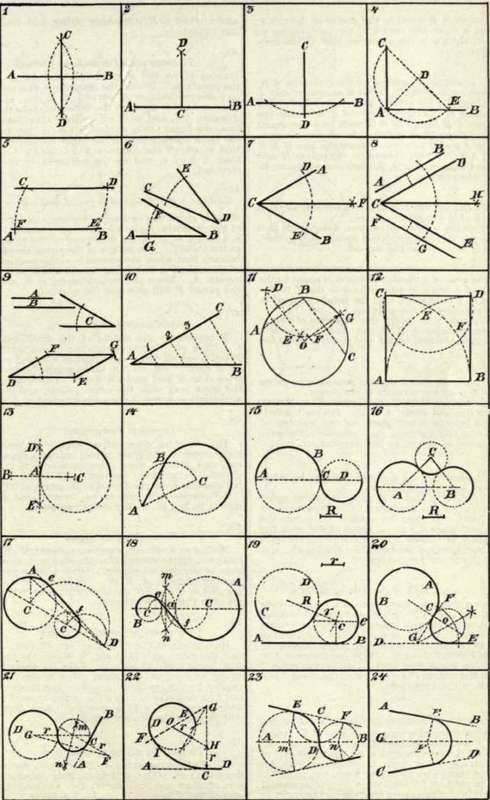
20.
To find the center and radius of a circle that will tangent the given circle A B at C, and the line D E.
Through the given point C, draw the tangent G F; bisect the angle F G E; then o is the center of the required circle that will tangent A B at C, and the line D E.
21.
To find the center and radius of a circle that will tangent the given line A B at C, and the circle D E.
Through the point C, draw the line E F at right angles to A B; set off from C the radius r of the given circle. Join G and F. With G and F as centers draw the arc crosses m and n. Join m n, and where it crosses the line E F is the center for the required circles.
22.
To find the center and radius of a circle that will tangent the given line A B at C, and the circle D E.
From C, erect the perpendicular C G; set off the given radius r from C to H. With H as a center and r as radius, draw the cross arcs on the circle. Through the cross arcs draw the line I G; then G is the center of the circle arc F I C, which tangents the line at C and the circle at F.
23.
Between two given lines, draw two circles that will tangent themselves and the lines.
Draw the center line A B between the given lines; assume D to be the tangenting point of the circles; draw D C at right angles to A B. With C as center and C D as radius, draw the circle E D F. From E, draw E m at right angles to E F; and from F draw F m at right angles to F E; then m and n are the centers for the required circles.
24.
Draw a circle that will tangent two given lines A B and C D inclined to one another and the one tangenting point E being given.
Draw the center line G F. From E, draw E F at right angles to A B; then F is the center of the circle required.
25.
Draw a circle that will tangent two lines and go through a given point C on the line F C, which bisects the angle of the lines.
Through C draw AB at right angles to C F; bisect the angles D A B and E B A, and the crossing on C F is the center of the required circle.
26.
To draw a cyma, or two circle arcs that, will tangent themselves, and two parallel lines at given points A and B.
Join A and B; divide A B into four equal parts and erect perpendiculars. Draw A m at right angles from A, and B n at right angles from B; then m and n are the centers of the circle arcs of the required cyma.
27.
To draw a talon, or two circle arcs, that will tangent themselves, and meet two parallel lines at right angles in the given points A and B.
Join A and B; divide A B into four equal parts and erect perpendiculars; then m and n are the centers of the circle arcs of the required talon.
28.
To plot out a circle arc without recourse to its center, but its chord A B and height h being given.
With the chord as radius, and A and B as centers, draw the dotted circle ares A C and B D. Through the point 0 draw the lines A O o and B O o, Make the arcs C o = A o and D o = B o. Divide these arcs into any desired number of equal parts, and number them as shown on the illustration. Join A and B with the divisions, and the crossings of equal numbers are points in the circle arc.
29.
To find the center and radius of a circle that will tangent the three sides of a triangle.
Bisect two of the angles in the triangle, and the crossing C is the center of the required circle.
30.
To inscribe an equilateral triangle in a circle.
With the radius of the circle and center C draw the arc D F E; with the same radius, and D and E as centers, set off the points A and B. Join A and B, B and C, C and A, which will be the required triangle.
31.
To inscribe a square in a given circle.
Draw the diameter A B, and through the center erect the perpendicular C D, and complete the square as shown in the illustration.
32.
To describe a square about a given circle.
Draw the diameters A B and C D at right angles to one another; with the radius of the circle, and A, B, C, and D as centers, draw the four dotted half circles which cross one another in the corners of the square, and thus complete the problem.
33.
To inscribe a pentagon in a given circle.
Draw the diameter A B, and from the center C erect the perpendicular C D. Bisect the radius A C at E; with E as center, and D E as radius, draw the arc D E, and the straight line D F is the length of the side of the pentagon.
34.
To construct a pentagon on a given line A B.
From B erect B C perpendicular to and half the length of A B; join A and C prolonged to D; with C as a center and C B as radius, draw the arc B D; then the chord B B is the radius of the circle circumscribing the pentagon. With A and B as centers, and B D as radius, draw the cross O in the center.
35.
To construct a pentagon on a given line A B without resort to its center.
From B erect B o perpendicular and equal to A B; with C as center and C o as radius, draw the arc D o; then A D is the diagonal of the pentagon. With A D as radius and A as center, draw the arc D E; and with E as center and A B as radius, finish the cross E, and thus complete the pentagon.
36.
To construct a hexagon in a given circle.
The radius of the circle is equal to the side of the hexagon.
37.
To construct a Heptagon.
The appotem a in a hexagon is the length of the side of the heptagon.
Set off A B equal to the radius of the circle; draw a from the center C at right angles to A B; then a is the required side of the heptagon.
38.
To construct an octagon on the given line A B.
Prolong A B to C. With B as center and A B as radius, draw the circle A F D E C; from B, draw B I at right angles to A B; divide the angles A B D and D B C each into two equal parts; then B E is one side of the octagon. With A and E as centers, draw the arcs H K E and A K I, which determine the points H and I, and thus complete the octagon as shown in the illustration.
Continue to:


My Books

