


Geometrical Constructions. Part 3
Description
This section is from the book "Scientific American Reference Book. A Manual for the Office, Household and Shop", by Albert A. Hopkins, A. Russell Bond. Also available from Amazon: Scientific American Reference Book.
Geometrical Constructions. Part 3
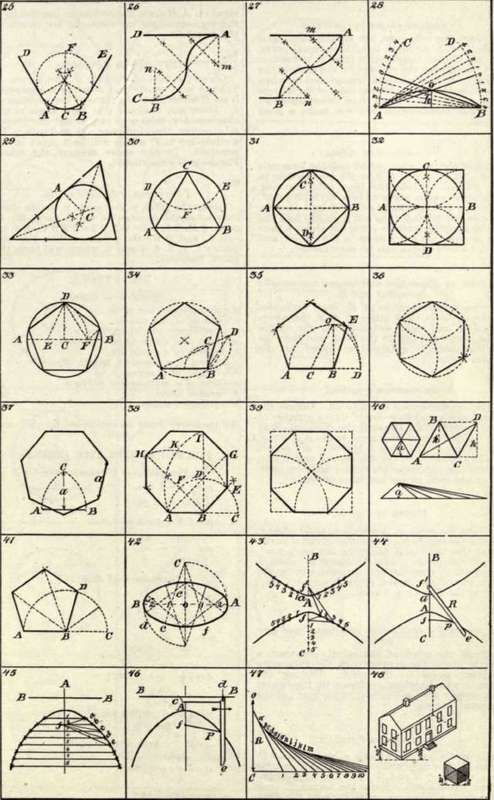
39.
To cut off the corners of a square, so as to make of it a regular octagon.
With the corners as centers, draw circle arcs through the center of the square to the side, which determines the cut-off.
40.
The area of a regular polygon is equal to the area of a triangle whose base is equal to the sum of all the sides, and the height a equal to the appotem of the polygon.
The reason of this is that the area of two or more triangles A B C and A D C having a common or equal base b and equal height h are alike.
41.
To construct any regular polygon on a given line A B without resort to its center.
Extend A B to C and, with B as center, draw the half circle A D B. Divide the half circle into as many parts as the number of sides in the polygon, and complete the construction as shown on the illustration.
42.
To construct an isometric ellipse by compasess and six circle arcs.
Divide O A and O B each into three equal parts; draw the quadrant A C. From C, draw the line C c through the point 1. Through the points 2 draw d e at an angle of 45° with the major axis. Then 2 is the center for the ends of the ellipse; e is the center for the arc d c; and C is the center for the arc c f.
43.
To construct a Hyperbola by plotting,
Having given the transverse axis B C, vertexes A a, and foci f f'. Set off any desired number of parts on the axis below the focus, and number them 1, 2, 3, 4, 5, etc. Take the distance a 1 as radius, and, with f' as center, strike the cross 1 with f' l = a l. With the distance A 1, and the focus f as center, strike the cross 1 with the radius F 1 = A 1, and the cross 1 is a point in the hyperbola.
44. To draw an Hyperbola by a pencil and a string,
Having given the transverse axis B C, foci f' and f, and the vertexes A and a. Take a rule and fix it to a string at e; fix the other end of the string at the focus f. The length of the string should be such that when the rule R is in the position f' C, the loop of the string should reach to A; then move the rule on the focus f', and a pencil at P, stretching string, will trace the hyperbola.
45.
To construct a Parabola by plotting.
Having given the axis, vertex, and focus of the parabola. Divide the transverse axis into any desired number of parts 1, 2, 3, etc., and draw ordinates through the divisions; take the distance A 1, and set it off on the 1st ordinate from the focus f to a, so that A 1 = f a. Repeat the same operation with the other ordinates - that is, set off the distance A 5 from f to e, so that A 5 = f e; and so the parabola is constructed.
46. To draw a Parabola with a pencil and a string,
Having given the two axes, vertex, and focus of the parabola. Take a square c d e, and fix to it a string at e; fix the other end of the string at the focus f. The length of the string should be such that when the square is in the position of the axis A f, the string should reach to the vertex A. Move the square along B B, and the pencil P will describe the parabola.
47.
Shield's anti-friction curve.
R represents the radius of the shaft, and C 1, 2, 3, etc., is the center line of the shaft. From o, set off the small distance o a; and set off a 1 = R. Set off the same small distance from a to b, and make b 2 = R. Continue in the same way with the other points, and the anti-friction curve is thus constructed.
48.
Isometric Perspective.
This kind of perspective admits of scale measurements the same as any ordinary drawing, and gives a clear representation of the object. It is easily learned. All horizontal rectangular lines are drawn at an angle of 30°.
All circles are ellipses of proportion, as shown in No. 42, on the following page.
49.
To construct an ellipse.
With a as a center, draw two concentric circles with diameters equal to the long and short axes of the desired ellipse. Draw from o any number of radii, A, B, etc. Draw a line B b' parallel to n and b b' parallel to m, then b is a point in the desired ellipse.
50.
To draw an ellipse with a string.
Having given the two axes, set off from c half the great axis at a and b, which are the two focuses of the ellipse. Take an endless string as long as the three sides in the triangle a b c, fix two pins or nails in the focuses, one in a and one in b, lay the string around a and b, stretch it with a pencil d, which then will describe the desired ellipse.
51.
To draw an ellipse by circle arcs.
Divide the long axis into three equal parts, draw the two circles, and where they intersect one another are the centers for the tangent arcs of the ellipse as shown by the figure.
52.
To draw an ellipse by circle arcs.
Given the two axes, set off the short axis from A to b, divide b into three equal parts, set off two of these parts from o towards c and c which are the centers for the ends of the ellipse. Make equilateral triangles on c c, when e e will be the centers for the sides of the ellipse. If the long axis is more than twice the short one, this construction will not make a good ellipse.
53.
To construct an ellipse.
Given the two axes, set off half the long axis from c to f f, which will be the two focuses in the ellipse. Divide the long axis into any number of parts, say a to be a division point. Take A a as radius and f as center and describe a circle arc about b, take a B as radius and f as center describe another circle arc about b, then the intersection 6 is a point in the ellipse, and so the whole ellipse can be constructed.
54.
To draw an ellipse that will tangent two parallel lines in A and B.
Draw a semicircle on A B, draw ordinates in the circle at right angle to A B, the corresponding and equal ordinates for the ellipse to be drawn parallel to the lines, and thus the elliptic curve is obtained as shown by the figure.
55.
To construct a cycloid.
The circumference C = 3.14 D. Divide the rolling circle and base line C into a number of equal parts, draw through the division point the ordinates and abscissas, make a a' = 1 d, b b' = 2'e, c c = 3 f, then a b' and c' are points in the cycloid. In the Epicycloid and Hypo-cycloid the abscissas are circles and the ordinates are radii to one common center.
56.
Evolute of a circle.
Given the pitch p, the angle v, and radius r. Divide the angle v into a number of equal parts, draw the radii and tangents for each part, divide the pitch p into an equal number of equal parts, then the first tangent will be one part, second two parts, third three parts, etc., and so the Evolute is traced.
57.
To construct a spiral with compasses and four centers.
Given the pitch of the spiral, construct a square about the center, with the four sides together equal to the pitch. Prolong the sides in one direction as shown by the figure, the corners are the centers for each arc of the external angles.
58.
To construct a Parabola.
Given the vertex A, axis x, and a point P. Draw A B at right angle to x, and B P parallel to x, divide A B and B P into an equal number of equal parts. From the vertex A draw lines to the divisions on B P, from the divisions on A B draw the ordinates parallel to x, the corresponding intersections are points in the parabola.
59.
To construct a Parabola.
Given the axis of ordinate B, and vertex A . Take A as a center and describe a semicircle from B which gives the focus of the parabola at f. Draw any ordinate y at right angle to the abscissa A x, take a as radius and the focus f as a center, then intersect the ordinate y, by a circle-arc in P which will be a point in the parabola. In the same manner the whole Parabola is constructed.
60.
To draw an arithmetic spiral.
Given the pitch p and angle v, divide them into an equal number of equal parts, say 6; make 0 1 = 0 1,02= 0 2,0 3 = 0 3, 0 4 = 0 4,0 5 = 0 5, and 0 6 = the pitch p; then join the points 1, 2, 3, 4, 5 and 6, which will form the spiral required.
The Circle. | |
Notation of Letters. | |
d = | diameter of the circle. |
r = | radius of the circle. |
p = | periphery or circumference. |
a = | area of a circle or part thereof. |
b = | length of a circle arc. |
c = | chord of a segment, length of. |
h = | height of a segment. |
s = | side of a rectangular polygon |
v = | center angle. |
w = | polygon angle. |
All measures must be expressed by the same unit.
Continue to:


My Books

