


Hydrometry
Description
This section is from the book "Alcohol, Its Production, Properties, Chemistry, And Industrial Applications", by Charles Simmonds. Also available from Amazon: Alcohol: Its Production, Properties, Chemistry, And Industrial Applications.
Hydrometry
Various rough-and-ready methods for trying the strength of "aqua vitae" were practised in bygone times. The property of inflammability was early made use of for this purpose. A piece of cloth was moistened with the spirit, and a lighted taper applied; if the cloth ignited the spirit was aqua vitae rectificata, or strong spirit. Another test was made by pouring oil into the spirit; if the latter were strong it formed a layer on the surface of the oil; if weak, it rested beneath the oil. Basil Valentine, in the fifteenth century, judged the strength of aqua vitae by igniting a certain volume of it; if the whole burned away, it was pure spirit; if more than half burned off, the spirit was strong; if less than half, it was weak. The well-known gunpowder proof test was applied by moistening a little gunpowder with the spirit and applying a light; rapid combustion implied "high proof" spirit; failure to burn, or burning only with difficulty, indicated weak or under proof spirit. The formation of bubbles or "beads" when the spirit was shaken in a glass vessel, and the length of time during which the bubbles persisted, gave to a practised observera a rough idea of the strength of a spirit, and is a test sometimes used for this purpose even at the present time.
With the inereasing importance of spirit taxation, however, the need for more satisfactory methods of evaluation became more and more apparent. Towards the close of the seventeenth century a good deal of attention was given to the question of obtaining a form of "areometer" or hydrometer suitable for testing spirits, as the use of this instrument appeared to promise a method easy of application and accurate in results. Robert Boyle, in his studies upon the properties of fluids, appears to have been the first to apply the principle of the hydrometer to the testing of distilled liquors, and a description of his instrument (" Boyle's Bubble ") appears in the Philosophical Transactions of the Royal Society for 1675. Pepys, however, mentions having seen the instrument, "a glass bubble to try the strength of spirits with," some eight years earlier.
Boyle's hydrometer, like all hydrometers, was an application of the famous principle of Archimedes - a body immersed in a liquid loses a part of its weight equal to the weight of the displaced liquid. It'was composed of two glass bulbs surmounted by a glass stem; the lower and smaller bulb contained mercury, the larger contained water; these liquids served as ballast to maintain the instrument erect when in use. Placed in water, it sank only so far as to cover the bulbs, leaving the whole of the stem exposed. Placed in strong spirit, it sank till only the top of the stem was uncovered. Placed in mixtures of spirit and water, it sank to intermediate positions depending on the proportions of the two ingredients. The larger the proportion of spirit, the deeper the "bubble" sank.
Later, the stem of the areometer was roughly graduated by means of "small bits of glass, of different colours, stuck on the outside" (Phil. Trans., 1730), or it was marked off into degrees by lines; also forms of the instrument were introduced with an attachment at the base on which different weights could be hung or screwed. These weights gave the hydrometer a greater range in use, since they allowed of the total mass of the instrument being varied. One form of hydrometer - Clarke's - used in the Excise about the year 1761, was provided with special "weather weights" for use when the weather was "hot," "warm," "cold," and so on, thus introducing a rough correction for variations of specific gravity due to changes in temperature. This hydrometer, moreover, was made of copper, instead of glass, wood, or ivory as in the earlier forms. There were three marks on the stem, one showing " proof " strength, the others one-tenth under proof and one-tenth over proof respectively (i.e., 10 per cent. over or under proof). Clarke's methods, however, eventually became very cumbersome with their unwieldy notation and their multiplicity of weights to meet different requirements, and in 1816-18 they were superseded by the Sikes's system, which is still employed for fiscal purposes in the United Kingdom. On account of the importance of Sikes's method of assaying spirits it must be 'described at a little length.
For some years previously there had been dissatisfaction with the processes in use for determining the amount of duty payable on spirits, and the Government of the day had applied to the Royal Society for assistance in the matter. The Secretary of the Society, Dr. Chas. Blagden, assisted in arranging experiments for the elucidation of the question, and in 1790 presented a first " Report on the best method of proportioning the Excise on Spirituous Liquors."1 It was recognised that ' no method can be accurate except one based upon specific gravities," and the experiments consequently took the form of determining, as accurately as possible and at a number of different temperatures, the specific gravities of a long series of mixtures containing known weights of " alcohol ' and water. Dr. Dollfuss, a Swiss chemist then in London, began the experiments; but he being called away, the work was entrusted to George Gilpin, the clerk to the Society, who in 1794 presented the results in a set of "Tables for Reducing the Quantities by Weight, in any mixture of pure Spirit and Water, to those by Measure; and for Determining the Proportion, by Measure, of each of the two
1 Phil Trans.. 1790, 80, 321.
Substances in such Mixtures."1 These tables of Gilpin's were constructed with great care, and are notable as being the first alcohol tables of reasonable accuracy and comprehensiveness. The "alcohol" taken as basis had the specific gravity at 60° F./600 F. of 0.82514, which would contain 88.974 per cent. by weight of absolute alcohol.
Gilpin's alcohol tables and Blagden's reports upon them had been published some years when, in 1802, improved hydrometers and methods of spirit assaying were inquired for by the Treasury, who appointed a scientific committee to adjudicate upon the proposals submitted. They selected the instrument and tables tendered by Bartholomew Sikes - who is believed to have been at one time a Secretary of Excise. It is reasonable to expect that in constructing his tables Sikes would avail himself of Gilpin's results, though this does not appear to be known for certain.
Sikes's hydrometer consists of a gilded brass bulb, 15 inches in diameter, to the bottom of which is affixed a short, tapering rod ending in a pear-shaped counterpoise, whilst on the top is a thin stem of rectangular section, 3 5 inches long, marked off into 10 equidistant spaces or " degrees." Each degree is sub-divided into fifths. The degrees are marked from 0 to 10, beginning at the top of the stem, and are of arbitrary value - that is, they do not by themselves express the strength of the spirit or its specific gravity, but are correlated with the tables supplied with the instrument. The readings on the stem are called the "Indication," and corresponding with each indication-number the tables show the strength of the spirit tested, in terms of "proof," "over proof," or "under proof." With its 10 divisions, each having 5 sub-divisions, the instrument gives 50 indication-numbers, namely 0, 0 2, 0 4, 0 6, and so on up to 10.0. At the temperature 60° F., these indications correspond with strengths of spirit from 67.0 over proof down to
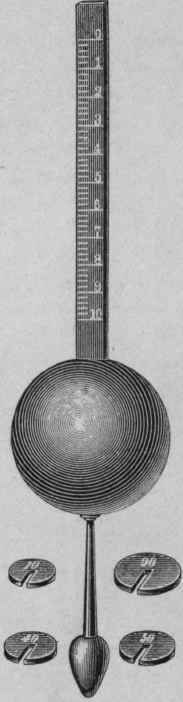
Fig. 34. - sikes's hydrometer.
With four of the weights
1 Phil. Trans., 1794, 84, pt. 2, XX.
58.2 over proof. For lower strengths than these the instrument is too light: it will not sink in the weaker, and therefore heavier, alcohol. To meet this difficulty, weights are employed, which rest on the counterpoise when in use, and are therefore immersed in the liquid tested. Nine such weights are provided, numbered 10, 20, 30, and so on, up to 90. Their volumes and masses are so related to those of the hydrometer that they furnish a continuous series of indication-numbers, aggregating 500 for the whole range, and allowing of the instrument being used for the determination of alcoholic strengths ranging from 70 over proof down to nil.
In addition to the nine weights, a brass cap is supplied which fits on to the top of the stem of the hydrometer. The weight of this cap is exactly one-twelfth of that shown by the instrument and the weight No. 60 taken together. If this cap is placed on the instrument, together with the weight 60, it will sink the hydrometer in distilled water at 51° F. down to a certain mark on the stem at the division 0.8 - that is, the "indication" shown is 60.8. This mark is called the "proof mark." If the cap is removed, and the instrument with weight 60 placed in proof spirit at 51° F., the indication will be found as before - viz., 60.8, As the same volume of liquid is displaced in the two experiments, but the weight supported in the second case is only 12/13ths of that in the first, it follows that the density of the proof spirit at 51° F. is 12/13ths of that of water at the same temperature.
The ordinary Sikes's hydrometer cannot be used with very strong spirits - e.g., those of strength upwards of 70 o.p. (= 96.95 per cent, of alcohol by volume). It has therefore been supplemented.by a smaller instrument of similar design, known as the "light hydrometer ' or the ' A ' instrument. This extends the range up to 73.5 o.p. at 60° F., corresponding with 98.94 per cent. of alcohol by volume, and up to 74.0 o.p. at 30° F.
Continue to:


My Books

