


French Embroidery
Description
This section is from "Every Woman's Encyclopaedia". Also available from Amazon: Every Woman's Encyclopaedia.
French Embroidery
In writing about the revival of needlecraft, it is unnecessary to mention France, for where there has been no decadence there is no need of revival. The nimble fingers of the French embroideress have never flagged, nor have they been employed on unworthy subjects. The purity and fineness of French taste rejected all the Berlin horrors, or, with inimitable acuteness and judgment, took what was inoffensive to good taste, rejecting all that was base.
Needlecraft is so important a handmaid of the arts, and holds such a prominent place in the social life of every country, that it is impossible to imagine beauty, comfort, and refinement in our lives without it. All that may be called a woman's most intimate possessions are beautified by needlework, and the more gentle and womanly we are, the more do we delight in dainty stitchery; it is the ultimate expression of woman's taste and refinement, costing nothing but time, love, and thought.
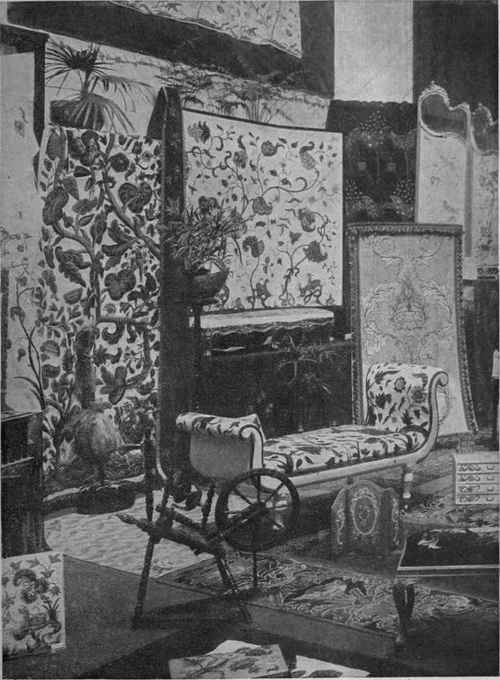
A group of hangings and furniture decorated with embroidery by the Royal School of Art Needlework
The writer recently examined some trousseau lingerie, such a tiny assemblage of garments, made of fine but very inexpensive materials; but the owner had embroidered "gentlewoman" all over them in the dainty knots and garlands, initials and borderings; they could never have been mistaken for the possessions of anyone but a lady born and bred. A shillingsworth of cottons and embroidery silks had done it all. but the result was fit for a queen.
One of the most important factors in the revival of needlework in England was the founding of the Royal School of Art Needlework in 1872, under the presidency of her Royal Highness Princess Christian. Not only did the Princess
Needlework give her name, but, what was of very high value, her active help and cooperation, and this is continued to the present day.
We quote from the words of a member of the council. The School of Art Needlework was founded " with the object of reviving what was at that time an almost lost art, and, at the same time, to find employment for women of the better class in reduced circumstances who had sufficient capacity to enable them to support themselves if given a fair chance in a world where the motto is ' every man for himself.' "
That the moment was ripe for such an institution is proved by the immediate success of the school, and the fact that three times it has been moved to larger premises in order to accommodate the large number of exhibits, the special exhibitions which are part of the policy of the school, and the large training school for embroideresses who desire to become professional or skilled amateur workers, receiving as thorough a training in every branch of needlework as is obtainable.
Numerous offshoots of the school in all parts of the British Isles, and also in America, now flourish and help to disseminate the sound traditions of the Royal School.
Gentlewomen of high birth were not slow to avail themselves of the training which enabled them to carry on the traditions of their ancestors in the execution of fine needlework. Perhaps one of the most skilful amateur embroideresses is Lady Carew, who, with her sister, Lady Clifford Cory, has made a very permanant contribution to the modern embroideries which emphasise this wonderful revival.
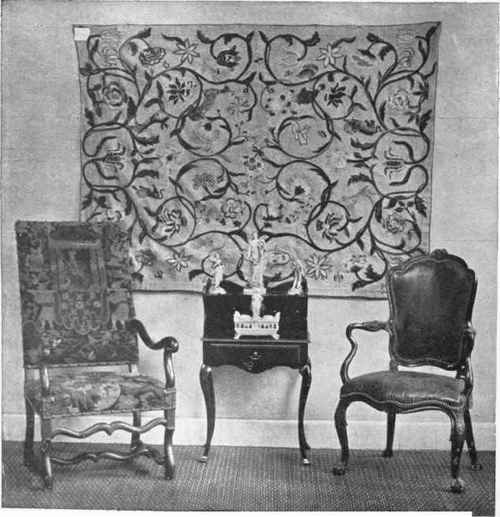
Chair-cover worked in coloured crewel wools, and bedspread (Royal School of Art Needlework)
Both at her house at Belgrave Square and also at Castle Boro in County Wexford are to be seen immense panels in needlework, some measuring 11 feet by 5 feet. At her Irish home there are no fewer than 130 of these huge embroideries in the drawing-room, and eight more in the stately old stone hall; while chair-seats, screens, cushions, and other fine examples of needlework, mostly in early English style, abound.
The patience and industry required for such labours is immense, and the fact that but recently Lady Cory had a five-hours' lesson on one stitch alone shows that, however expert an enthusiastic worker may be, she delights in perfecting herself in this exacting art of the needle.
Lady Viola Talbot is also one of the clever needlewomen in society. Her special delight is in filet lace, and she prides herself on being self taught. She inherits much of her skill from her great-grandmother, who was a marvellous needlewoman.
Broderie anglaise and other white cut-works appeal to her, and, eschewing the allurements of coloured silks and wools, she devotes herself to the dainty darning and white work.
The daughters of the gifted Duchess of Rutland are excellent needlewomen, and have contributed much to the revival of fine needlework.
It is natural that with an artist-mother, Lady Mar-jorie Manners should always design her own needlework, and whether we examine a sachet of green linen embroidered in ribbon work and gold thread, or a bedspread with garlands of fruit and flowers, one traces the restrained beauty of design which is only a-chieved with sound artistic training and inherited talent.
There are other influences at work which have assisted enormously in this great revival. These will be treated on another occasion.
Continue to:


My Books

