


Needlework - A First Lesson In Crochet
Description
This section is from "Every Woman's Encyclopaedia". Also available from Amazon: Every Woman's Encyclopaedia.
Needlework - A First Lesson In Crochet
Choice of Cotton - Hook or Needle - First Stitches - Chain Stitch - Single Crochet - Double Crochet-treble - Hairpin Work
Crochet dates from the sixteenth century. About 1840 it became fashionable in England, and has ever since been one of the most popular kinds of work. All the elementary details for crochet are dealt with in this article.
Choice of Cotton. - It varies in number from 000 to 60 - that is, from very coarse to very fine; 26, 28, 30 are useful for ordinary purposes, and 36, 40, 50, and 60 for very fine work.
Choice of Hook or Needle. - Choose a smooth one, and select it according to the thickness of the cotton. Hooks vary by half sizes, from 1 to 6, 4 1/2 being a good medium size, price Id. or 2d.
Method of Holding the Work. - When working, hold the hook lightly in the right hand in a horizontal position, and with the left hand grasp the work and hold the last stitch between the thumb and forefinger. Put the cotton over first and second fingers, under the third, and over the little finger of the left hand (see illustration). Remember it is dangerous to carry hooks about without a holder
To Make a Very Simple and Pretty Hook-protector. - Cover two medium-sized corks with a piece of silk, and work over them with different coloured crewel silks. French knots and feather stitching look well.
On the top of corks - sew round and round fine silk cord, and leave a strand between a trifle longer than the crochet hook. Place the hook into centre of corks, and the cord keeps it in place.
Method of Making a Chain Stitch (Fig. 1). - Make a slip-knot (see sketch), put needle through it, and cotton over hook, and draw it through loop on needle, and proceed in this manner for length of chain required.
First Stitches (Fig. 2). 7 - A foundation of chain is necessary for working all the stitches in to form the pattern.
Double Foundation (Fig. 3). - This is a row of chain and single crochet worked into it - viz., put the hook into a foundation stitch and draw the cotton through it, and the loop on needle at the same time.
Cord Founda-tion Worked with Two Threads (Fig. 4). - Make a slip-knot, put hock through it. Do the same with another length of cotton, and put hook through it (two loops on needle), and draw through both loops with the cotton on the left-hand side; then make one chain with the cotton on the right-hand side and one with the cotton on the left-hand side, and continue this alternately. Draw the cotton tightly after each stitch. Note. - This, if worked in black silk, makes a nice thick cord for eyeglasses or for draw-strings for work-bags, etc.

Fig. 2

Fig. 1

Fig. 3
Single Crochet (Fig. 5). - Put the hook through a foundation stitch, draw the cotton through it, and through the loop on hook at the same time. Double Crochet (Fig. 6). - Put the hook through a foundation stitch, draw the cotton through, put cotton over -needle, and draw it through both loops together.
Half Treble (Fig. 7). - Cotton over hook, put hook through foundation stitch, draw it through; cotton again over hook and draw it through all three loops together.
Treble (Fig. 8). - Co t t o n over hook, put hook into foun-d a t i o n stitch, draw cotton through
(three loops on needle), cotton over hook, and draw it through two loops; cotton again over hook and draw it through the last two loops. Double Treble (Fig. 9). - Cotton twice over hook; put hook through foundation stitch, draw cotton through, then cotton over and draw it through two loops; cotton over, draw it through two more loops, cotton over, and draw it through the last two loops.
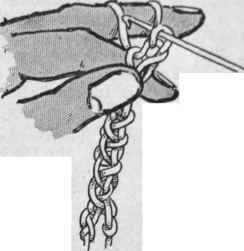
Fig. 4

Fig. 5

Fig. 6

Fig. 7

Fig. 8
Treble Treble. - Work this in the same way as a double treble, only put the cotton over the needle three times at the commencement instead of twice.
Double and Treble (Fig. 10). - The 1st and 2nd rows are of double crochet; 3rd row 4 doubles, then 3 trebles into the 1st row (see sketch); repeat throughout row; 4th and 5th rows the same as 1st and 2nd. 6th row the same as 3rd row, but work the 3 trebles into the 3rd row to commence with, as this alternates the pattern. Repeat from 1st row.
Note. - In turning, do one chain.
More Advanced Stitches French Knots on Crochet Patterns. - Make six trebles into a stitch of former row; remove hook, place it through back loop of 1st treble, and draw loop of 6th treble through it.
A Solomon's Knot (Fig. 11). - Make an ordinary chain stitch; draw it out loosely on hook, and make a double crochet into the back part of the stitch.
To Form Them into a Group (as will be given later in fancy patterns). - Start by making two Solomon's knots, then put the crochet hook into the first knot made, and draw the cotton through into a long loop, and * make another Solomon's knot; put cotton over hook and draw it through the loops on hook. Make another Solomon's knot, then put hook into the centre of next knot on the left-hand side, and draw a long loop through, and continue from*.
A Picot. - Make a certain number of chain (say five or six) and then a double crochet into the first or second stitch from hook, and this will make a small tight loop; then do one or two chain (according to whether the first or second stitch is worked into) into the next stitch on the crochet foundation. These small loops are often seen on the last round of a pattern.
Hairpin Work (Fig. 12). - This is used in many patterns. To make it, form a slip loop, pass it over one side of the large " hair " pin (price 1d.), turn pin round, and there is a loop on each side. Draw up a loop through the first loop, make one chain *; remove the hook, then turn, and put the hook in the loop from which it was removed, then make one double crochet under the left-hand loop. Repeat from *. Note. - If a broader ridge in centre is required, work two* double crochet (see illustration).
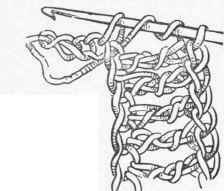
Fig. 9
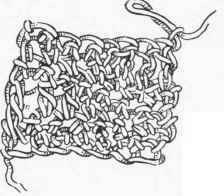
Fig. 10

Fig. 11
Fringes. - To make these, use a piece of cardboard the depth required for the fringe, Work from left to right. Make a slipknot, insert hook, and hold in position at top edge of card.* Place the cotton over the hook round the front of card, then up at the back of card, and with hook draw the thread under the front thread and make a double crochet stitch to keep it in place; continue * until the fringe is the required length.
On the top of fringe work a small edging of some kind. Picots form a good one - viz., five chain and a double crochet into the first stitch, and continue to work a picot into every other stitch all along.
After the cardboard is removed it is a matter of taste whether the loops are cut or left double. This kind of fringe is specially useful for toilet mats and covers and for edging bedroom towels.
Note. - In doing double crochet, directions usually say whether it is better to crochet through the front thread, back thread, or through both threads together. In each case the patterns produced are different.
In finishing off crochet, draw the cotton thread, or wool, through the loop and pull firmly, then thread the strand through a needle and darn it in and out through the work, making it quite secure and neat.
Very useful garments and beautiful patterns can be made out of two or three different kinds of stitches when these are well understood and grouped together properly.
In the case of lace and insertion and doyleys, fancy braids can be introduced, and greatly improve their appearance. They are bought by the dozen yards either on a card or in skein form, and vary in price from 2 1/2d. to 6 1/2d.
It is extremely important to keep these braids clean and flat, for crochet work should not need washing before it is used. For this reason the braid should be well matched with the cotton and too blue a shade rejected, while a yellowish braid should on no account be chosen, as it shows up badly against the white cotton, and a yellow shade cannot always be removed with washing. The flatness of the braid is a great assistance in working smoothly.

Fig. 12
Continue to:


My Books

