


Occupations For Women. No. 3. The Nursery Nurse - Queen Alexandra's Imperial Military Nurses
Description
This section is from "Every Woman's Encyclopaedia". Also available from Amazon: Every Woman's Encyclopaedia.
Occupations For Women. No. 3. The Nursery Nurse - Queen Alexandra's Imperial Military Nurses
Author of " Every Way of Earning a Living," " Our Sons and Daughters," etc.
The nursery nurse occupies a position of the greatest importance in English home life, practically the whole responsibility for the upbringing of children falling upon her shoulders. Not only does she bathe, dress, and feed the little denizens of the nursery, but she teaches them how to behave, shows them their proper outlook upon life, and generally acts the part of a foster-mother to them. It follows, therefore, that a young Woman who desires to become a nursery nurse should have training that will fit her for her work, as well as infinite tact added to a patient temperament, and a sound, healthy constitution. The latter, it should be made clear at once, is absolutely essential, for a nurse finds her charges frequently very trying, and unless her constitution be a sound one her health will soon suffer from the strain.
Training for this calling may be obtained in one of two ways, either by entering a training establishment such as the Norland Institute or the Princess Christian College, or by obtaining a situation Whilst between fifteen and seventeen years of age as a nursery maid under a good head nurse.
The latter is the simplest, and, of course, possesses the great advantage of being inexpensive. All a girl has to do is to put her name down at a registry office, or reply to advertisements in the " Morning Post." In due course she will find an opening, where she will start Working hard in the nursery at a wage of about £12, or perhaps less, per annum.
At the Norland Institute (Address: The Principal, the Norland Institute,10, Pem-bridge Square, London, \V.) the scheme of training extends over a period of one year, the time being divided in the following manner:
About twelve Weeks in the institute.
Thirteen Weeks in a children's hospital.
Two Weeks' holiday.
Ten Weeks' return to the institute.
Four weeks' holiday.
Ten weeks in the practising nurseries.
The course of study in the first twelve Weeks comprises instruction in the following subjects:
Domestic work (including the simple branches of cookery, laundry-work, and housewifery, the knowledge being acquired by actual work).
Needlework (making and mending chilwoman's Work drcn's garments, cutting out, dressmaking for little children).
Hygiene and nursery management (care and management of infants and young children, simple remedies, nursery diet).
Hospital teaching (enables probationers to acquire a knowledge of how to manage sick, convalescent, or incurable children).
After the hospital work, the student takes a fortnight's holiday, and on returning to the Norland Institute she receives Frcebelian Instruction as follows:
Frcebelian occupations and methods.
Nature study and brush-work.
Principles and art of education.
The care and management of little children.
Needlework.
The above instruction is followed by tour weeks' holiday, after which the probationer enters the Norland Nurseries, where her training is completed by practical work, a nurse, assisted by a probationer, acting as under-nurse, managing a model day and night nursery containing, as a rule, three children.
On completion of training, as outlined above, probationers over twenty-one who have attained the standard of proficiency required by the authorities of the institute will be provided, if required, with situations at salaries varying from £26 to £30 per annum. Those under twenty-one and those not- quite so well qualified are found situations at salaries from £20 to £24.
The certificate of the institute is awarded for general proficiency on condition that the testimonial for each period of training is satisfactory and the probationer has completed six months' satisfactory work in a family.
The fees payable for complete training at the Norland Institute amount to £80, payable as follows: £30 on entrance,£20 at the end of the first three months, £20 on return to the institute, and £10 on entering the nurseries.
Princess Christian College
The Princess Christian College (Address: 19, Wilmslow Road, Withington, Manchester) is another first-class training college, established under the presidency of H.r.h. Princess Christian, to meet the increasing demand for ladies as children's nurses, and to provide the necessary training for a career which is so eminently suited for educated women who have a natural sympathy with young children.
The fees are sixty guineas, payable in two instalments of thirty guineas each, the first before the commencement of the training, and the second within fifteen weeks afterwards. The instruction consists of two terms of fifteen weeks each. Practical training is afforded by the residence in the college of several children under six years of age, as well as young infants.
The subjects taught include general rules of health, first aid and home unrsing, infant feeding, nursery management, domes-tic work, nursery laundry-work, nursery cooking, needlework, Kindergarten games, drilling, etc.
Students are not admitted under twenty years of age, and the commencing salary required by the college for a certificated Princess Christian nurse is, as a rule, £30 per annum. After obtaining her " nurse's certificate," the nurse finds her own posts, and arranges her salary with and receives it direct from her employer. Posts are to be obtained with salaries of £40 and £50 per annum and upwards.
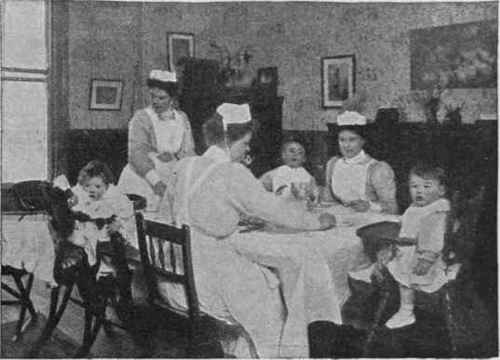
A day nursery - Princess Christian College, Manchester
How to Become a Queen Alexandra's Imperial Military
Nurse
The woman who aspires to become a Queen Alexandra's Imperial Military Nurse musthave served at least three years in a civil hospital of not less than one hundred beds. If she possesses this qualification the candidate should write to the War Office, Whitehall, S.w., making application.
She will then be required to satisfy a subcommittee of the nursing board that she is fit, socially, professionally, and physically, for the post she seeks.
A candidate for appointment as staff nurse must be from twenty-five to thirty-five years of age.
Any nurse may expect to be drafted to foreign stations. Egypt, Gibraltar, Malta, South Africa, and -Hong-Kong are all places to which she may be sent.
Her period, therefore, of service abroad is, as a rule, limited to from three to five years, and this part of her career should prove very pleasant, especially if she comes of a military family or has male relations in the Service. By the by, she herself takes rank as being "in the Service."
If a woman is accepted for service as a staff nurse, she is appointed provisionally for
Woman's Work six months. If at the end of that time her conduct has been satisfactory, she will be placed on the establishment. She will thus become a unit of the nursing service of our Army.
Rates Of Pay
Imperial military nurses are much better paid than nurses in hospitals and institutions. The pay of a staff nurse commences at £40 per year, rising by £2 10s. per year to £45. As well as her pay, she receives £39 per year for board and washing, £8 for uniform, £11 3s. for fuel and light (when these are not provided), and £41 is. 3d. for her lodging (when quarters are not provided). So her total receipts for her first year may reach £139 4s. 3d., but it is no use to look upon the last two items as a cash asset, because it is highly probable that fuel, light, and lodging will be provided for her. Thus, if these were provided, she could count upon receiving in actual cash £87per year.
Sisters in this branch of the service begin at £50 per annum, and rise by annual increments of £5 to £65. They also receive precisely the same allowances as staff nurses. When a sister is promoted and becomes a matron, her pay will begin at £75, and will use by annual increments of /io until £150 is reached, but her allowances will not be increased.
A principal matron is paid £175, with annual increments of £10 to £205, and her allowances remain as before, save that her fire, light, and lodging allowances are £16 4s. 3d. and £54 15s. respectively.
The matron-in-chief starts at £305 per year, and rises by £15 annually to £350. She has for board and Washing allowance 39, for fuel and light £22 5s. iod., and for lodging £73.
In addition, a matron or sister, if in charge of 300 beds or more, is granted 30 per year; if in charge of 200 or more, £25 per year; if in charge of 100 or more, £15 per year.
Pensions, again, are very liberal. They are calculated on the rate of pay at retirement as follows:
After ten years' service, 30 per cent, of such rate of pay, with 2 per cent, extra for each year of service over ten, up to a maximum of 70 per cent.
Women are bound to retire at the age of fifty-five. Pensions are granted after ten years' service if a nurse is rendered unfit for hospital duty through illness or injury.
Holidays
The matron-in-chief, principal matrons, and matrons are allowed six weeks annually, a sister five weeks, a staff nurse four weeks. All these holidays are on full pay. If a womanis serving on a foreign station she can, whatever her grade, accumulate her leave, but not for a period exceeding three years.
Enough now has been said to show that this is a very desirable branch of the nursing profession. It is the goal of many a nurse's ambition. It is not easy work, but there is a great deal about it that is pleasant. Girls who love travelling, and who could not otherwise indulge their fancy, have in this way facilities offered them, and a large number of gentlewomen take up this particular form of nursing because the social position of a Queen Alexandra's Imperial Nurse is certainly a good one.
Navy Nurses
The Navy has its special nurses. These, like Army nurses, must have served for three years in a general hospital and have taken their certificates. The age in the Navy, is twenty-five to forty-eight. Women who wish to serve in this branch must apply by letter to the Admiralty Medical Department.
The Navy has similar grades to the Army, but the pay differs slightly. Sisters, receive from £30 to £50 per annum, with increments of £2; head sisters receive, at Chatham, £40 to £60: at Plymouth, 105.to £130; at Haslar, 125 to £160, with annual increments of 5. All are eligible, for pension, and all charges for food, laundry, etc., are met by the Government. A uniform is provided. The nurses have good quarters and an excellent library.
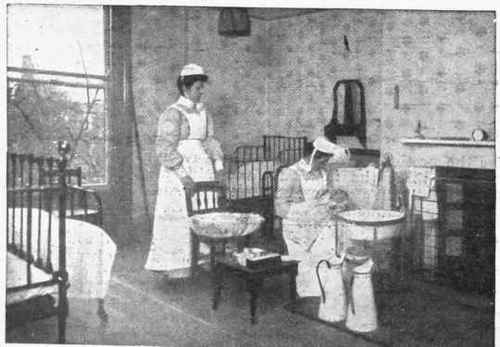
A night nursery in the Princess Christian College, Manchest
Continue to:


My Books

