


Training Girls for the colonies
Description
This section is from "Every Woman's Encyclopaedia". Also available from Amazon: Every Woman's Encyclopaedia.
Training Girls for the colonies

The Increasing Attractions of Emigration - The Establishment of the School of Farming at Arlesey, near Hitchin - The Life and Routine at the School - The Type of Girl required in the Colonies and her Prospects
"The high-spirited and enterprising young English girl of the upper and middle classes, who is not bound by home ties, is being drawn more and more strongly towards the idea of emigrating to the Colonies, and seeking a living in the Empire beyond the Seas - in Canada, South Africa, or New South Wales - rather than staying at home to fight in the already overcrowded market for a post as secretary, journalist, governess, companion, or lady clerk.
It was to meet the demand for a thorough training in the various household arts and crafts, and in the care and management of a garden, poultry-yard, orchard, and farm, which is a very necessary part of the girl colonist's equipment, that Lady Frances Balfour, Lady Burton, the Hon. Mrs. Evelyn Cecil, and a number of other ladies who have Imperialism keenly at heart, gave their active patronage to a scheme for starting a Colonial Training School at Arlesey, Near Hitchin, Herts.
The Arlesey Training School
This school was opened in 1907, under the governorship of Miss Turner, F.r.h.s., the former superintendent of the Glynde School of Gardening.
Miss Turner is an ardent advocate of emigration for girls of the upper classes. Not only is she an expert on all matters appertaining to the management of a garden or farm, but also is a distinguished lecturer on horticulture and small holdings in the intervals of personally supervising every detail of the entire daily work at Arlesey House, where eight students are in constant residence. And this work is not easy, since many of the girls have no knowledge of the practical running of a farmhouse when they first arrive, and have everything to learn.
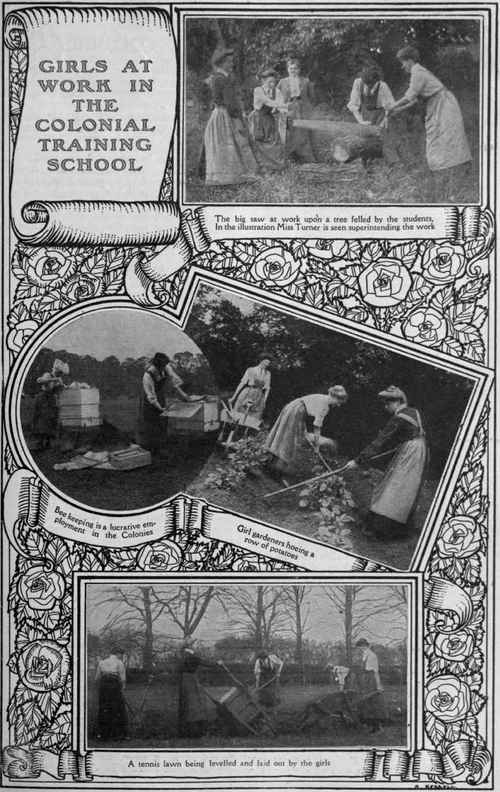
No servants are kept at Arlesey with the exception of a single maid to do the roughest work, and a garden boy. The students take it in turns, week by week, to act as gardeners, housemaids, or cooks, and the whole work of the farmstead, both inside and out, with its pig-stves, poultry farm, bee-hives, orchard, greenhouses, cucumber frames, and kitchen and flower garden, covering some four acres of ground, is carried on entirely by the girls themselves'.
Everything is kept in perfect order; the place is in a thriving condition, and is run in the most workmanlike and profitable manner.
The training in practical housewifery i planned so as to prepare the Arlese students to meet with perfect equanimit a feature of colonial life which, to the un trained girl emigrant of gentle birth, is ofte one of its chief hardships, not merely th absence of any but the roughest domesti servants, but often the impossibility c getting any " hired help " at all.
An Ideal Farmhouse
Arlesey is a big, rambling farmhouse c the cheerful, old-fashioned type, standing in about four acres of ground. Inside, it i roomy enough to provide a separate bed room for each of the eight students.
The terms for the ordinary course of train ing work out at about 80 a year. The course includes housework in all its branches plain cooking and bread-making; preserv ing and bottling fruit and vegetables; pick ling and curing bacon; the care of pigs bees, and poultry, and the management c incubators; and, in addition, gardenin in all its branches. After six months c general training, girls are allowed to specialis in riding, driving, and stable management laundry work, dairy work, and in simple car pentry for moderate extra fees. Student are also prepared for the Royal Horticultura Society and Board of Education examinations
The Course Of Training
The full course of training extends over two years, but students can enter for on year at ordinary fees, and shorter course may be arranged for at special terms.
The school year is divided into four quarters - Christmas, Lady Day, Mid summer, and Michaelmas - but students ma; enter at any time, and six weeks' holiday i given by arrangement.
The girls wear the most business-liki garb. In the garden they may be seen in very short skirts, shirts with the sleeve: rolled up to above the elbow, and the thickest of garden boots, each carrying on her own special work for the day with youthful vigour and enthusiasm quite de rightful to see.
The poultry-yard is well stocked, and contains a special incubating shed, of which two students have the entire charge for a fortnight at a time, to learn how poultr} management should be carried on - a most important branch of training for the girl colonist.
Inside the house all is order and precision. In the kitchen may be seen a girl - the cook of the week - enveloped in a huge apron, with her arms plunged in an earthenware bowl of flour, busily making bread.
Students specialising in dairy-work and the management of cows spend two mornings and three afternoons a week at a neighbouring farm, where the farmer's wife - a noted butter-maker - initiates them into the arts of milking and butter-making, and teaches them the use of the various types of churns and separators in common use, while students of laundry-work repair regularly on Tuesdays each week to the dwelling of an excellent local washerwoman, where they put in a hard morning's work at the washtub, again making their way thither on Tuesday and Wednesday afternoons, in order to learn how to iron and get up the outcome of Tuesday morning's work. Thus, they soon learn to turn out snowy piles of beautifully got-up personal and household linen.
The Type Of Girl Wanted
Miss Turner firmly believes that for the well-educated young gentlewoman, equipped with a thoroughly practical preliminary training for colonial life and able to work for herself, a place is ready and waiting in our possessions beyond the seas. Such a girl, if she takes a post as mother's help, will prove a real help, and when she marries will be a true helpmate to her husband.
Arlesey House, moreover, is intended also for girls who have no intention of emigrating, but who want to learn the right way to manage a small holding, consisting perhaps of a farmhouse or cottage with a garden and farmyard attached, so as to make it pay.
In the gardens are special greenhouses for tomatoes, chrysanthemums, and cucumbers. In addition, there is a vinery. Thus, it is easy for a student to acquire a thorough horticultural training, and for skilled gardeners there are great openings for women in the Colonies.
Miss Turner has, naturally, special facilities for acquiring information as to the different Colonies and their requirements, and pupils are not only advised and helped in their selection, but every endeavour is made to get them suitable posts when trained.
The age limit for students is nominally from eighteen to thirty, and Miss Turner finds twenty to twenty-five is the ideal age at which to start work at the school.
Nothing is more helpful to students than an occasional object lesson in successful gardening, and the Arlesey students have the advantage of visiting the various famous gardens in the surrounding neighbourhood from time to time, for Miss Turner receives many invitations for herself and her pupils to spend an afternoon in some beautifully kept old-world or modern garden. Here the iris can study aspects, soils, ferneries, orchid-houses, and the thousand-and-one things appertaining to garden lore, as carried on in other and different surroundings.
The Management Of Arlesey House
The Arlesey House garden and farm are managed on thoroughly comfortable but economical lines. No labour is wasted merely for the sake of learning how this or that task or duty should be performed; there is always some definite object in view.
The girls learn to utilise every scrap of ground for some practical and, if possible, lucrative purpose, so that both garden and farm may at least pay their own expenses.
Thus, the shady corners of the garden are utilised for planting a goodly supply of bulbs in early autumn. The flowers then are cut and sold in the early days of spring.
Then with the potato bed - which the students are seen hoeing so energetically in the illustration - every care and precaution had been taken to make the crop a success, with the consequence that Miss Kitson foresaw a harvest worth some £20 from that one piece of work alone.
Through dealing only with pedigree stock, the girls get to know the points, for instance, of a good healthy, well-bred bird, by instinct, and would never, in purchasing later on for themselves, be taken in by inferior live stock in starting a poultry farm of their own.
Home Nursing Taught
A knowledge of ambulance and home nursing is one of the utmost value in colonial life in order to deal promptly and successfully with accidents or sudden cases of illness where the girl settler's farmstead may be situated many miles from the nearest doctor, and accordingly each student is expected to go in for the course of lectures and to obtain the St. John's Ambulance certificates in these two subjects.
Life resolves itself into a simple and very pleasant affair at Arlesey, and, in spite of early hours and plenty of hard work, mealtimes are always very cheery. An excellent library and a good piano in the students' sitting-room provide plenty of recreation for the long winter evenings.
For outdoor recreation in the winter the girls can play hockey, and in the summer tennis and croquet. An admirable lawn was levelled and laid out by the students in 1909.
In New South Wales suitable students can be sent out to a small farm - mainly poultry and dairy - at Yarraford, Glen Innes, belonging to Miss Brace, who will take pupils who have a certificate of proficiency in cooking and dairy-work; but someone must deposit or guarantee their return fare - about 25 - should they not prove suitable.
On arrival Miss Brace helps them to find work or to take up land of their own.
In Canada, Miss Binnie-clarke receives pupils on her homestead in much the same way, and the expenses of the journey to Canada or British Columbia are from £15 to £20.
Continue to:


My Books

