


2. True Love Stories Of Famous People. Two Warriors In Love - Wellington And Wolfe. Part 2
Description
This section is from "Every Woman's Encyclopaedia". Also available from Amazon: Every Woman's Encyclopaedia.
2. True Love Stories Of Famous People. Two Warriors In Love - Wellington And Wolfe. Part 2
And in her mother's heart, perhaps, Mrs. Wolfe sorrowed that the boy's sense of duty was stronger than his love. She would gladly have kept her son at home. She would gladly have welcomed Miss Lowther as his wife.
But what had Wolfe to offer to such a lady? Nothing; only his love. But in the girl's eyes, although the sister of an earl, the first Lord Lonsdale (and therefore, it may prove interesting to note, related to the present Earl and the present Speaker of the House of Commons), this alone surely would have proved enough - this and his valour, for Katherine Lowther was no mere butterfly. And she was very beautiful.
But in the following year, when Wolfe returned to England, after the expedition to Louisbourg, things were very different. He left England an unknown soldier. He returned a hero, the man of the moment; his name was on the lips of everybody. Then he could speak. Then he did speak. Nor was his suit rejected. And in one moment he became the proudest, happiest man in England.
But it was a fleeting happiness. A few days later Pitt summoned him to London. Why? Eager with curiosity, Wolfe hastened to obey.
And what did the great statesman require of him? Merely that he should achieve the impossible, that he should take Quebec by storm and so win Canada for the Empire! Merely this! Only a Pitt would have made such a proposition to a soldier thirty-three years old. But only a Wolfe could execute it. Pitt knew his man; like most great statesmen, the secret of his genius lay in the power of recognising ability in others.
But Wolfe received the mandate with mingled feelings of joy and sorrow. At last, it is true, had come his great opportunity. But why had it not come before? In front of him lay a hazardous undertaking. He might never return. Sorrow tinged his joy; regrets his pride. He must leave his Katherine. What would she say? Could he leave her? Perhaps one might forgive him had he wavered for a moment in his sense of duty But he did not. Straightway he hastened down to Bath. And there he said farewell.
Charles Johnstone, in "Chrysal," has given an elaborate description of the scene. But here it need not be quoted. It is merely a characteristic piece of eighteenth century emotional writing, quite untrue to life. Yet still one may believe that Katherine, when she received her lover, "soon perceived an alteration in his countenance that showed that his heart was not at ease." She asked him the reason. He told her. Then she said: "Go, go, and Heaven guide and guard your steps ... I shall no longer struggle with the sacred impulse that leads you onto glory." These may not have been her words. But surely they tell her thoughts. Wolfe was a hero. She would be a hero's bride.
His mother the young general spared from the suffering of an interview. He wrote to her. Then he set sail.
But here to tell again the story of the expedition would be superfluous. How Wolfe achieved the impossible, and won Canada for Britain, that is history. Only the final, splendid scene on the Heights of Abraham calls for description here, the picture of Wolfe leading his troops in that mad, memorable charge to victory.
Never had man more dauntless courage. Even when a ball struck him in the groin, still he pressed forward, heedless to the pain. But soon another struck him. Then a third - this one in the breast. He could barely stagger now, but bravely he kept his feet while the grenadiers dashed past. Then his strength failed him.
"Support me!" he gasped, clutching at Lieutenant Brown. "Let not my brave fellows see me fall."
But it was too late. Before Brown could save him, he had fallen unconscious to the ground. Two other men then hastened to his side. The remainder of the victorious army still surged forward. These three men alone had seen their general fall. And between them they carried his helpless, suffering body to the rear. One of them then proposed setting out to find a doctor. But Wolfe restrained him.
"It is needless," he said. "All is over with me."
For a moment there was silence, a grim, anxious silence. Then from the distance came a cry: "They run! They run!"
Wolfe raised himself slightly on one elbow. "Who run?" he asked.
"The enemy, sir."
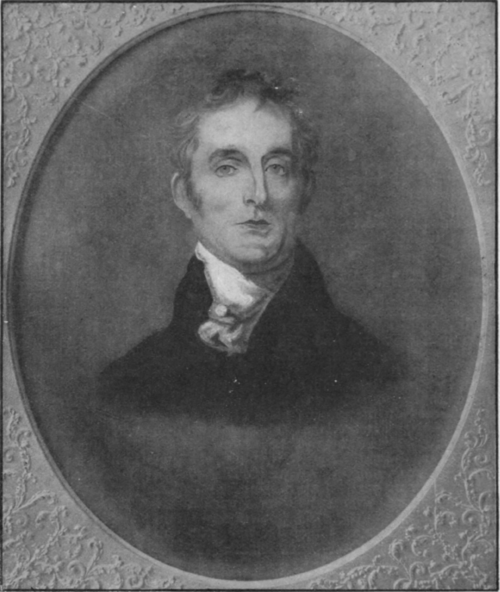
Arthur Wellesley, the great Duke of Wellington. The Iron Duke was not a successful lover, despite his magnetic personality
From the original painting, by Lawrence, at Apsley House
"Now God be praised," he sighed. "I die happy."
And then, his last breath spent, he rolled over on his side. The hero of Quebec was dead.
And, it would seem, he had known that he would die that day. Indeed, only on the previous evening, he had entrusted to the care of his friend John Jervis - afterwards Earl of St. Vincent - the will which he had made three months before at sea, his notebook, and his papers. He had had, he said, a presentiment of death.
Then he drew from below his tunic the portrait of a girl. For a moment he gazed wistfully at it; then he gave it to his friend. The portrait was Miss Lowther's. Should he fall, Wolfe said, he wished it to be returned to her - set in jewels.
For six years Miss Lowther mourned her soldier lover. Then she married another man - the Duke of Bolton. But still, and to her dying day, she wore this miniature, covered with black velvet, on a chain around her neck.
Perhaps she did not like to wear openly the gift of a former lover. But still she wished to keep his memory ever green. Wolfe always remained her perfect hero. Besides, had not his last thoughts been of her - of her and of his country?
The Iron Duke's Story
But throughout the long life of the Iron Duke there is not one such glimpse of lovely sentiment. He was ever a lonely man, despite his greatness, despite his fame and splendour, and in private life never a happy one. He may have won most of the prizes that the world can offer, but he failed to win the greatest. A woman's love always was denied him - even a mother's.
Continue to:


My Books

