


How To Make The Most Of Garden. Continued
Description
This section is from "Every Woman's Encyclopaedia". Also available from Amazon: Every Woman's Encyclopaedia.
How To Make The Most Of Garden. Continued
As the garden year may be said to begin in October, so that of the greenhouse begins in February, with the awakening of plant-life induced by a genial temperature indoors, and the possibilities of seed-sowing without fear of injury by frost or wet.
Beyond the fact that a succession of early bulbs in pots will begin in January, a succession of late chrysanthemums being sustained as well, the month of January will be a quiet time, when a good clear-out can be accomplished. Spring cleaning should precede the spring in this case, and the house can be re-painted, or, at all events, cleaned, pots scrubbed, and moss removed from walls, etc., and all plants, which allow of it, sponged with soft soap and water or gishurstine, after any dead leaves have been removed.
The seed list can also with advantage be consulted, and a definite plan made for a succession of flowers during the coming year.
The practical amateur gardener who does not wish to spend large sums on her indoor flowers should bear in mind that a wonderful display of flowers can be had both indoors and out by raising annuals and biennials from seeds. A few packets of seed at id. or 3d will produce a marvellous result. Full directions for the sowing of these subjects have already-appeared in Vol. 2, pp. 925 and 1163.
When they have attained the " pricked out " stage, the young plants should be potted up, either singly or several in a pot, according to circumstances. Many hardy annuals may be flowered in this way, but it is especially suited to half-hardy annuals and biennials, such as asters, balsams, cinerarias, nemesia, schizanthus (butterfly flower), zinnia elegans, and mignonette. Brow-allia, dwarf scabious, and phlox drummondi are other and uncommon flowers which can be grown in the same way.
Such flowers as these can, indeed, be sown either in spring or autumn - autumn sowing will in most cases bring about a satisfactory amount of flower in early spring, while spring sowing will result in a good show throughtout the summer. Particularly good are the effects which can be had by growing stocks of different varieties - the Brompton, East Lothian, Intermediate, and so on - by which a succession of flowers can be kept up. Asters are also excellent subjects, whether as pot plants or for an early autumn show in the garden.
A Nursery for Young Plants
As a nursery of young plants for the outside garden, the greenhouse will, of course, be used for raising a stock of cuttings of many kinds. Geraniums come first to mind, but many others can be obtained easily - such as marguerites, salvias, lobelia car-dinalis, begonias, verbenas, eupatorium, ageratum, and so on. Cuttings of these may be struck in spring or autumn. Clean pots of light soil, thickly surfaced with sand, should be used, and the cuttings should be put in firmly with a wooden dibber.
Such cuttings as geraniums will be placed on a shelf near the glass, while others of the type of eupatorium will do best with bottom heat, by filling a box or frame on the greenhouse bench with hot-bed litter, or with cocoanut fibre if less heat is required, and keeping the temperature close.
How To Repot Plants
Plants struck from cuttings inserted in autumn will require potting off singly as soon as the year has turned. In preparing to repot a plant, have the new pots quite clean and well-drained with crocks (as has been frequently described). Cover the drainage with turfy material, and place just so much soil as will allow of the old plant, when standing in the new pot, to be well below the rim. Turn the plant out by rapping the rim of the pot sharply on the bench, and be careful not to break the ball of soil and roots.
It is best even to leave the old crocks, if the roots will be broken by taking them out. Hold the plant upright, and fill in all round the edges with fresh soil, pressing it quite firmly around the ball, so that there shall be no holes left for water to become sour. The compost must not, of course, be either dry or sticky. After repotting, it is best to water lightly and shade for a little until the plant has taken good hold in its fresh quarters.
Fuchsias like a moister and warmer temperature than geraniums. If 60° can be given, they can be very well struck early in the year, but otherwise August is the best time. Cuttings about two inches long are the most suitable, and should be placed round the edges of the pots, and the cuttings potted off singly after striking, before the roots become entangled. Small-sized fuchsias can be had in good condition with a very little pinching to keep them in shape.
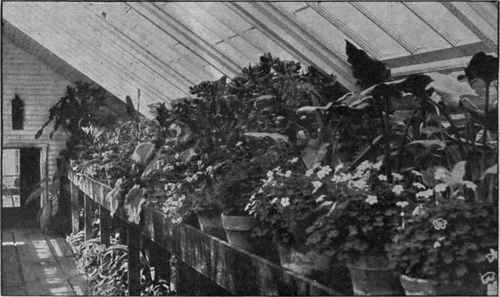
A mixed greenhouse showing the possibilities of a small glasshouse. If economy is exercised, the possessor of such a house will obtain from it both pleasure and profit Copyright, One & All Association
Begonias are a specially good class of plant which can be raised in the greenhouse both for garden and conservatory. Nothing is easier than the culture of tuberous begonias, the tubers of which are shaken out of their pots each winter, and then divided and started in slight heat as soon as the year has turned. They may be grown freely from seed, though the seed, being small, needs careful handling and it is an advantage to prick off the young plants when still quite tiny.
Such a useful plant as the cineraria should certainly be grown, and the star-shaped sorts are particularly charming, but the beginner in greenhouse work must be prepared to exercise care and patience in its culture, as the plant is much subject to attacks of insect and other pests throughout its career.
Quite different in this respect is the primula, a delightful plant for the greenhouse lover, as well as one which can be used with charming effect out of doors. It can be raised for either purpose by sowing the seed deep but thinly in March or early April, and pricking off before the seedlings have time to become drawn, being careful to keep in a light position, and not to over water. A few of the best coloured specimens can be saved from seed.
Among the more shrubby subjects for greenhouse culture should be mentioned New Holland plants, a class which includes rhododendrons and azaleas, etc. The d for American plants such as the above should consist chiefly of peat and sand, and when repotted this should be rammed " as hard as a road." Cuttings are often struck in summer in a shady corner of the cool house, using a bell-glass to induce satisfactory striking. Gentle bottom heat will accomplish the same result, the cuttings being of half-ripened wood in either case. Camellias will form good subjects for the interesting practice of grafting, which will be dealt with later on.
Success with the Greenhouse
The general care of the greenhouse is a subject in which the amateur can only become proficient by experience. Some of the chief points in the matter will be more fully dealt with in the following article, but it may be said here that careful potting, great attention to cleanliness, and to the prompt destruction of pests, and, above all, the exercise of watchful intelligence in the matter of watering plants should tend to a success in culture which will make the glasshouse an endless source of interest and pleasure.
Continue to:


My Books

