


3. Fruit Culture For Profit
Description
This section is from "Every Woman's Encyclopaedia". Also available from Amazon: Every Woman's Encyclopaedia.
3. Fruit Culture For Profit
Author of " Small Holdings for Women," "Flower Culture for Profit," etc.
Canker - Tying-up and Securing - When Fruit Trees Fail
It is surprising what a number of fruit trees there are suffering from cankerous growth, particularly in apple orchards. With hoary veterans one must expect such troubles, but often canker appears on the limbs of trees that are quite juvenile, and in such cases drastic remedies must be taken forthwith.
The fact that two branches, even slender ones, rub against one another as they are moved by the breeze is sufficient to set up canker in a tree. Soil, too, is a factor, and frequently, when the roots get down into stiff clay or that peculiar crumbly marl known as brick earth, the disease makes its appearance. In the former example steps should be taken to cut away one of the offending branches, but with unsuitable soil one is powerless to do much, and a summing-up of the case can only prove that there was lack of judgment in selection of the site.
Painting with Paraffin
To take the typical instance of cankerous formation shown in the photograph on this page, the first task should be to cut away the affected branch immediately below the wound. The adjacent places remaining on the tree should be treated with paraffin or petroleum, the oil being applied copiously with a paint-brush from time to time till healthy, normal growth is assured.
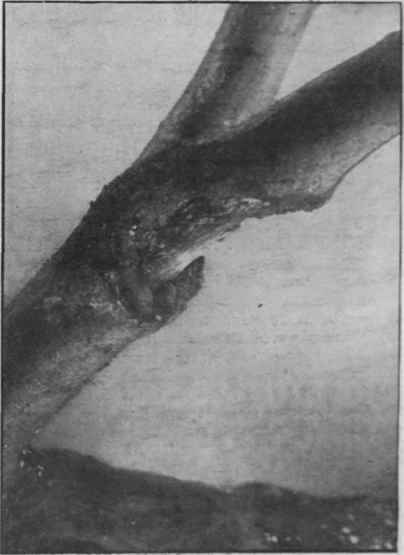
Canker in a branch of an apple tree. The affected branch must be cut away immediately below the wound. and the parts adjacent treated with paraffin or petroleum
The mineral oils, by the way, are greatly used by orchardists, and many experts are warm in their praises. For American blight - that white, cottony substance may be taken as evidence of the pest - paraffin may be used with perfect safety, provided the fluid does not touch very young wood or foliage. Certainly the bark of fruit trees that has been treated with either paraffin or petroleum presents an exceedingly satisfactory appearance.
The second photograph that appears with this article depicts the old-fashioned method of securing a newly-planted tree to its supporting posts with the aid of a hay band. A straw band is equally effective, and, if anything, is a trifle the stronger of the two.
The Use Of Hay Bands
Hay bands are used for tying up a truss or bale of hay, and straw bands are employed in a similar way with straw. They are made by the countryman with the aid of an instrument called a " twiddle," but as the art is one of those true countryman's acquirements, not to be taken lightly or learned easily, it will be better for the lady fruit-grower to pay a few pence for the bands.
By using bands of hay or straw for the purpose there cannot possibly be friction on the bark of the young tree, and as it grows the soft material will amply allow for expansion.
Another plan is to wind lengths of flannel round the trunk of the tree, and then to employ cord, but though this is perhaps the more simple, the writer prefers the old-fashioned method.
It must inevitably happen occasionally that young fruit trees fail. At the time of planting they may be perfectly robust, and they may even bloom the first spring ; but before the summer has passed the trees will shed their leaves, the branches will die back, and in the trunks little brown patches will appear, signifying death.
In such cases as these, when the trees are planted in an orchard, the matter is hopeless; and as soon as planting-time comes round again the saplings should be taken up and replaced by further specimens. If the trunks are green for a part of their length they may be cut off - always cutting below any of the brown patches - and the living butt may then be planted in an out-of-the-way corner, so that it may have an opportunity of throwing up fresh wood from above the bud. Indeed, in time, it is quite probable that such a tree will provide quite an acceptable specimen of the bush-trained class.
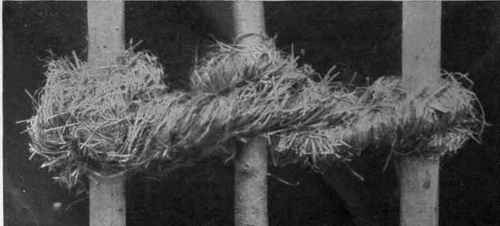
Hay or straw bands are excellent media for securing newly planted fruit trees to their supporting posts.
Straw is somewhat stronger than hay for this purpose
With trees that have merely shed their leaves and have not died back to any great extent, all one can do is to prick lightly over the ground around them with a garden fork, and then apply a liberal mulch of well-decayed manure. Frequently this treatment will put fresh heart into a flagging tree.
By the way, it is a great error to allow a tree to bear a crop the season after planting; and it is a mistake also to permit grass to grow round the stem of a young tree till the third season at least. By the same rule, for a season after planting, the pruning-knife should be withheld, except to trim any branches that have suffered in transit or been broken during the planting process.
Stock In The Orchard
Frequently when apple trees are grown in an orchard there comes the question of the disposal of the grass. For many years after planting, grass should not be affected by the fruit trees, and it is only in the case of long-established orchards when the trees are closely set that the verdure is apt to become coarse and sour. Under other circumstances, orchard grass should make perfectly good hay. True, it will be what is technically known as " plain hay" - i.e., hay that is lacking in clover and the richer grasses - but even this may be remedied by sowing a mixture of sanfoin, lucerne, and the perennial clovers in September, at the rate of about twelve pounds of seed to the acre. Such seed would cost a shilling a pound.
Pigs do very well in an orchard, and if they have been rung - that is, if their snouts have been fitted with a ring - they can do little harm. Calves will thrive in such a place, but sheep are apt to gnaw the bark from the trees, especially if feed is at all scarce. A small pony, on the other hand, should be thoroughly at home in an orchard, and unless he is abnormally mischievous is not at all likely to do harm. Then there are fowls ; and where could one find a better run than an orchard ? To be concluded.
Continue to:


My Books

