


The ABC Of Sweetmeat-Making. Part 2
Description
This section is from "Every Woman's Encyclopaedia". Also available from Amazon: Every Woman's Encyclopaedia.
The ABC Of Sweetmeat-Making. Part 2
A small half-saltspoonful of cream of tartar is used to a pound of sugar to prevent it from graining.
The term "graining" means that the dissolved sugar for some reason or another, re-forms again into crystals.
Unless saccharometers are of a good quality, they are liable to burst when placed in the syrup. Before putting them into the pan they should stand for a time in hot water.
If marble slabs are brought from a very cold place, and boiling sugar is at once poured on them, they will be likely to crack. The atmosphere is of the greatest importance when sugar-boiling, or chocolate-coating.
If the day is wet and damp, good results will never ensue. The room must be devoid of any steam from cooking utensils, and the temperature should be under and not over 70 deg. Fahrenheit. This point is often disregarded by inexperienced workers.
For sugar spinning the same rule holds good, a damp atmosphere being fatal to success.
Should the sugar grain when boiled, add the same amount of water used at first over again, and re-boil it to the required degree.
If the sugar is accidentally boiled past the necessary degree, cool it down a little, add a little more water, and re-boil it, watching it carefully till the right degree is obtained.
If the sugar is under-boiled the sweetmeat will not harden sufficiently; over-boiled it will be in too advanced a stage, and be too hard or too dark in colour.
Fondant will keep good for a long time in airtight jars or tins, and so can always be kept ready for use. Glucose added to it will also aid in its preservation.
Fondant, if touched when too hot, will grain. If it is intended for immediate use, two large teaspoonfuls of thick cream added to it will make it specially good.
Gum-arabic, used in certain sweets, is very beneficial to individuals suffering from throat and chest complaints.
If candied fruits are to be dipped in boiled sugar for the purpose of glazing them, they must first of all be washed free of all sugar, and thoroughly dried in a soft cloth, or the glazing sugar will all drain off.
For toffee and all sweets made with treacle and Demerara sugar, use a saucepan that will hold three or four times the amount of ingredients to be actually used, as these mixtures boil over very easily.
Water that is used for dipping sugar in for testing purposes, should be as cold as possible. If iced, so much the better. It must also be changed frequently, as it soon becomes tepid. Chocolates are frequently wrapped in tin-foil, as this keeps them dry and in good condition.
Fancy boxes, edged with lace paper, and bon-bon cases and sacks, add greatly to the appearance of sweetmeats, and may be bought very cheaply either wholesale or retail.
Candy-hooks are fixed in the wall usually at a height a little below that of the worker. Sugar should be thoroughly saturated in the required amount of water before being heated. It should not be stirred after it is dissolved in the water during the boiling process or it will grain. For the same reason the thermometer must be kept in the pan, and not taken in and out.
When the sugar is dissolved keep the lid on the pan till a good force of steam escapes from under it, after which keep the lid off.
Prevent crystals of sugar forming round the edge of the pan from the syrup-line by brushing it round with a brush or a piece of soft rag dipped in water.
The stem of a clean clay pipe or small wooden skewers may be used to dip first in the boiling sugar and then into the cold water for testing purposes.
Boiling The Sugar
It is essential to understand the changes that take place when sugars are boiled to the exact degree required needs skill, experience, and the most careful attention, but the results are so fascinating and capable of such variation that the trouble is well repaid.
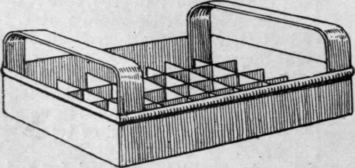
A caramel cutter for shaping these favourite sweets various degrees of heat, if even the very simplest of sweets are to be attempted. To boil the syrup of sugar and water to

Wire sweetfork
The saccharometer will save much trouble and waste of material, and is a very necessary instrument for beginners. Professionals frequently prefer to test the sugar by the fingers, or with water, when by its consistency when cooled they can judge whether or not the right degree has been attained.
An intelligent worker will endeavour to grasp thoroughly, not only the use of the saccharometer, but also the simplest methods of testing the condition of the sugar, so that she is independent should the saccharometer not be at hand.
It will be sometimes noticed in recipes that the degrees directed vary a little from those printed on the saccharometer. For example, the recipe may order some syrup to be boiled to the "large ball" (250 deg.).
The worker may note that on the saccharometer "large ball" is printed against 247 deg., and consequently be puzzled. The reason is that "large ball" is obtained between the degrees of 247 deg. to 252 deg., the consistency of the ball being a trifle firmer with the higher degree. The same applies to the other degrees given; they will vary a little according to the nature of the sweetmeat which is being prepared.
Eleven degrees are used by experts, but all these stages need not be mastered by amateurs, for whom the most useful are:
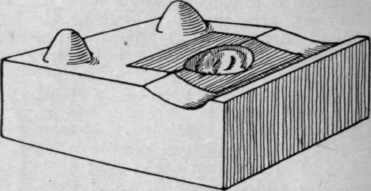
Lower half of a marzipan mould, walnut pattern
Continue to:


My Books

