


The ABC Of Sweetmeat-Making. Part 3
Description
This section is from "Every Woman's Encyclopaedia". Also available from Amazon: Every Woman's Encyclopaedia.
The ABC Of Sweetmeat-Making. Part 3
The Thread,
The Soft Ball,
The Crack and Caramel.
However, as nothing short of perfection should be one's aim, the intermediate degrees will be explained for the benefit of those who wish to become really expert.
The Degrees Of Sugar Boiling
I. Small Thread (215 deg.). - Take a little of the syrup between the finger and thumb, and separate it gently, when a fine thread that breaks at a short distance will be formed.
2. Large Thread (217 deg.). - Boil the syrup for a little longer than for "small thread," and apply the same test as for the latter, when a stronger thread, capable of being drawn to a greater length, forms.
3. Small Pearl (220 deg.). - Note if the boiling syrup forms large bubbles like pearls on the surface. Then take a little of the syrup between the finger and thumb, separate it, and if a thread that can be drawn to a good length, but still breaks, is formed, "small pearl" has been reached.
4. Large Pearl (222 deg.). - The pearls or bubbles formed on the surface of the syrup must be closer together than for "small pearl," and the thread should stretch without breaking.
5. The Blow (230 deg.). - Dip a skimmer or a loop of coarse twisted wire into the syrup. Blow gently through the holes, and the syrup will form small bubbles or globules on the under side.
6. The Feather (232 deg.). - Dip the skimmer or wire loop into the syrup, blow through the holes and shake the skimmer, when the bubbles will fly off in fine threads or make a light feathery edge along that of the skimmer.
7. Small, or Soft, Ball (238 deg. to 240 deg.). - Dip a small wooden stick or skewer into the coldest water obtainable, then put it into the syrup and back again into the water. Take it out after a second, draw off the set sugar, and note if it will work up in the fingers like a piece of soft putty; if not, boil it for a short time longer.
8. Large, or Hard, Ball (247 deg. to 252 deg.). - Try the syrup as directed for the "small ball," but the ball formed should be larger and harder in its consistency than for the latter.
9. Small Crack (290 deg.). - Throw a few drops of the syrup into very cold water. If when set it breaks, but becomes soft and sticks to the teeth when bitten, the right degree is safely reached.
I0. Large Crack (312 deg.). - Drop a little syrup into the water. When set it should be perfectly hard and brittle without any tendency to stick when bitten.
II. Caramel (300 deg. to 350 deg.). - The sugar begins to colour from the faintest straw colour to a deep brown. As soon as the tinting begins add a drop or two of lemon-juice.
If over-coloured the flavour will be spoilt, and great care is also needed to prevent the sugar burning at this high degree.
How to Make and Fill Starch Moulds
To make and fill these moulds offers the worker much scope for displaying her skill and originality.
It consists in making impressions with moulds in a tray of corn starch. The same indented patterns are afterwards filled in with variously coloured and flavoured syrups, liquid fondant, etc., which are then left till cold and hard.

Degrees: Fahrenheit.
The use of a saccharometer will save much trouble and waste of material when boiling sugar
If no corn starch tray is at hand, use a long wooden box-lid with an edge to it. Fill it with warm, perfectly dry, sieved corn or potato starch, and see that the surface is level.
If proper plaster moulds are used, a convenient number are usually fixed securely on a piece of wood, and these are then gently and firmly pressed down in the starch, so that six or eight impressions are made at a time. When the entire surface is covered with holes that tray is ready for filling.
Should plaster moulds not be obtainable, stick shells, nuts, or buttons of a pretty shape and suitable size on a flat penny wooden ruler. They may be fastened on with glue or sealing-wax, and can then be used in the same way.
The liquid fondant, chocolate, syrup, etc., should be poured in through a funnel with a small hole at the end. Into this fit a little stick, so that by pulling it up the flow of liquid is permitted, and, when pushed in, stopped at once. A steady hand is necessary or the impressions made will be filled too full.
After filling in the moulds, dust the top of each with a little fine icing sugar, and leave the tray in a warm place for about eighteen hours to dry and harden the sweets.
The starch should be gently brushed off the sweets when they are removed from the moulds.
To Make Marzipan
Required: Three-quarters of a pound of ground almonds. One pound of loaf sugar. One gill of hot water. One whole egg or two yolks. Orange-flower water. Vanilla. Lemon-juice.
Put the sugar and water into a clean pan, let it slowly dissolve by the fire; then cover it, and bring the contents to boiling point. Remove the lid and boil the syrup to 240° - that is, "soft ball."
Skim the syrup well if necessary, and brush round the sides of the pan to prevent granulation. When the right degree of heat is reached, draw the pan off the fire, and stir in the ground almonds.
Let the mixture cool a little, and then add the egg, slightly beaten. Mix it well, and cook the marzipan over a slow fire till it can be rolled about in the pan without
adhering to the sides. If more than a gentle heat is applied, the flavour will be spoilt.
Turn the mixture out on a dry slab, and knead till it is nearly cold and feels perfectly smooth.
When quite cold add any flavouring and colours required, and it is ready to mould.
Note. For a very white marzipan use the raw, unbeaten whites of two eggs instead of yolks, or yolk and white. Cost, Is. 10d.
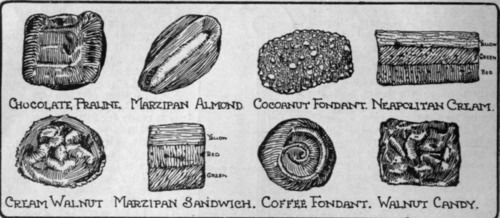
Some delicious sweetmeats that are quite within the powers of the home maker. The making of sweets at home is a delightful hobby, and may be turned to profitable account
How to Mould Marzipan
Here again those blessed with deft fingers can produce really exquisite modellings of shells, animals, fish, various fruits, nuts, etc., and by artistic tinting and delicate painting of the same with vegetable colourings,
Fish
Bream
Crayfish
Eels
Haddock
Mullet (red)
Dublin or
Lobster Prawns Shrimps Soles Trout Whiting
Brill
Crabs
Flounders
Halibut
Lobsters
Oysters
Plaice
Skate Slips Turbot Salt Fish
Cod
Dory
Gurnet
Hake
Mackerel
Prawns
Salmon
Smelts Lemon Soles Whitebait
Beef Pork
Meat Mutton Venison
Veal
House and grass lamb
Capons
Ducklings
Pigeons
Poultry Chickens Fowls Rabbits (tame)
Ducks Guinea-fowls
Ortolans
Ruffs and reeves
Plovers' eggs
Game
Capercailzie Partridges
(Russian) Ptarmigan Rabbits (wild)
Hares Quails
Prairie hens Ostend rabbits
Artichokes (Globe and Jerusalem)
Batavia
Broccoli (purple)
Cauliflowers Celery Corn-salad Endive
Lettuces Onions Parsnips New potatoes Shallots
Vegetables Beetroot
Cabbages (spring) Carrots (old and new) Chicory Cucumbers Garlic Mint
Spring onions Parsley
Sweet potatoes Scotch kale Turnips (old and new) Asparagus
Broccoli-tops
Cabbage-greens Celeriac
Cress Chervil Leeks Mushrooms
(cultivated) Spanish onions Potatoes Radishes Seakale Turnip-tops
Apples Green figs Lychees
Mandarin oranges Rhubarb (forced and outdoor) Plums from the
Cape
Fruit Bananas Lemons Melons
(hothouse) Pears
Grape berries (for cooking)
Grapes
Limes
Oranges
Pineapples
Nuts melted chocolate or caramel, the productions will be most realistic.
Moulds, however, can be bought for about one and sixpence or two shillings. They are made in white stone, in two parts for each cast, and on each half is a perfect imprint of a shell, almond, walnut, fruit, etc.
See that the two parts are perfectly dry and clean, and dust them thinly with a little sieved icing sugar. Press a little piece of marzipan firmly and evenly into each indentation in the block, and fit the two on each other, pressing them quite tightly. Pull them sharply apart, and lift out the little model from within. Of course, these moulds will last for years with ordinary care.
Continue to:


My Books

