


The Renovation Of Old Screens
Description
This section is from "Every Woman's Encyclopaedia". Also available from Amazon: Every Woman's Encyclopaedia.
The Renovation Of Old Screens
An Added Charm to a Room - What We May Learn From Japan - How to Re-cover and Decorate an Old Screen - Painted and Embroidered White Satin - A Lantern Design - A Plain Screen
Adorned by Japanese Friezes
Very often one of the most unattractive additions to a room is the screen which is placed to keep the draught from coming through the door, and it is not unusual for the smaller screen that embellishes the grate to be so extremely inartistic that it quite jars upon our sensibilities.
But a screen, when it is pleasing, is one of the most decorative and delightful adjuncts possible.
A beautiful screen can be used for numerous decorative schemes apart from its original purpose. A screen placed at a correct angle will break up stiff, hard lines if the room is not a pleasing shape. It can also form a background for a cosy corner. In summer-time a screen will disguise a hideous mantelpiece, and it can be arranged effectively to decorate the entrance of a room or square hall.
The Desire for Simplicity
There is a distinct inclination in these days to intermingle ideas of the East with those of the West, a desire for simplicity in the arrangement of our homes, and the furniture which is selected is chosen with greater care than it used to be. One sees that a genuine regard is paid to its utility and design, and there is less tendency to buy one's belongings in " suites " - all of which points to the influence of the East. The humblest Japanese workers are artists. They are trained to make a study of things beautiful from childhood. The value of placing each article in its surroundings in such a manner that relatively it will enhance the beauty of each other object in its vicinity is one of their most striking characteristics.
Ideas from Japan
Children from infancy are taught the artistic possibilities that rest in the simple arrangement of a flower or branch, so that the rare china bowl with its pink-and-white almond blossom that so often adorns a Japanese apartment has not been arranged haphazard, but has been placed carefully in that position with due regard to its effect upon the tout ensemble of the room. What a lesson in the arrangement of our own homes we might learn from the Japanese - choosing simple furniture, odd pieces of Japanese art, a cabinet decorated with mother-of-pearl, buds, and flowering plants, a cloisonne bowl. With a little care and patience the most original room could be arranged at comparatively small cost, and a quaint screen or two would further add to its charm.
It is very often quite easy to buy old screens at sales. These screens are often dilapidated, the embroidery or painting
" impossible," but the frame may be quite she can gc good. Bamboo screens with frayed silk panels are no uncommon sight, but with what can we replace these deficiencies ? Many ideas could be borrowed from Japanese art, and the embroidery needle or paintbrush, or both, must be called into use.
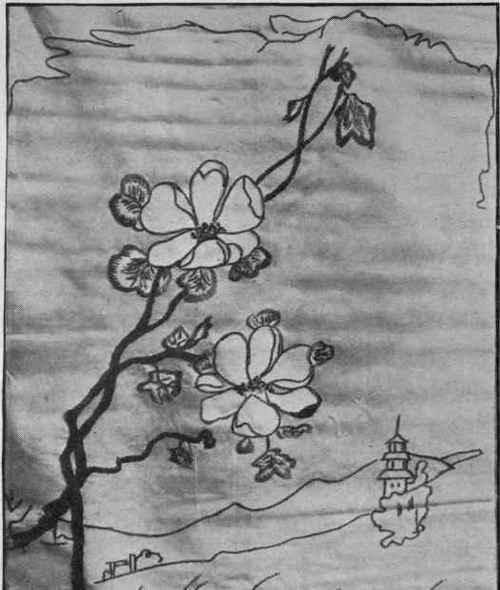
A Japanese design for a fire-screen. In this simple yet effective design there is a charming combination of needlecraft and brush work, the magnolia blossom being out-lined in embroidery, as well as the clouds and landscape. The panel should be covered with glass when mounted
In considering possibilities for new panels for old screens many women will favour suggestions which can be worked out quickly; so, therefore, a design which is simple and effective should be chosen, also one that aims at bold results with comparatively little work - for, unless the embroideress is a very devoted needlewoman, by the time the third or fourth panel is reached she will begin to find very minute and elaborate work tedious. The best results are often obtained by the more simple designs. A simple design chosen for its breadth and simplicity seldom spells failure.
The characteristic beauty of Japanese art is the freedom and sureness of its bold, sweeping lines - be it in embroidery 01 water-colour. Every curve, every line is placed in such a manner that the best possible results are obtained with surprising ease. This is the result of the most careful observation before one line has been placed on silk or paper. The subject has been learnt and understood before, and not whilst it is being transmitted to the tangible medium. The brain has first of all evolved and completed the idea. Let the woman who desires to possess an artistic screen select one of these sweeping designs, and she will gain excellent results for her panels.
The panels may be composed of linen, satin, or Roman satin. The satin must, of course, be cut into the exact size of the various panels. If it is for a fire-screen, as a rule, one square panel is quite sufficient. If the needlewoman is able to sketch, direct to a Japanese print for her design. A spray of large flowers might sweep boldly right across the panel, and beneath this there might be a range of mountains, a quaint Japanese tower, a few birds, some blades of grass, and these objects may be lightly sketched in. To gain a most artistic and quick effect there is nothing more delightful, if the fabric is white satin, than to tint the background with water-colour paints. If the needlewoman has no knowledge of drawing, and her design has been stamped in the orthodox way on to the satin, even if she has no knowledge of painting she will find it quite easy to tint the background of the satin for her embroidery. We . will consider that a spray of flowers is traced on the satin and, below, a range of mountains, trees, and a tower.
Continue to:


My Books

