


2. Japanese Goldfish
Description
This section is from "Every Woman's Encyclopaedia". Also available from Amazon: Every Woman's Encyclopaedia.
2. Japanese Goldfish
There is also an extremely bizarre variety of these Japanese goldfish, called the " Deme-ranchu." It is known in Europe as the " Celestial-eyed " goldfish, and is so called because the eyes, as well as being protuberant, do not look laterally, but are turned upwards. The protrusion varies from being very slight to such a degree that the eyes stand out half an inch or more from the head, and, as a result, the fish labours under the disadvantage of only being able to look in an upward direction. This peculiarity, combined with its feeble swimming powers, makes the telescope-eyed goldfish a solitary creature which seldom moves from the bottom of the aquarium.
Some examples have been brought to Europe, but owing to the great difficulty of keeping them alive during the sea voyage, they are not very common.
Most people fail to succeed in keeping the Japanese goldfish through not knowing the difference which exists between the methods adopted respectively by Japanese and Europeans.
In Europe, we have the cleanest and purest water that can be got, we keep down all confervoid growths, and change the water as soon as any animalculae are seen.
In Japan, on the contrary, the water supply is seldom pure, and often contaminated by receiving the gutter discharges of the town or village. The wells from which the supply is drawn being shallow, " surface " water, with all its attendant impurities, is all that can be drawn up.
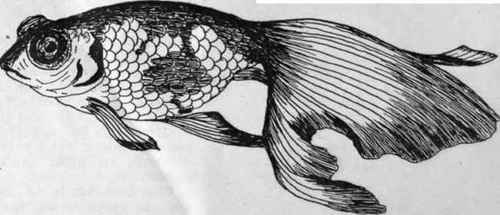
The Deme'ranchu, or "Celestial-eyed goldfish, so called from its protruding and upturned eyes. The value of a specimen is gauged by the amount of eye distortion
The reason given by the breeders of goldfish for the use of water other than that from clear running streams is that such water is the most favourable for the growth of the living organisms (entomostraca) on which the fish principally feed. All plant life is usually avoided. We feed our goldfish on ants' eggs and vermicelli principally. In Japan gnat larvae and other forms of freshwater insect life, crushed molluscs, small annelid worms, and boiled wheat are used, the last-named only when the supply of the former kind fails.
When starting an aquarium for Japanese goldfish, it should be prepared a couple of months before the fish are purchased. The water must be from a source which is infested with entomostraca, and a water-butt should be kept in which a constant supply of these organisms can be provided. The bottom of the aquarium should be covered with sand, into which a few plants, such as valisneria, can be rooted. Care must be taken to avoid frightening the fish, as they are very timid, and the practice of stirring them up to make them swim about must be avoided. The proper way of feeding them is indicated above. The prices of fish vary from about 3s. to 15s. each for the Wat-kins and Ruykins and from 1os. to 3 o s . for the "tele-scope-eyed" and "Ce-1estial-eyed" goldfish.

A charming yet practical coiffure, capable of modifications to suit various types of face, and demanding but little expenditure of time or money. (See page 4097.)
Continue to:


My Books

