


Useful Hints For Dog Owners
Description
This section is from "Every Woman's Encyclopaedia". Also available from Amazon: Every Woman's Encyclopaedia.
Useful Hints For Dog Owners
An Ailing Dog Should be Isolated - A Method of Stopping Bleeding - Treatment of Burns - Canker of the Ear - Chorea - Constipation-how to Bandage - On Distemper - An Invalid Dog's Coat Painless Death
If the novice is within reach of a skilled veterinary surgeon, let her send for one if she is puzzled by any symptoms in her dog.
But there are some accidents that may be treated at home, and there are some illnesses that at least may be recognised and for which certain steps may be taken pending the arrival of the medico.
The first thing to do, if a dog appears to be ill, is to isolate him, if other dogs are kept. To do so minimises the risk of possible infection, and adds to the animal's chances of speedy recovery. A safe rule is to put him in a quiet, dry place, cool and shaded in summer and warm in winter, until a diagnosis can be made.
Cough, or husk, as it is often termed, is not uncommon among dogs, and should not be neglected, or it may turn to chronic asthma. As cough is one of the symptoms found with distemper, the temperature should be taken. If normal, or practically so, the case is one of ordinary cold, contagious but curable. The dog should be kept from getting wet, and will benefit by a course of cod-liver oil. Ac-
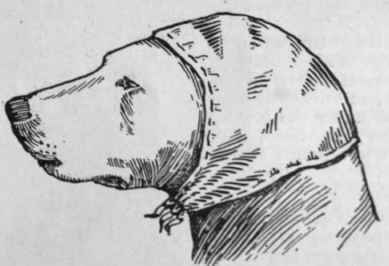
A simple but effective form of cap for a dog suffering from an injury to the head or ellbreed, the veterinary surgeon will most probably prescribe a cough mixture. If the dog is not taken to him, this matter of weight and breed should always be stated, as upon it depend the quantities prescribed.
To Stop Bleeding
If a wound is bleeding very severely, a hot sponge should be pressed upon it ; or a pledget of absorbent wool, soaked in tincture of iron, can be applied, and the part bandaged tightly. Bleeding from the lungs or elsewhere will be a matter requiring expert attention. A kindly doctor will usually help if the bleeding is serious and the veterinary surgeon not at hand.
Burns
Severe burns will require advice: if slight, boracic ointment will be found excellent, applied twice daily. As with human patients, air must be excluded at once, which can be done by a thick powdering of flour or starch, covered by a bandage ; indeed, the same treatment can be used throughout for both dogs and humans.
. Canker of the ear is often induced by water getting into the ear. It is easily recognised by the fact that the patient holds his head on one side, shaking it constantly and scratching his ear. The lining of the ear becomes inflamed, and there is often a discharge. Boracic powder blown into the ear daily through a clay pipe will be found efficacious. Long-eared dogs are most subject to ear canker. A cap should he worn in severe cases, as illustrated.
Chorea, Or St. Vitus' Dance
This distressing complaint is incurable. It is often the result of distemper. The perpetual twitchings are painful to watch, and if the dog is badly affected it is best to put him to sleep. If a very mild case, the doctor can give relief, but there is no cure.
Acute Constipation
Castor oil should not be given except under advice, as it usually increases the condition later. Much may be done by diet and exercise. Brown bread, or in the case of Toys a piece of gingerbread, in place of biscuits or white bread, together with a dose of fluid magnesia, will often effect a cure.
Bandaging
Broken limbs are matters for expert attention, but it is useful to know how to renew or replace a bandage.
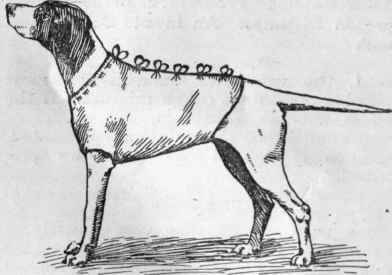
A coat for a dog suffering from distemper or any chest affection.
It should be made of flannel or blanket and, if necessary, wadded inside over the lungs
A leg bandage must always begin at the foot, no matter how high placed may be the injury. Otherwise, the limb will swell below the bandage and cause pain, and prevent the bone setting easily.
To bandage the head, begin by two turns round the neck, then take the lint between the ears over the head, down by the checks and underneath the jaws, and over the neck once more. Then take it under the jaw up the other cheek, across the head, and between the ears. A few stitches should be put in to hold all taut.
Distemper
This deadly complaint requires skilled advice and the most careful nursing. The points for the novice to recognise are : Mild cases need as careful treatment as severe ones ; the premonitory symptoms should be recognisable, and help sought at once ; the dog must have rest, warmth, quiet, and proper medicine and food.
The symptoms vary, but if a dog, especially a young one, seems to be unwell, without appetite, languid, losing flesh, with catarrhal symptoms, and especially with a rise in temperature, no time should be lost in suspecting distemper and taking precautions. Isolation is imperative. The disease being most contagious, the nurse should disinfect herself or himself after being with the patient. An old rubber coat and rubber overshoes are useful, as they can be sponged with disinfectant. The hands, of course, must be thoroughly washed in the same. The doctor will prescribe as to food and medicine. In any case, the former should be light, easily digested, and liquid.
As in bronchitis and pneumonia, a coat will have to be worn. An illustration shows such a one made from flannel or blanket. If required at once, a sufficiently large piece of material, with holes for the forelegs, sewn or safety-pinned down the back, will answer the purpose of a more elaborate garment. Possibly it may be necessary to wad it over the lungs with medicated cotton wool. To keep the wool in place, be sure to put in a few stitches where required.
The strictest fumigation and disinfecting of the dog's quarters will be necessary when it is well. The chief point in the nursing is never to hurry convalescence ; mild cases often end fatally, because the owner has been deceived into a belief that there is no further need for so much care.
Great care must be taken to wipe away (burning the rag each time) any discharge from nostrils or eyes, or any mucus from the floor. No one who has a distemper case should go to a dog-show or come into contact with the dogs of others.
Euthanasia
By this term is meant a painless death. Alas ! the day comes all too speedily when it is our duty to do for a canine friend what none may do for a human one. The owner should see that there is no chance of terror or unnecessary suffering connected with the death of his dog, and it is usually best to take him to a friend or have it done at home under personal supervision.
The best way is to have injected under the skin a sufficient dose of morphia, from one to a quarter grain, according to size. When it is certain that the dog is asleep, then chloroform should be administered, very slowly and gently, lest the patient be awakened, and this be continued until the animal has stopped breathing for several minutes. A piece of linen, folded into a funnel, can be used to receive the chloroform and be held to the nostrils of the patient.
But be sure that all is done by one who cannot blunder, and, if possible, by one to whom the dog is accustomed. To send away a pet to a distant lethal chamber, to wait its death amongst strangers under terrifying conditions, is horrible cruelty.
Continue to:


My Books

