


Foreign Squirrels
Description
This section is from "Every Woman's Encyclopaedia". Also available from Amazon: Every Woman's Encyclopaedia.
Foreign Squirrels
The Dorsal Squirrel - American Grey Squirrel - Flying, Malabar, and Prevost's Squirrels - Chipmunks - Prices of Squirrels - How to Feed and Care for Squirrels
All the foreign squirrels form delightful pets for ladies by reason of their hardiness, the handsome appearance which characterises most of them, and the charming little ways they possess.
Among the exotic species specially suitable may be named the dorsal squirrel, the American grey squirrel, the flying squirrel, the Malabar squirrel, and Prevost's squirrel ; there are also the ground squirrels, or chipmunks, as they are more commonly called.
The Indian palm squirrel, of which specimens have been imported, can only be recommended to the experienced squirrel-keeper. Some are more expensive than others ; chipmunks cost about Ios. per pair; dorsal squirrels, 30s. each; grey squirrels, 20s. ;flying squirrels, I5s. ; Malabar squirrels, 30s. ; Prevost's squirrels, 30s.
Squirrels, when properly treated, become astonishingly tame and are full of " cheeky " little mannerisms which endear them to all beholders. Few animals equal in softness of fur, delicacy of colouration and delightful tameness the beautiful little flying squirrel; few are more impudent and self-assertive than the dorsal squirrel.
The cage for all exotic squirrels - with the exception of the flying squirrel - should be as large as the space at one's disposal will permit; it ought never to be less than three or four feet square, and must be firmly put together of one-inch material, with every projecting edge covered with sheet tin or zinc to prevent the inmates nibbling the wood away. The wire front may be made of from half-inch to one-inch galvanised wire-netting, according to the particular species kept, the larger ones needing the one-inch mesh. It must be carefully stapled on to the woodwork, as the squirrels will run up and down and jump on it, and if it were flimsily attached one unlucky jump might push the netting sufficiently off to let the squirrel get out and away without being noticed.
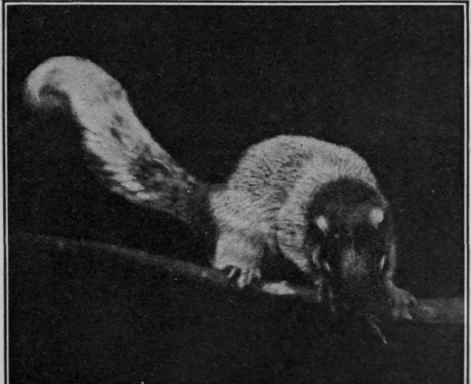
The dorsal squirrel, one of the most engaging of the squirrel family and the quaintest of ladies' pets. It is easily tamed and reasonably hardy
A sleeping box a foot square should be placed at the top of the cage just under the roof and a tree branch from there to the floor of the cage, so that the squirrels can easily get access to it. This sleeping box can be filled with nice sweet, clean hay or straw. The floor of the cage should be strewn over thickly with either sand or sawdust - the latter being the better deodorant and absorbent of the two.
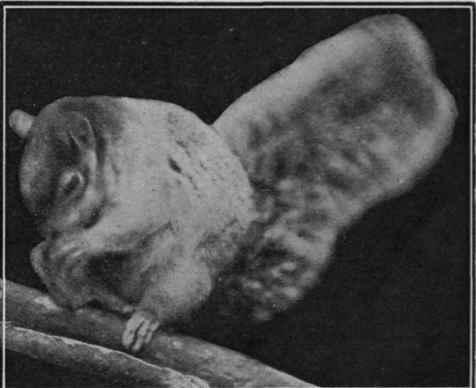
The grey squirrel, so called from the colour of its fur, is a pretty and attractive pet, which can be kept indoors, and with proper food and housing will live for a long time
This must be raked over and a fresh surface exposed every day, and entirely removed whenever necessary, the floor being scrubbed over with a boiling solution of soda and water combined with the use of strong disinfectant soap. If the fresh supply of sawdust be heated in the oven before being put down, the wet floor will be dried very quickly, and the damp cause no ill-effects to the inmates. If kept clean in this manner, squirrels may be comfortably housed indoors without there being any trace of smell to upset one's olfactory nerves.
The best kinds of food vessels are the earthenware ones, as they only want dipping into hot water and wiping dry to be kept perfectly sweet. The food itself is very simple, merely nuts of all kinds, fresh fruit in season, a little grain, and plenty of fresh water. Monkey nuts are the cheapest, but whenever possible, filberts and brazils should be given. Oats and maize are the easiest procured grain food. The fruit may be bananas, dates, apples, pears, and grapes. Carrot and greens may also be given. Bread-and-milk is useful, but must not be sloppy, merely with sufficient milk poured on the bread to be thoroughly absorbed by the latter, and then removed from the cage directly the squirrels have had all they want. The great thing is to vary the food as much as possible ; of course, plenty of nuts can be used, but to give this food only is to court the setting-up of intestinal ailments.
Those fair readers who prefer rich colouring, and are prepared to pay the price, will, no doubt, let their choice fall upon the Malabar squirrel, with its beautiful dark chestnut coat and creamy under-parts, but the majority will probably prefer the grey squirrel, typical of its name, or the dorsal squirrel. Where reasons of space and economical considerations must prevail, the tiny chipmunks are to be recommended ; these are prettily striped with black and white on a dusky-fawn ground colour, and can be kept very comfortably in a cage half the size of the one required for the other species ; in fact, a large bird-cage with a sanded floor and a bundle of hay in a corner into which the little squirrels can burrow, will be as good as anything. Chipmunks are especially fond of beechmast, and whenever this can be obtained it should be given.
Continue to:


My Books

