


Fricasseed Chicken, Legumes - Meat Substitutes, Preparation Of Pea Timbales, White Sauce, Seeds
Description
This section is from the "Cooking" book, by Lilla Frich. Also see Amazon: Cooking.
Fricasseed Chicken, Legumes - Meat Substitutes, Preparation Of Pea Timbales, White Sauce, Seeds
Fricasseed Chicken
This method is used in cooking a fowl which needs long cooking to make it tender. Dress, clean and cut up in pieces suitable for serving. Cover with boiling water and salt to taste. Cook very gently until tender. The length of time will depend upon the age of the fowl. Place chicken on a platter and keep hot. Make a sauce of the stock, allowing 2 tablespoons of thickening to each cup of liquid. A cup of cream added just before serving improves the sauce, or half each of stock and milk make a very good tasting sauce. Pour the sauce over the chicken. (Be careful that there is no grease floating on top of the sauce.)
If young chicken is used, it may be sauted first, then cooked one-half hour to one hour in the sauce, depending on the tenderness.
Legumes - Meat Substitutes
Preparation Of Pea Timbales
Peas, beans and lentils are sometimes called the "poor man's meat," as they have meat value and may be purchased at a small cost. They are slower of digestion, however, than meat and fish, but may be eaten freely by those who are engaged more or less in muscular labor.
GREEN PEA TIMBALES. School Recipe.
MATERIALS:
GREEN PEA TIMBALES. 2 Tablespoons Green Pea Pulp. 1/2 Teaspoon Melted Butter. Salt and Pepper to Taste. 1 Tablespoon Stale Bread Crumbs. 1/4 Yolk. 1/4 Beaten White.
White Sauce
1/4 Cup Milk. 1/2 Tablespoon Flour. 1/2 Tablespoon Cold Water. Salt and Pepper.

In these days of high prices, we must reduce the amount of meat in the diet. Dried peas, beans and lentils will take the place of meat because they contain vegetable albumen called casein. These may be used in soups, scalloped dishes, croquettes, timbales, etc. Oatmeal bread, whole wheat bread, macaroni and cheese dishes also have meat value and may be used as meat substitutes.
Seeds
Seeds constitute one of the most important food groups. The seeds of plants contain the embryo from which the new plant grows.
The seed usually contains a store of nourishment on which the new plant feeds for its growth for a longer or shorter period after it has sprouted.
The stored material varies in different plants, some containing a large proportion of starch, others oil, etc. The seeds are usually protected with an outer covering or coverings, ex., pod which covers peas and beans, husk on an ear of corn, bran layers and skin of cereals and hard shell of nuts, etc. The seeds commonly used for food are these:
1st: Legumes or pulses - Peas, beans, lentils and peanuts.
2nd: Nuts - Walnuts, etc.
3rd: Cereals - Wheat, corn, etc.
Legumes are among the most important food plants. Next to cereals they are the most valuable and most extensively used of all the vegetable foods. As a class, even when green, they are richer in protein than any of the other vegetable foods. For this reason they can be substituted for meat; and have been so widely used for this purpose that they are often spoken of as "the poor man's beef."
The chief protein found in the pulses is legumin, sometimes called "vegetable casein." Legumin unites with the salts of lime and the compound resulting is not soluble in water. Therefore, peas and beans do not cook readily in hard water which always contains some lime salts. A little soda added to the water will soften it and the legumes.
The legumes contain a rather high per cent of carbohydrates, but are poor in fats, and should therefore be eaten with foods rich in fat or fats, such as salt pork or butter to make them a perfect food.
The protein in legumes is not as completely digested as the protein in meat, but careful cooking will remedy this greatly. Although, even then, they are more suitable for persons engaged in outdoor labor than for those of sedentary habits.
Peas, beans and other legumes should be soaked 8 to 48 hours in cold water, preferably soft;1/4 teaspoon soda to 1 cup beans and 4 quarts water will aid in softening them.
To soften every particle, burst and swell the starch grains, to cook the protein compounds without too high a temperature, and to develop a good flavor, they should be cooked at the simmering point a long time.
The addition of seasonings, onions or herbs makes the dish palatable. The addition of fat provides a food that meets all the requirements of nutrition.
They are more completely digested when combined with other foods, with the skins removed, and when finely divided. Hence, we obtain more nutriment from them when they are prepared as soups than in any other way.
Working Directions To Be Followed By All Odd Numbered Girls
In today's lesson you are to prepare the bread crumbs for the pea timbales for your partner and make the White Sauce.
See Recipe on Front Page.
Prepare the bread crumbs by rubbing 2 pieces of stale bread together (see FIGURE 1). Pass them to your partner.
To make the white sauce first measure and scald the milk.
Measure the flour into your sauce plate, add an equal amount of cold water, beat until perfectly smooth. (See FIGURE 2.) Thin out with a little more cold water.
Add to scalded milk, stirring all the time, until thickened. (See FIGURE 3.)
Season with salt and pepper.
Serve the white sauce with the pea timbales.
You are to WIPE the dishes today according: to directions already learned.

FIGURE 1.

FIGURE 2.

FIGURE 3.
NOTE BOOK WORK. Pea Timbales.
MATERIALS:
1 Cup Dried Green Peas.
2 Tablespoons Butter.
1/2 Cup Stale Bread Crumbs. 1/2 Teaspoon Salt. 1/8 Teaspoon Pepper. 1 or 2 Beaten Eggs.

Working Directions:
Soak peas in enough cold water to cover. Cook slowly about 3 hours. Force peas through a strainer, add butter, salt, pepper, bread crumbs and beaten egg.
Butter and crumb a mold. Turn pea mixture into mold, steam 40 minutes or bake 25 minutes in a slow oven. May be served with boiled Salt Pork.
Cost of preparing Home Recipe of Pea Timbales:
Materials: | Cost. |
1 Cup Dried Green Peas...... | cts. |
2 Tablespoons Butter or Other Fat......................... | cts. |
1 Cup Stale Bread Crumbs................................. | cts. |
Seasoning....... | cts. |
1 or 2 Eggs........ | cts. |
Working Directions To Be Followed By All Even Numbered Girls
In today's lesson you are to prepare the Pea Timbales.
See Recipe on Front Page.
Measure the pea pulp; force it through strainer into your bowl (see FIGURE 1), add the melted butter, salt and pepper.
Measure and add the stale bread crumbs and the yolk passed by housekeeper.
Fold in the stiffly beaten white, (see FIGURE 2) prepared and passed by housekeeper.
Butter your steamer mold or custard cup. Put a teaspoon of rolled crumbs into your mold, shake it until thoroughly crumbed; pour remaining crumbs back into the dish at the supply table. Pour into it the pea pulp mixture.
Put steamer in the ring. (See FIGURE 3.)
Place steamer and ring in the saucepan filled with boiling water to reach half way to top of mold. (See FIGURE 4.)
Cover and cook 25 minutes.
Remove from mold and serve yourself and partner.
You are to WASH the dishes today according to directions already learned.
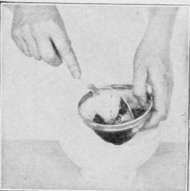
FIGURE 1.

FIGURE 2.

FIGURE 3.
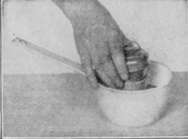
FIGURE 4.
HOME RECIPES. SAVORY LIMA BEANS.
MATERIALS:
1/2 Pound Lima Beans. 1 Slice Onion. 1 Clove.
1 Small Bunch Herbs. 1 1/2 Cups White Sauce. 1 Beaten Egg.
WORKING DIRECTIONS:
Soak the beans in cold water to cover, for 3 hours. Put soaked beans into a saucepan, cover with milk and water; add onion, clove and herbs. Simmer about 4 hours. Remove onion, clove and herbs; drain off the liquid.
Pour the white sauce over the beans and reheat. Remove from fire, stir in the slightly beaten egg. Serve.
Continue to:


My Books

