


Proteins - Tissue Building Foods, Preparation Of Fish, Hollandaise Sauce, Boiled Fish With Potato Balls, Fish - Tissue Building Foods, White-Fleshed Fish: - Ex, Red-Fleshed Fish: - Ex, How To Select Fresh Fish, How To Clean Fish, How To Skin A Fish, How To Bone A Fish, Methods Of Cooking Fish, Boiled Fish
Description
This section is from the "Cooking" book, by Lilla Frich. Also see Amazon: Cooking.
Proteins - Tissue Building Foods, Preparation Of Fish, Hollandaise Sauce, Boiled Fish With Potato Balls, Fish - Tissue Building Foods, White-Fleshed Fish: - Ex, Red-Fleshed Fish: - Ex, How To Select Fresh Fish, How To Clean Fish, How To Skin A Fish, How To Bone A Fish, Methods Of Cooking Fish, Boiled Fish
Proteins - Tissue Building Foods
Preparation Of Fish
Fish is regarded as a most valuable meat substitute. It contains the same kind of nutrients and at a lower cost. Stale fish may be poisonous, so great care should be exercised in its selection.
Hollandaise Sauce
MATERIALS:
1 Piece of Fish. 1 1/2 Teaspoons Salt. 1 1/2 Teaspoons Vinegar. 1 Cup Water.
1 Teaspoon Butter. 1 Teaspoon Flour. 1/4 Cup Fish Stock.
1/2 Yoik.
1 Teaspoon Lemon Juice.
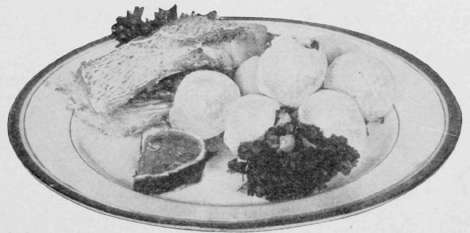
Boiled Fish With Potato Balls
Individual Serve.
Fish is the animal food next in importance to meat. One should be very careful in selecting fish to make sure that it is strictly fresh.
Steaming, baking, and broiling are the three methods that are considered the best ways of preparing fish, because these methods retain the juices.
In today's lesson, we are going to boil fish. In boiling, part of the juices are extracted but if a sauce is made from the stock and it is served with the fish we lose none of the nourishment.
When salt and vinegar have been added to the water, it is called salted and acidulated water. The water gives flavor and the vinegar makes the flesh firm.
Fish - Tissue Building Foods
FISH is the animal food next in importance to meat. The fish flesh is less stimulating and nourishing than meat but it is considered more easily digested.
Fish is classified into the white-fleshed and red-fleshed.
In the white-fleshed fish, most of the oil is located around the liver, while in the red-fleshed the oil is distributed throughout the flesh.
White-Fleshed Fish: - Ex
Whitefish, Haddock, Cod, Flounder, Smelt. Perch, Pickerel, Sun-fish, Croppies, etc.
Red-Fleshed Fish: - Ex
Salmon, Shad, Lake Trout, Butter F'ish, Herring, etc.
The white-fleshed fish is more easily digested than the red-fleshed, therefore, it is selected for invalids, convalescents or those suffering from weak digestion.
Fish should be eaten while fresh and in season. Stale fish is poisonous.
How To Select Fresh Fish
Select a fish that has bright eyes and gills, shiny scales, firm flesh and is free from a disagreeable odor.
How To Clean Fish
Remove the scales by drawing a knife over the fish, beginning at the tail and working toward the head.
Wipe the fish inside and out with a cloth, wet in cold salted water, then wipe with a clean dry cloth kept for the purpose. Head and tail may or may not be taken off, according to the manner of cooking.
How To Skin A Fish
Rub fingers with salt so that the fish may be held without slipping. Remove fins along the back with a sharp knife. Cut off a narrow strip of skin the entire length of the back. Loosen the skin from the bony part of gills and draw it off very carefully, one side at a time.
How To Bone A Fish
Clean, then begin at the tail and run a sharp knife under flesh close to the back, working toward the head. Turn and repeat on the other side. Pick out any small bones that may remain.
Methods Of Cooking Fish
Broiling, baking and steaming are the best methods of cooking fish.
Fish suitable for broiling are - Split mackerel, whitefish, cod, shad, trout, etc., sliced halibut and salmon, white smelts and small fish.
Fish suitable for baking whole are - Whitefish, cod. haddock, small salmon, shad. etc.
Fish suitable for boiling are - Salmon, halibut, cod, haddock, trout, etc.
Fish suitable for frying are - The white-fleshed fish.
Working Directions To Be Followed By All Odd Numbered Girls
NOTE: In today's Lesson, you will prepare the fish, and your partner will prepare the sauce. Follow each paragraph closely.
See Recipe on Front Page.
Put the salt, vinegar and water into your saucepan. Place it over the fire.
Wipe the piece of fish.
Put it very carefully into the saucepan containing boiling salted acidulated water, using your wire whisk beater. See FIGURE 1.
Let it cook gently until flesh will leave the bone when tried with a fork. Take out with the wire whisk beater. See FIGURE 2.
While the fish is cooking, make a lemon boat by cutting a lemon in half and scalloping edges with a knife or pair of scissors; remove the inside and serve the sauce in the lemon boat.
Put onto a hot plate.
Serve your partner and self.
You are to WASH the dishes today according to directions already learned.

FIGURE 1.

FIGURE 2.
Note Book Work
1 fish.
2 teaspoons salt.
2 tablespoons vinegar to each quart water.
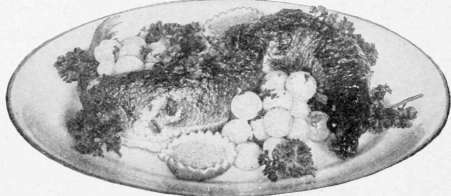
Boiled Fish
Working Directions:
Clean and wipe the fish; tie in a cheese cloth to hold the fish together and to prevent the scum from adhering to the fish. Place the fish on a rack or frying basket to keep the shape and to make it easier to remove from the water. Cook gently in boiling salted acidulated water to cover the fish, using 2 teaspoons salt and 2 tablespoons vinegar to each quart of water. The salt gives flavor and the vinegar or lemon juice keeps the flesh white. Allow about 15 minutes to the pound. The fish is cooked when the flesh is firm and separates easily from the bone.
Remove from water, take off the cheese cloth, put on a hot platter, and serve with Hollandaise Sauce.
Cost of Preparing Boiled Fish:
Materials | Cost |
Fish ................................................................ | cts. |
2 teaspoons salt......... | cts. |
2 tablespoons vinegar........ | cts. |
Continue to:


My Books

