


White Custard, Chocolate Custard, Cheese Custard, Custard Bread Pudding, Invalid Cookery, Proteins - Tissue Building Foods, School Recipe, Prune Whip, Custard Sauce
Description
This section is from the "Cooking" book, by Lilla Frich. Also see Amazon: Cooking.
White Custard, Chocolate Custard, Cheese Custard, Custard Bread Pudding, Invalid Cookery, Proteins - Tissue Building Foods, School Recipe, Prune Whip, Custard Sauce
White Custard
2 Cups Scalded Milk. 1/8 Teaspoonful Salt. 1/2 Teaspoonful Vanilla.
1/4 Cup Sugar. Whites of 4 Eggs.
Beat the whites slightly; stir in the sugar and salt. Pour on the scalded milk gradually. Add vanilla, strain into a buttered baking dish. Bake as
Yellow Custard.
Chocolate Custard
1/2 Square Unsweetened Chocolate. 1/2 Cup Sugar. 2 Tablespoonfuls Water. 1/2 Teaspoonful Vanilla.
2 Cups Milk.
3 Eggs.
1/8 Teaspoonful Salt.
Scald the milk; melt the chocolate, stir in half the sugar, add the water and cook until smooth and glossy. Add the scalded milk to the chocolate mixture, stirring until well mixed. Beat the eggs slightly, add remainder of sugar and the salt. Pour into it the chocolate and milk mixture; strain into buttered moulds. Bake as Yellow Custard.
Cheese Custard
1 Cup Milk. 1 Egg. 2 Tablespoonfuls Cheese. Sprinkling Pepper. Scald the milk; stir into it the beaten egg; add the cheese and pepper. Bake as Yellow Custard.
Custard Bread Pudding
May be made by pouring any of these mixtures over buttered slices of toast and baking according to directions for Baked Yellow Custard.
Questions
1. At what temperature does albumen coagulate?
2. How should egg and egg mixtures be cooked?
3. How do eggs spoil? Explain.
4. How can you tell a fresh egg from a stale one?
5. How may eggs be kept or preserved?
6. How would you break eggs?
7. With what would you beat the whites of eggs?
8. With what would you beat the yolks of eggs?
9. Give composition of eggs.
10. Give nutritive value of eggs.
11. Why are eggs given to persons in a run-down condition?
12. Where are eggs digested?
13. What digestive fluids act on eggs?
14. Into what are they changed during the process of digestion?
15. Name 3 egg and milk dishes.
Suggestions For Home Application
Invalid Cookery
Food for an invalid should always be prepared so as to render it most digestible. Eggs and milk are usually prescribed and should be prepared and served in a variety of ways that the appetite may be tempted. Milk may be served warm or cold, plain or flavored in junkets, frozen as in ice-cream, heated with a little vegetable, fermented as in kumyss or soured as in buttermilk, and seasoned as in cream soups, combined with eggs as in eggnogs or custards soft or firm. Eggs may be soft cooked, coddled, poached or made into omelets, or the white or yolk or both added to broths or mixed with fruit juices, or with gelatine as in Spanish Cream pudding and Lemon Pudding. All of the above combinations furnish highly nutritive, easily digested foods.
When the patient is permitted to take fruit juices they will be found very refreshing. They are particularly desirable in fevers.
The foods listed above may be given to a patient when he is in a weak condition, and the digestive organs are not able to take care of heavy foods.
When the temperature is normal, as a rule, the patient will crave more substantial food and it should be furnished. As long as he is confined to bed, or is unable to take any kind of exercise, the food should not tax the digestive organs very severely. Naturally all rich puddings, cakes, pastries, and meats, like veal or pork, that are difficult of digestion should be avoided. Frozen desserts, egg puddings, baked potatoes, chicken breast, squabs, quail, lamb chops, sweetbreads and tender, rare beef carefully prepared furnish valuable nourishment in an easily digested form.
Foods should be given to invalids in small quantities at frequent intervals during the day. In this way it is easier to judge the effect of different foods given and there is less danger of the organs of digestion being overtaxed.
The personal likes and dislikes of the patient should be given careful attention in preparing his food. A food which in itself might be perfectly suited to his needs may actually prove harmful if he is forced to eat it when it is distasteful to him.
In any case, the physician's orders in regard to the diet of the patient should be carefully followed, as the physician is responsible for the recovery of the patient. Failure to obey his orders might cause very serious results.
Proteins - Tissue Building Foods
EGGS IN DESSERTS (Continued).
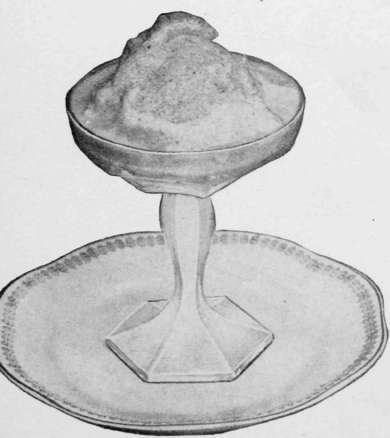
Air may be beaten into the white of egg, filling it full of bubbles, making a light and porous mass. Sweetened fruit pulp may be added to the beaten white of egg and the result is a delightfully fluffy dessert.
School Recipe
MATERIALS:
Prune Whip
4 Soaked Prunes.
1/2 Beaten White of Egg.
1 Tablespoonful Powdered Sugar.
Custard Sauce
1/4 Cup Scalded Milk. 1/16 Teaspoonful Salt.
2 Teaspoonfuls Sugar. 1/2 Yolk.
Few Drops Vanilla
In the above recipe, we have a combination of eggs and milk with fruit pulp. The eggs are beaten separately. This makes a wholesome, nutritious dessert. Prunes are dried plums. They are classed as sub-acid fruits, as they do not contain a large proportion of acid. They are rich in sugar.
Continue to:


My Books

