


Directions For Canning Some Vegetables Which Require Special Treatment, Canning Fruits, Canning Peaches, Acid And Salt Supplying Foods, Fruits, How To Serve Fresh Fruits
Description
This section is from the "Cooking" book, by Lilla Frich. Also see Amazon: Cooking.
Directions For Canning Some Vegetables Which Require Special Treatment, Canning Fruits, Canning Peaches, Acid And Salt Supplying Foods, Fruits, How To Serve Fresh Fruits
Directions For Canning Some Vegetables Which Require Special Treatment
Canned Sweet Potatoes:
Peel and slice the potatoes and boil them in slightly salted water until they are tender. Pack them in jars, adding a sprinkling of sugar and salt for seasoning if desired. Put on the rubbers and screw the covers on loosely. Place the jars in a pan of water and can the same as tomatoes, steaming them for 4 hours one day or 1 hour for three successive days.
Canned Young Beats:
Small, tender beets fresh from the ground should be used for canning. Cut off the leaves so about an inch of stem remains and wash the young beets without bruising the skins. Cook them until tender, drain, and cover with cold water. Remove the skins and pack the beets in jars. Cover with warm salted water and can the same as tomatoes, steaming only one-half hour, or until beets are thoroughly heated.
Beets for Winter Use:
Boil the beets in water until they are tender, and then pack them in jars. Heat together equal parts of water and vinegar with a little salt and vinegar. When it reaches the boiling point, pour it over the beets until it overflows the jar, and seal at once.
Canned Corn on the Cob:
Boil five to ten minutes, according to size, freshness and ripeness; plunge quickly into cold water. Pack, alternating butts and tips; add a little boiling water and one level teaspoonful of salt to each quart. Put on rubbers, then cover loosely. Steam the same as tomatoes, four hours, or one hour three successive days. A quart jar will hold about two ears, a two-quart jar from three to five. A gallon tin can is really more practical because it will hold a good many ears. Begin to pack on the outer edge of the can and work . toward the center; place the butt end down in the first row, then the butt end up in the second row, alternate butt ends and top until the can is full. The tin cover may be sealed with melted resin.
FOOD PRESERVATION (Continued).
Canning Fruits
Vegetables or fruits may be cooked in the jar or in a kettle and then placed in a sterilized jar. Successful results in both depends on perfect sterilization. If directions are followed accurately, in today's lesson, the fruit will keep indefinitely.
MATERIALS: 2 Peaches.
1/2 Cup Sugar. 1/2 Cup Water. 1 Clove. 1 Thin Shaving of Lemon Rind.
Canning Peaches
In today's Lesson we are going to preserve fruit, employing a different method from last week's Lesson.
In place of cooking the materials in the can, as we did last week, we are going to cook them in the saucepan and pour thorn while hot into a sterilized can or jar.
The object is the same in both methods - complete sterilization.
The amount of sugar may be small or large, according to individual taste.

Acid And Salt Supplying Foods
Fruits and vegetables are the principal sources of acid and salt-supplying foods. These food elements are also found in fish, meat, and cereals.
The human body includes compounds of lime, potassium, sodium, iron and common salt, the latter of which is found in every part of the body except the enamel of the teeth.
Foods containing mineral matter are necessary for the formation of bones and teeth. Since cereals are rich in mineral matter they should form an important food in the diet of growing children.
Fruits
Fruits are seed vessels of plants. They contain a large amount of water, cellulose, sugar, acids and salts. They not only refresh and cool the system, but stimulate the appetite and act as blood purifiers.
The cellulose helps to carry off waste matter and the acids destroy disease germs in the body. People who eat a large amount of fruit are seldom ill.
Bananas, dates and figs are rich in sugary and starchy substances, and form the staple food in the countries where they grow.
Prunes are dried plums. Raisins are dried grapes.
Eat only sound, ripe fruits. Unripe fruit or fruit that has been kept a little too long may be cooked to make it safe for eating.
You should not eat acid fruits with milk or cream.
How To Serve Fresh Fruits
Small fruits, such as strawberries, raspberries, blackberries, huckleberries and currants should be moderately chilled. The fruit should be handled as little as possible.
It is a good plan after picking them over to put the selected berries into a colander, dipping it in and out of a pan containing cold water.
Strawberries should be washed before being hulled.
Cantaloupes should be thoroughly washed and scrubbed, then chilled. Just before serving, cut them into halves, crosswise, and scoop out the seeds. Serve one-half to each person.
Working Directions To Be Followed By All Odd Numbered Pupils
NOTE: In canning the peaches, you are to prepare the syrup and cook one peach. Your partner will assist you in preparing the syrup and will likewise cook one peach. Follow each paragraph closely.
See Recipe on Front Page.
Measure the sugar into the saucepan; add a thin strip of lemon rind.
Pour boiling water over the peach, allowing it to stand just long enough to loosen the skin, so it can be easily removed.
Remove the skin; cut the peach in halves.
When the sugar and water have boiled five minutes, drop the peach halves into it and cook the peaches until they are soft enough to be easily pierced with a fork.
Carefully put cooked peaches into a sterilized jar, and with a spoon place each so the round side faces the outside of the can. See FIGURE 1. It may require the peaches which four or more of the girls have prepared to fill the jar.
After the can has been filled with fruit, pour in the syrup until the can is filled to overflowing.
If you have a silver knife drop it into the boiling water in which your jar was sterilized. Slip the blade around the fruit on the inside of the jar; this will cause the juice to fill in closely around the fruit, and thus avoid leaving any air spaces. Dip the rubber into the boiling water, and place it smoothly on the jar.
The lid must be put on securely.
You are to WIPE the dishes today according to directions already learned.
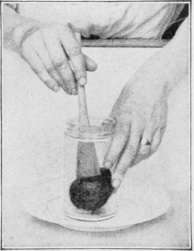
FIGURE 1.
Note Book Work
2 Cups water.
3 Lbs. peaches. 8 Peachstones.
1 Lb. sugar.
8 Cloves and a few shavings of lemon rind, if desired.

Continue to:


My Books

