


How To Buy And Cook Poultry
Description
This section is from the book "The Pure Food Cook Book: The Good Housekeeping Recipes, Just How To Buy, Just How To Cook", by Harvey W. Wiley. Also available from Amazon: The Pure Food Cookbook.
How To Buy And Cook Poultry

A FEW simple rules cover the selection of all poultry. In the first place, the bones should be tender; that is, if one places the forefinger of the right hand in the hollow of the neck (at the elbow of the wishbone) and the thumb of the same hand at the end of the breastbone and then contracts the hand gently, if the bird is young and tender the bone will give; if it is old and tough, the bone will be stiff and hard, and impossible to bend. The same is true of the wings. If the bones are tender and bend under pressure, the bird is young.
There is another test for wings, akin to that used in the testing of fish. If, when the wings are pulled out, they spring back into shape when released, it is a sign of young meat. The same thing is true of the feet of the bird. If, when spread apart, they collapse easily, the bird is young. The breastbone and wingbones may be broken in order to make the unsophisticated think that the bird is young, but it is a simple matter to feel the bones crunch under such circumstances, when one may be fairly certain that the bird is no longer young.
Another test is that the skin should be firm and smooth. The color, authorities say, should be yellow. This is not a question of age or youth, but of the breed, and consequently is not of special value. On the other hand, hairs are a sign of age, and while it is said that pin-feathers are a sign of youth, this is not true, because the presence of feathers and the color of them depend upon the breed of the chicken and the time of year it is killed. Heavy scales on the feet are also a sign of age; but with a turkey, when the spurs are soft and loose, it is a good sign.
In domestic poultry the flesh of the breast and wings will be white, and should be firm and not heavily fatted, while the legs are of dark meat. In game, the meat of the bird throughout is usually dark and the wings will be of a tougher quality than the legs, which is exactly the reverse in the domestic bird. This is because in the one the wings are used in flying, while in the other the legs are the means of locomotion, and in consequence the fibers will be heavier and coarser. The breast of game should, if it is good, be full and firm and rather fat. On the whole, game will have a large percentage of fat in its composition and be less easily digested than chicken or turkey.
Chickens which are not a year old are known as broilers, and at the present time are usually incubated. Chickens which are exactly a year old are known as prime roasters, and those over a year old are qualified by the term " fowl." The so-called spring chicken, which appears in the market in January, weighs about one and one-half pounds. Fowls are the best from March until June. Turkeys are the best in the winter months. Geese are usually at their best from May until September. A goose twelve weeks old is called a " green goose." Young geese are often called goslings. The time of the quail and partridge is limited by the game laws, but as a rule we can find them on the market in fall, while we have the plover through the spring and cold storage at other seasons. The grouse comes in the available at all times of the year, provided we are willing to pay the price.
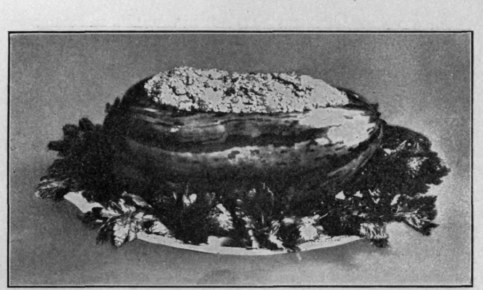
Steamed Squash in Shell. Recipe on Page 335.
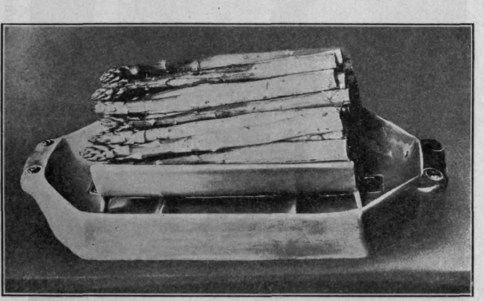
Boiled Asparagus. Recipe on Page 317.
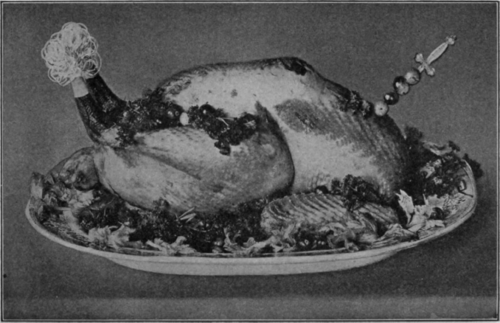
Roast Turkey, Garnished with Cranberries for the Thanksgiving Table. Recipe on Page 177.
In general, the domestic poultry should be well cooked, and the game served rare. This statement, however, should be qualified by the fact that if the game is white-meated it should be better done. The characteristic flavor is not a sign of tainted meat, as some occasionally think, but of breed and life. Game should never hang any longer than until it is just tender.
Continue to:


My Books

