


Insects, No. 5. - Illustrated - Aphidiphagi
Description
This section is from "The Horticulturist, And Journal Of Rural Art And Rural Taste", by P. Barry, A. J. Downing, J. Jay Smith, Peter B. Mead, F. W. Woodward, Henry T. Williams. Also available from Amazon: Horticulturist and Journal of Rural Art and Rural Taste.
Insects, No. 5. - Illustrated - Aphidiphagi
Having, in our last article, considered several species of plant lice, we will now consider those insects known to feed upon the aphids, in three sections. The First, larvae of coleopterous insects - the Beetle family; in the Second, those of Neurop-tera, and also the Ichneumons, which, however, do not feed, but oviposit upon aphids, and are classed among the Hymenoptera; Section Third, those of dipterous species, or two-winged Flies.
Sect. I. The Family Coccinellidae
Sect. I. The Family Coccinellidae, comprised of about twelve genera, among which are the Coccinella - perhaps twenty-six species. These are usually of a red, yellow, or orange ground color, ornamented with black spots, varying in number. Others are black, with white, red, or yellow spots; they are smooth, and very pretty, observed by every child, and called "lady birds," Common among flowers and plants in oar gardens, Figs, 4, 5, 6, and 7, show the perfect insect. Fig, 3, a pupa similar to those of Chrysomela, found attached to leaves. Fig. 11, the hatchet-shaped terminal joint of the maxillary palpi. Fig. 12, the oblong labium and bind mandible. Fig. 13, the pseudo-three-jointed tarsi. Fig. 10 is a most beautiful insect I have met with - a species of Cassidadac, or Tortoise Beetles (?); this had the centre of the thorax and scutcl-lum of a burnished gold color, the centre of the elytra reddish-orange, the external margin of the elytra and thorax of a delicately veined, transparent, pearly border, concealing the head, etc In the cabinet they lose their brilliancy. Fig. 9 is without spots - perhaps Say's Coc-cinella normata. They are difficult to name; hence, without first comparing those and others in my collection with a well arranged cabinet, I prefer silence.
Figs. 1 and 2 are the larvae, so destructive to aphids that, by placing a few upon an infested plant, they will speedily exterminate them. The parent usually lays her eggs in clusters among the aphids, where they batch, and find their food at hand.
The perfect insect, and the larvae, as also some species of Chrysoraela, emit a viscid, yellow fluid, which, according to Dr. Hirseh, of Vienna, when bruised with the finger, imparts thereto the property of allaying the severest toothache, by simply robbing the teeth and gums with it. It is deemed an admirable specific, and that the efficacy on the finger lasts for several days. M. V. Andouin states he has observed the union of individuals of opposite colors, but found that the eggs resulting from this union were sterile.
There is another smaller, blackish beetle of this family, usually pubescent, comprising eighteen species, known as Scymnus, which means a lion's whelp, and the larvae distinguished from the last by being clothed with tufts of white, down-like hairs. Mr Harris says they "are as sanguinary and ferocious as the most savage beast of prey," "catching and devouring, with the greatest ease, lice nearly as large as its own body, one after another, in rapid succession, without, apparently, satisfying its hunger, or diminishing its activity!" This reminds one of Paddy's greedy pig, which, after devouring a bucketful of feed, failed to fill the same vessel, head, bristles, and all.
Sect. II. Hemerobiidae (Lace-Winged Flies)
Sect. Ii. Hemerobiidae (Lace-Winged Flies), remarkable for the golden brilliancy of its prominent eyes (Fig.7), and the delicate green wings of our Crysopaperla (Fig. 4)- Mr. Harris states that "it suspends its eggs in clusters beneath the leaves where plant-lice abound." I hare not found any so suspended, but standing erect on the top of the leaf of an apple-tree, on a rather long and delicate stipe (Fig. 8), sometimes in clusters like minute fungi. Figs. 1 and 2, the larvae; Fig. 1, greatly magnified, is of a dark, purplish-lead color, beautifully ornamented with orange yellow spots; head rather broad in front, yellowish, with two black, longish spots on its middle. The mandibles are long, curved, and pointed, grooved beneath, in which the maxilla are concealed, enabling them to hold and suck their prey. The "jaws are not perforated with a hole," as stated by Mr. Harris; this is a mistaken view of older writers than Mr. H.
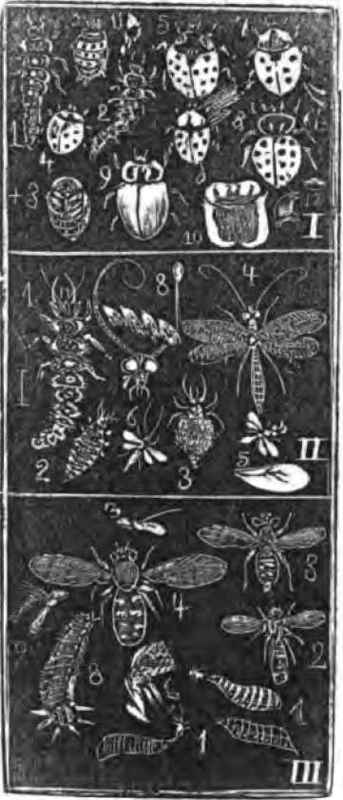
By opening excrescences common on the elm, infested by a species of Erisoma, I have frequently found this larva in their midst, like a wolf among a flock of sheep, making havoc to their utter extermination. The pupa I have not seen, but copy that of the Hemerobius merdiger (Fig. 3) escaping from its net-veined cocoon, about the size of a pea. Such is the case, also, with our species, I infer. Figs. 5 and 6 are two species of minute Ichneumons - captured while engaged at ovipositing upon the aphids on the cabbage - called blight, A. brassica (Fig. 5), and its wing; this has a brilliant gold bronze thorax and abdomen; the antennae, short, clavate. The other had long, filiform antennae. Those, again, have their parasites, a species of Ohalcididae; are said to deposit their egg into the maggot of the Ichneumon already preying upon the vitals of the Aphid, thus producing a maggot within a maggot within so minute a carcass. This reminds one of Mr. Stephen's quaint couplet in his Illustration*, vol. vii., which says; -
"Great fleas and little fleas have smaller fleas to bite 'em, The smaller fleas have lesser fleas - so on, ad infinitum".
Continue to:


My Books

