


Management Of Pyramidal Trees
Description
This section is from "The Horticulturist, And Journal Of Rural Art And Rural Taste", by P. Barry, A. J. Downing, J. Jay Smith, Peter B. Mead, F. W. Woodward, Henry T. Williams. Also available from Amazon: Horticulturist and Journal of Rural Art and Rural Taste.
Management Of Pyramidal Trees
In the August number of the Horticulturist, page 337, there is an extract from the London Gardeners' Chronicle, by William Mason. Mr. Mason complains of the absence of good pyramid pruning in that country (England). Now, sir, the question which arises is this: Are we in advance of our trans-atlantic friends, the British, in that department of horticulture? I think not, and will give you my reasons; but, in justice to the cultivators of pyramid Pears in this country, I must here state that I have never seen any large pyramid Pears in America, my observations being entirely drawn from the sample of young trees that I have secured at different times from Nurseries North and East.* These trees have all had plenty of good clean wood; and had they been headed down, as Mr. Mason recommends, they would have pleased the most fastidious taste in Pear culture. Now, my reasons for supposing that good pyramids are scarce in this country as well as England, arises from the fact tha tthe majority of our trees are not headed down low enough the first year from the bud, aa all the trees that have come under my notice have been headed down to eighteen inches and upwards.
If pyramid Pears were cut down from ten inches to a foot, we should never see any trees like No. 4, as figured in the June number of the Horticulturist, page 255,+ for the top of that tree must have been where the spurs are at its base. Every body that knows any thing about working up deep trees, must be aware that if we prune sparingly the first season our trees never can become fully developed at the base, although very high authorities in England as well as in America have recommended the leaving of eighteen inches of the first year's wood. Now, if there is any analogy between working up a horizontal tree and a pyramid, why would not the same system of pruning be adapted to the one as well as the other in the first formation of the tree, the object being the same in both, viz., to secure a well-developed base the second year from the bud?
* Nurserymen generally find it to their advantage to have tall trees, aa the tallest sell the beat The English Nurserymen seldom attempt to grow pyramidal trees for sale. Borne advertise them, but we do not remember to hare seen one worthy of the name. Very little is really known yet in England of the management of pyramidal trees; and whatever Mr. Thompson teaches has been gathered by him from French practice. - ED.
+ Very much depends upon the variety. It would never do to adopt a uniform length or number of buds, as eighteen inches would be as low for some as ten for others. For instance: the Glout Morceau throws out side branches with the slightest provocation, whereas the Louise Bonns is obstinate. - ED.
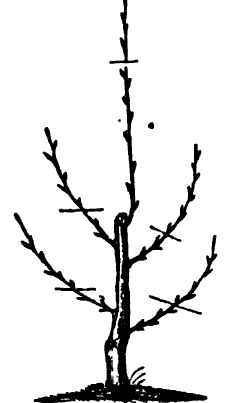
I can not think that any of the advocates of this system of long pruning for pyramids, would recommend the same length of wood in a horizontal tree. For my part, if I was going to head down a tree of one year's growth, to be worked up as a horizontal or a pyramid, I would cut down to about five good buds, leaving the top bud for the perpendicular, while the four remaining ones would form the base; and if for a pyramid, it would be something like the annexed figure. But the objection to this system of pruning might be this: the growth in this country is so great, as compared to the growth in England, that the bottom buds on our trees are abortive;* and by heading down to full and perfect buds, accounts for our long system of pruning. But suppose these trees were headed down as soon as all danger of a second growth was over, would not these buds become fully developed by the spring? This, I am aware, would not suit nurserymen, as most people like to prune their own trees, whether they know how or not.
But I think there is no danger even if the lower buds are not as well developed as we could wish, for this reason: I headed down several trees last January that were two years old, without any appearance of good buds; these trees all threw out good strong shoots, and may be formed into handsome pyramids. I think there can be no doubt that a tree may be formed the first year from the bud, similar to the above figure, by keeping the terminal bud pinched out until the base of the tree is formed.+ This ought to be done when the shoot reaches about eight or ten inches, but never ought to exceed ten. This is an experiment I have not tried, for the want of young trees; but still I think, by not allowing the shoot to make one straight growth, we stop the superabundant sap which would flow into that part of the tree that is to be cut off - therefore there can be no economy in allowing the tree to grow into one straight shoot the first year, to be cut off and thrown away the next. But if by pinching the first year's bud, as directed above, we get from four to six good laterals at the base of the tree, I think we shall be saving one year.
The object in growing pyramidal Pears ought to be the beauty of the tree, as well as the goodness of the fruit; but if in the first instance we spare the knife, we spoil the tree. All deep trees ought to be pruned after Mr. Thomson's method - that is, the summer pinching - always beginning at the top of the tree first, allowing the under part of the tree to remain ten or twelve days before it is pinched. This check upon the upper part of the tree forces the sap into the lower branches, and keeps the tree uniformly the same from top to bottom.
• No difficulty on this point - the lowest buds on a yearling shoot may be forced out by close pruning. - ED.
+ This answers very wen with some varieties, such as form lateral buds as the growth proceeds, Many varieties, however, will not throw out side branches by pinching, but merely stop growing for a time, until a good terminal bud is formed, when it pushes; and trees of this kind are much injured by pinching. We hare tried this experiment extensively. We are satisfied that, in all cases, it is safer to allow the yearling tree to complete its growth in our climate, and then cut back to the desired point; the buds thus left have great forcs, and push vigorously. In the South, where a late growth is common, pinching the extremities at a time when the lateral buds are not likely to push, will no doubt aid in ripening the wood and perfecting the buds. - Ed.
Continue to:


My Books

