


Culture Of The Camellia Japonica
Description
This section is from "The Horticulturist, And Journal Of Rural Art And Rural Taste", by P. Barry, A. J. Downing, J. Jay Smith, Peter B. Mead, F. W. Woodward, Henry T. Williams. Also available from Amazon: Horticulturist and Journal of Rural Art and Rural Taste.
Culture Of The Camellia Japonica
The vegetable kingdom has presented us with an inexhaustible richness of gratifying and inquiring meditations. Sometimes it is beautiful flowers that attract our attention; at other times, the variegated leaves of the Begonias, Ma-rantas, Draeamas, or Crotons, or the flavor of some fruit. It would be impossible for any contemplative mind to pass by the Camellia Japonica, whose flowers by cultivation have attained such great perfection. When we behold their waxlike appearance, clear colors, and differently formed flowers, and dark green, shining foliage, it refreshes our soul. Would it, then, be out of the way if we made use of these long winter evenings to make ourselves familiar with this noble plant?
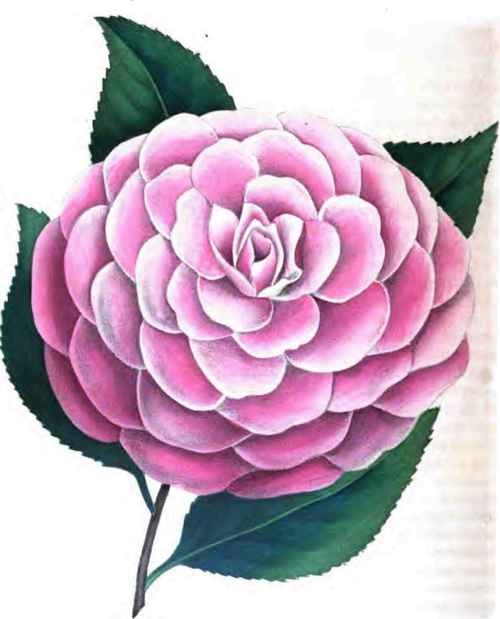
CAMELLIA JAPONICA.
The Camellia Japonica is so generally known that it will be needless here to describe it Among the other species of this family, we may here name the C. Bohea, (Thea Bohea,) black tea plant. This plant, which has given to mankind a refreshing beverage, first became known in the city of London, England, in 1660, where a tobacconist sold it as a remedy against different diseases. After this it became a general drink in Europe. The other, C. viridis, (Thea viridis,) the green tea plant, is a native of China, Tonquin, and Japan. In my present communication, it is not my wish to instruct the old veterans of floriculture; all I desire is to give those that wish it some useful hints.
In connection with the culture of the Camellia, it will not be uninteresting to inquire into the different laws of nature which govern vegetation; this will tend to convince us of how important it is, that theoretical and practical knowledge should go hand in hand. The man without theory is blind, and the man without practice is blind. The natural agents which govern vegetation are four in number; these are, Air, Heat, Soil, and Water. Yet to have the proper influence upon vegetation, they must stand in certain proportions to each other; if the plant is deprived of one of those agents, it will be impossible for it to develop itself perfectly; consequently, when we undertake to cultivate plants we must, to secure their perfection, place them in a soil and temperature that harmonize with the one in which they grew in their natural state; the question therefore arises, How are we able to naturalize a plant? The maxim upon which the naturalization of plants is founded is principally, the similarity of temperature in regions. In other words, it is impossible for us to naturalize a plant in a country unless its temperature is equal to the one of which the plant is a native. We know that the temperature of a place depends upon two different circumstances: First, its distance from the equator.
Meteorology has taught us, that the nearer a plant is to the equator, so much warmer is it placed, and the plants that grow there need a higher temperature. Secondly, the temperature of a place is different according to its altitude. When we ascend a range of mountains, like the Himalaya in Asia, or Andes in South America, we perceive that the temperature diminishes, as it does when going from the equator towards either of the poles. After passing through regions of different plants, for instance, Orchids, Palms, Tree-like Ferns, Adrom-edas, etc., and familiar plants of our northern climate, we find the mountain tops crowned with perpetual snow, which hinders the further progress of vegetation. It will therefore appear evident to us, that we could never arrive in the haven of success, if we should place all the different families of plants in the same temperature; it has therefore been found expedient to erect different glass struc-tures, in which, by means of artificial heat, a temperature can be maintained equal I to the one the plants grow in when in their native home.
It may not be uninter- eating to some of your readers to make here a few remarks concerning temperature, and plants kept in the five principal departments.
1. The Orangery
In this house Oranges, Myrtles, Pittosporams, and other of the hardiest exotic plants, are kept during winter. Temperature, 40 to 45 degrees Fahr.
2. Conservatory
40 to 50 degrees Fahr. The plants in this house are mostly all planted in a prepared border.
3. Green-House
Here are kept plants which are natives of New-Zealand and the Gape of Good Hope. Temperature, 45 to 50 degrees Fahr.
4. Hot-Home
This house is more used than any of the others. Here a tem-perature between 55 and 60 degrees Fahr. is maintained, and it serves to keep some of the hardiest stove-plants, and the more tender green-house plants.
5. Stave
The greatest heat is kept in this house. The plants are natives of the tropics, and require in the winter from 75 to 80 degrees Fahr. If we, there-fore, wish to have fine specimens of Camellias, our first object must be to place them in a proper temperature.
Continue to:


My Books

