


Deciduous Lawn Trees
Description
This section is from "The Horticulturist, And Journal Of Rural Art And Rural Taste", by P. Barry, A. J. Downing, J. Jay Smith, Peter B. Mead, F. W. Woodward, Henry T. Williams. Also available from Amazon: Horticulturist and Journal of Rural Art and Rural Taste.
Deciduous Lawn Trees
Our correspondent, Col. Jacques, whose communication appears on another page, asks: "What are the twelve best deciduous trees for lawns and streets, in our cold climates?" We thought it necessary to draw a line of distinction between lawn and street trees, and gave in our last number a brief sketch of the leading characters of what we regard as the best street trees. We now propose to offer, in answer to the question, a few remarks on lawn trees.
In landscape gardening, a lawn is a smoothly dressed and finished grass surface attached more immediately to the dwelling. In every style of gardening it is intended, in all its aspects and features, to represent the beautiful. A lawn - a smooth, soft, verdant, "velvet lawn," as it is expressively styled - is itself one of the most forcible illustrations of the beautiful; and its appropriate embellishments, whether they be trees, shrubs, plants, or objects of art, should all be characterized by symmetry, grace, and beauty. The rough and rugged, which in the landscape express the picturesque, do not belong to the lawn, unless under peculiar circumstances. This principle must not be lost sight of in selecting trees.
Again, lawns are of various dimensions, from the few square rods of the cottage garden to that of the country residence, embracing several acres. This is another important consideration; for fitness is a principle that lies at the very foundation of judicious planting, in all places and under every circumstance. A lofty, wide spreading, magnificent elm, would be an object of beauty on grounds of a corresponding amplitude; but place it on a limited lawn, and its beauty would be destroyed by the impression of unfitness which it would at first sight convey. Variety, too, is an object that should be aimed at in planting lawns, as far as may be consistent with good taste; and this compels us to consider the dimensions of trees.
There is also another consideration that should not be forgotten in selecting lawn trees, and especially those to be planted in more immediate contact with the dwelling, or in such a position as to strike the eye in connection with it. We shall only allude to this at present. It is very well understood that certain forms of trees make better contrasts, or are more in harmony with certain styles of architecture, than others. Thus, it is very generally acknowledged that Grecian and Italian houses, or houses in such styles as are characterized by horizontal lines, are relieved and exhibited to the best advantage by spiry-topped trees, like the Lombardy poplar, the larch, the balsam fir, Norway spruce, hemlock, Arc.; while those of the Gothic character, with pointed roofs, abounding in vertical lines, small ornaments, lightness, etc., are best shown in contrast with trees of the round-headed, massive character, such as horse chestnuts, lindens, maples, oaks, elms, the tulip tree, etc. This is a consideration of some impor-tance, too often entirely overlooked.
The man who takes pains to adopt a particular style of architecture, for its intrinsic value or its appropriateness to locality, should be very careful in planting such trees around it, and in so arranging them as not to destroy, but rather to bring out fully and boldly, the particular expression of his style, whatever it may be. Everywhere we look we see blunders committed on this very point, either through ignorance or negligence. But we shall return to it soon, and draw attention to it more in detail.
We spoke of the American Weeping Elm, English Elm, Scotch or Wych Elm, Morse Chestnut, Sugar Maple, Silver Maple, Bed Maple, Norway Maple, European and American Linden, and American White Ash, as street trees, and all these possess sufficient symmetry of form and beauty of foliage or flowers to give them admission to the lawn; but they are all trees of large size, and require considerable space to enable them to make an ample development on all sides, as they should do on the lawn. They are therefore adapted only to extensive grounds. With trees of this class we may include the American Chestnut, some of the Oaks, the Beech, the Tulip Tree, the Magnolia acuminata or "cucumber tree".
Then among trees somewhat rare, or less generally planted, is the Japan Sophora* (Sophora Japonica,) a large, round-headed, or compact tree, with pinnate leaves and clusters of dull white or cream-colored papilionaceous flowers, bearing considerable resemblance to the Robinia, or locust tree. It is remarkable for the deep dark green of its foliage, and for retaining this in the warmest and dryest seasons, and until quite late. In winter, too, it is as remarkable for the greenness of its bark as the Cornus sanguinea is for its brilliant red. It is strange that this tree has not attracted more attention. It may not prove quite hardy in all parts of the country, but it is so at Rochester, where the thermometer annually falls below zero 4 or 5 deg., and occasionally 10 deg., as last winter. It grows somewhat slowly at first, until well established, when it makes fair progress on good ground. It was first introduced into France, from Japan, in 1747. There is a weeping variety, which is one of the most remarkable and beautiful of all pendulous trees.
The common sort is propagated by seeds, or by cuttings of the roots; and the weeping one is grafted on it, generally at six to ten feet from the ground.
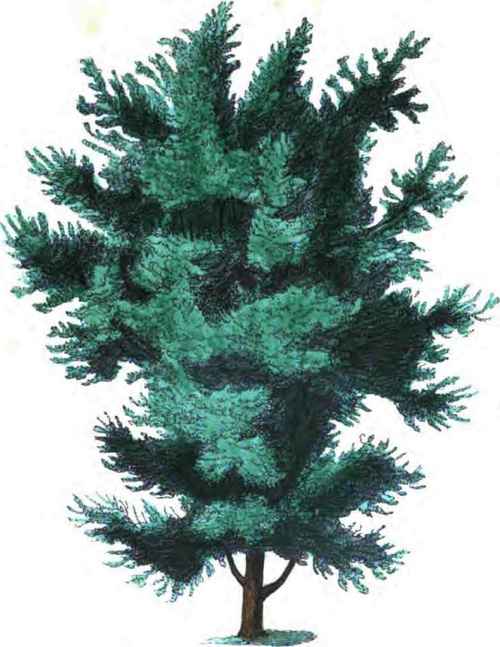
SOPHORA JAPONICA. The Japanese Sophora 90 feet high, 9 Indies in diameter.
The Virgilia lutea, or Yellow Wood, is a beautiful native tree, abounding in some parts of the western States, and especially Tennessee. It is of the same character in foliage and flowers as the Sophora, and indeed the elder Michaux was of the opinion that it belonged to the same genus. It is successfully grafted on that tree, and this affords a strong proof of affinity. The leaves are pinnate, considerably larger than the Robinia or Sophora, and the flowers are white, produced in pendulous clusters. We hope to see it more extensively propagated and planted.
The Salisburia adiantifolia, or Ginko, or Maiden Hair tree, of Japan, is a singular and beautiful tree, well worthy of attention, and fit to occupy a prominent situation on a lawn. It has curious wedge-shaped, smooth, shining leaves, and makes a lofty and somewhat conical tree. It is dioecious, and very few specimens even in Europe have produced seeds; most of the plants sold and disseminated have been raised from cuttings. It is yet rare and scarce everywhere. Cuttings of the ripe wood are easily struck, and of the young wood with leaves on, placed under a bell glass, still easier. It may also be propagated from layers.
Tlie Kentucky Coffee Tree, (Gymnocladus canadensis,) is another large and handsome indigenous tree, erect, regular and somewhat conical in its growth, with long pinnate foliage, approaching the ailantus in this character. Flowers white, in small spikes. Seeds produced in large pods, like those of the honey locust The shoots are remarkably blunt, and have a singular appearance in winter. We remember having observed some good specimens in the streets in Newburgh a short time ago. This tree is easily propagated from seeds, which ripen well in all parts of the country. Of the smaller class of deciduous lawn trees we shall speak hereafter.
Continue to:


My Books

