


Deciduous Shade Trees For Private Grounds
Description
This section is from "The Horticulturist, And Journal Of Rural Art And Rural Taste", by P. Barry, A. J. Downing, J. Jay Smith, Peter B. Mead, F. W. Woodward, Henry T. Williams. Also available from Amazon: Horticulturist and Journal of Rural Art and Rural Taste.
Deciduous Shade Trees For Private Grounds
In our last December number we named some few varieties of trees that we consider eminently deserving to be planted for street shades. We now designate a few of the many beautiful trees that we regard as especially desirable for planting in private grounds. First of all, we name our American Beech, as combining more of beauty, grace, and magnificence than perhaps any other of our forest trees. True, it has not the grandeur of the oak; but, with its stateliness of upright, spreading growth, every line and twig is one of graceful ease, and from the first opening of the buds in spring, onward until in full foliage, its glossiness and changing shades are a constant but varying feature of beauty. In winter, its delicate spray, combined with the prominence of its long-pointed buds, make it especially an object of attraction and admiration. Some planters object to the Beech on account of a tendency to sucker, but we have never found any such tendency where the roots remained unbroken by cultivation.
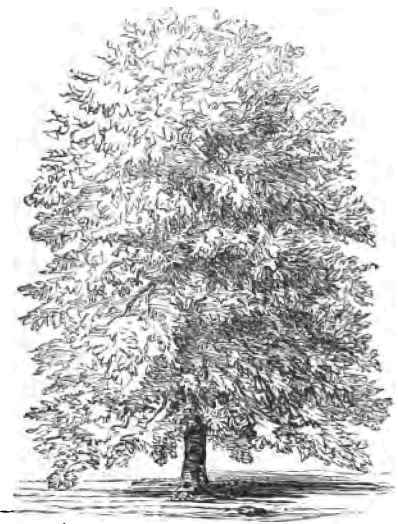
Fig. 14. - American Beech.
Young trees should always be procured with branches starting from near the ground, and rarely does it need the knife applied to give it regularity and symmetry of form. A deep loamy, rather moist, soil gives it most vigor and causes it to grow to a large size; but it also grows freely in poor, thin soils, as the roots spread widely and keep near the surface.
Of fancy varieties of the Beech, the true Purple-leaved is the most desirable. It has rather stronger limbs and twigs than the common plain variety, and the young shoots and buds are of a rose color, while the foliage when young or half grown is of a reddish purple tinge, and when mature becomes dark purple, forming a pleasing and attractive contrast with the green of other trees. The Cut-leaved forms, while young, a vigorous, well-marked tree, with leaves variously cut, resembling in some cases ferns, in others willow; as it gets age, however, these markings of the foliage become less and less distinct. The Variegated-leaved, Crested, etc., are all singular, but of feeble growth, and only desirable in an arboretum.
The family of Maples are all good as shade trees for lawn or roadside, but among them, the Rubrum, red-flowering, or, as generally termed, Scarlet Maple, is most to be prized. Its red flowers and leaves in early spring or beginning of summer, its brilliant shades of red foliage in autumn, taken in connection with its rapid growth and upright, half spreading form, render it one of the most ornamental of hardy trees. Although a native, and abundant in many parts of our Northern Middle States, one or more trees of it should be found in all grounds of half an acre or more in size. In places of considerable extent, when variety as well as beauty is desired, the following are varieties that possess characters rendering their introduction requisite, viz., the Tartarian, on account of the early opening of its leaves. The Striped-barked, because of the stripes, white and black, upon its young, green wood, making it always a curiosity and attractive to visitors. The Norway, from its contrast with others in spring and fall, the foliage then being yellow, is deserving a place. Next to the Norway, and similar to it, is the Sycamore Maple, a variety of rapid growth, and forming at maturity a large and stately tree. As an avenue tree, or standing by itself singly, it is always effective.
Of the fancy varieties, the Purpurea is the only one that is particularly desirable. Its leaves are purplish underneath, and pale green above when fully expanded; and at midsummer, and thereafter until the fall of the leaf, every breeze that ruffles and disturbs them produces a singular effect.
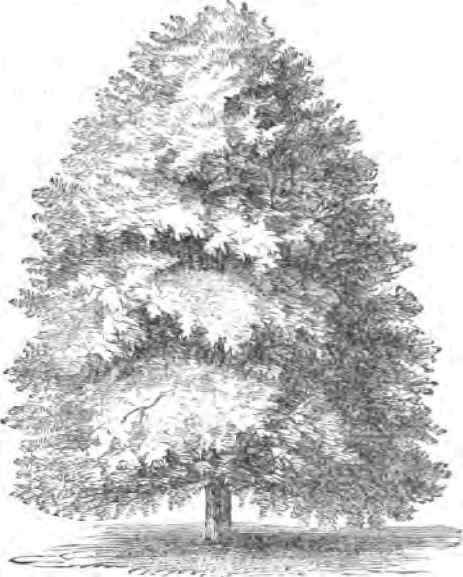
Fig. 15. - Scarlet Maple.
Continue to:


My Books

