


August - First And Second Weeks. Fruit. Continued
Description
This section is from the book "The Garden Week By Week Throughout The Year", by Walter P. Wright. Also available from Amazon: The Garden Week by Week Throughout the Year.
August - First And Second Weeks. Fruit. Continued
Ripening Figs
Outdoor Figs will be ripening now, and as the fruit is of very little flavour unless quite ripe, it will have to hang for some time at the mercy of the birds unless netted, and they are not very fastidious. When the fruit is quite ripe a point should be made of gathering it early in the morning, and keeping it in a cool place until the time comes for it to be put on the table.
Pruning Peaches
Most Peach and Nectarine trees under glass will have been cleared of their fruit by now, and the pruning and training may be proceeded with. We saw a few weeks ago that a shoot was to be allowed to grow from the base of each fruiting growth, and a healthy tree will be full of young shoots, ranging from a foot to two feet long, by mid-summer; they will be growing out from the wall, and will give the tree a lively and luxuriant, but somewhat untidy, appearance. As soon as the fruit has been picked, the shoots that carried it may be cut back to the point where the new shoots start, and these tied in to bear next year. If there are more young shoots than can be tied in (the word "tied " is used on the assumption that there are wires; if not, the shoots can be fastened to a wall with nails and shreds) without having them nearer than four inches apart, some had better be cut out altogether, as a close network of growth is undesirable. The weak shoots, under a foot long, and very thin, may be dispensed with first. If there are still too many, the very strong ones, a yard long or more, may go. It is true that large late Peaches like Princess of Wales may be allowed to carry stronger wood than small Nectarines like Pine Apple, but, speaking generally, wood eighteen to twenty inches long is best. The crossing or twisting of shoots is considered bad workmanship. After the trees have been pruned and trained, the hose may be turned on them to get rid of insects. Peaches are sometimes kept too dry after fruiting, with the result that red spider fastens on them.
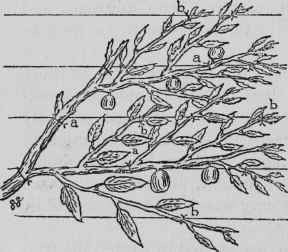
Fig. 59. - Tying in Peaches.
a. How to tie in the main branches.
b. How to tie in the young shoots.

Fig. 60. - Repotting Young Strawberries (p. 310).
a. Leaves on drainage.
b. Compost.
c. Ball of soil and roots.
Strawberries
Very young plants struck in small pots early in summer will now be well rooted. If they are wanted for forcing they may be repotted into 6-inch pots. Fibrous loam should form the greater part of the compost, but a quarter of decayed manure and some sand may be added with advantage. The soil should be pressed firmly round the plants. Well-rooted plants intended for fruiting next year in an outdoor bed may be planted immediately, but they should be watered in.
Continue to:


My Books

